


Prevalence and predictors of complications of radiofrequency catheter ablation for atrial fibrillation
- PMID: 21235674
- PMCID: PMC3471534
- DOI: 10.1111/j.1540-8167.2010.01995.x
Prevalence and predictors of complications of radiofrequency catheter ablation for atrial fibrillation
Abstract
Introduction: Up to 6% of patients experience complications after radiofrequency catheter ablation (RFA) of atrial fibrillation (AF). The purpose of this study is to determine the prevalence and predictors of periprocedural complications after RFA for AF.
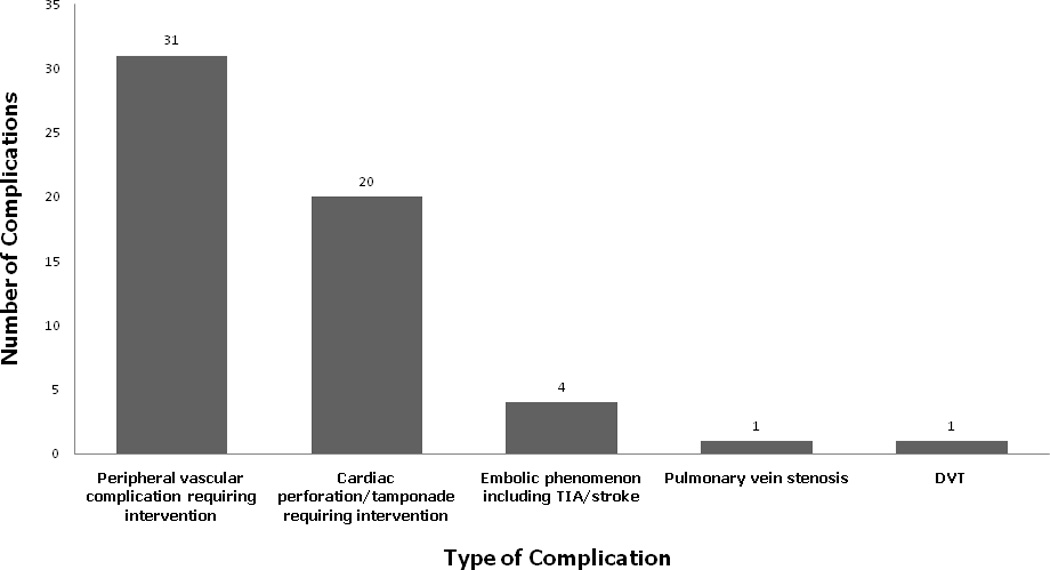
Methods and results: The subjects were 1,295 consecutive patients (age = 60 ± 10 years) who underwent RFA (n = 1,642) for paroxysmal (53%) or persistent AF (47%) from January 2007 to January 2010. A complication occurred in 57 patients (3.5%); a vascular access complication in 31 (1.9%); pericardial tamponade in 20 (1.2%); a thromboembolic event in 4 (0.2%); deep venous thrombosis in 1 (<0.01%); and pulmonary vein stenosis in 1 patient (<0.01%). There were no procedure-related deaths. On multivariate analysis, female gender (OR = 2.27; ±95% CI: 1.31-2.57, P < 0.01) and procedures performed in July or August (OR = 2.10; ±95% CI: 1.16-3.80, P = 0.01) were independent predictors of any complication. For vascular complications, treatment with clopidogrel (OR = 4.40; ±95% CI: 1.43-13.53, P = 0.01), female gender (OR = 3.65; ±95% CI: 1.72-7.75, P < 0.01) and performing RFA in July or August (OR = 2.71; ±95% CI: 1.25-5.87, P = 0.01) were independent predictors. The only predictor of cardiac tamponade was prior RFA (OR = 3.32; ±95% CI: 0.95-11.61; P < 0.05).
Conclusion: Prevalence of perioperative complications for RFA of AF is 3.5% and vascular access complications constitute the majority. The need for clopidogrel therapy should be carefully considered prior to RFA. At teaching institutions close supervision should be exercised during vascular access early in the year. Improvements in ablation technology and elimination of the need for repeat procedures may decrease the risk of pericardial tamponade.
© 2011 Wiley Periodicals, Inc.
Figures
References
-
- Piccini JP, Lopes RD, Kong MH, Hasselblad V, Jackson K, Al-Khatib SM. Pulmonary vein isolation for the maintenance of sinus rhythm in patients with atrial fibrillation: a meta-analysis of randomized, controlled trials. Circ Arrhythm Electrophysiol. 2009;2:626–633. - PubMed
-
- Bertaglia E, Zoppo F, Tondo C, et al. Early complications of pulmonary vein catheter ablation for atrial fibrillation: a multicenter prospective registry on procedural safety. Heart Rhythm. 2007;4:1265–1271. - PubMed
-
- Cappato R, Calkins H, Chen SA, et al. Worldwide survey on the methods, efficacy, and safety of catheter ablation for human atrial fibrillation. Circulation. 2005;111:1100–1105. - PubMed
-
- Wieczorek M, Hoeltgen R, Akin E, Salili AR, Oral H, Morady F. Results of short-term and long-term pulmonary vein isolation for paroxysmal atrial fibrillation using duty-cycled bipolar and unipolar radiofrequency energy. J Cardiovasc Electrophysiol. 2010;21:399–405. - PubMed
-
- Good E, Oral H, Lemola K, et al. Movement of the esophagus during left atrial catheter ablation for atrial fibrillation. J Am Coll Cardiol. 2005;46:2107–2110. - PubMed
Publication types
MeSH terms
Grants and funding
LinkOut - more resources
Full Text Sources
Medical
