


Adulthood stressors, history of childhood adversity, and risk of perpetration of intimate partner violence
- PMID: 21238860
- PMCID: PMC3023909
- DOI: 10.1016/j.amepre.2010.10.016
Adulthood stressors, history of childhood adversity, and risk of perpetration of intimate partner violence
Abstract
Background: More than half a million U.S. women and more than 100,000 men are treated for injuries from intimate partner violence (IPV) annually, making IPV perpetration a major public health problem. However, little is known about causes of perpetration across the life course.
Purpose: This paper examines the role of "stress sensitization," whereby adult stressors increase risk for IPV perpetration most strongly in people with a history of childhood adversity.
Methods: The study investigated a possible interaction effect between adulthood stressors and childhood adversities in risk of IPV perpetration, specifically, whether the difference in risk of IPV perpetration associated with past-year stressors varied by history of exposure to childhood adversity. Analyses were conducted in 2010 using de-identified data from 34,653 U.S. adults from the 2004-2005 follow-up wave of the National Epidemiologic Survey on Alcohol and Related Conditions.
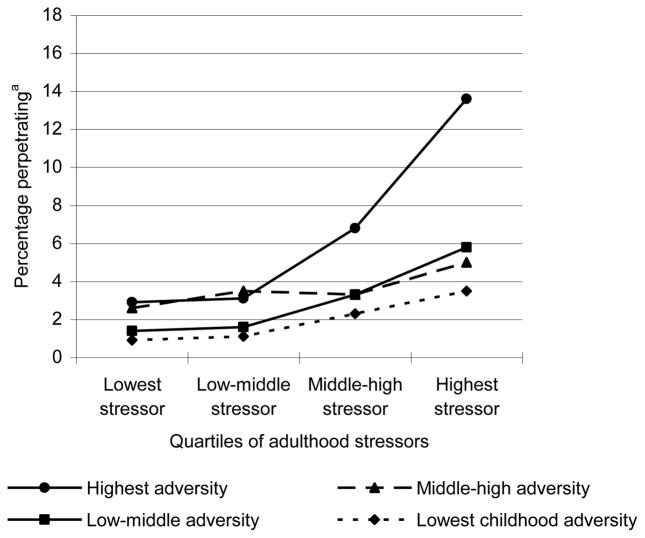
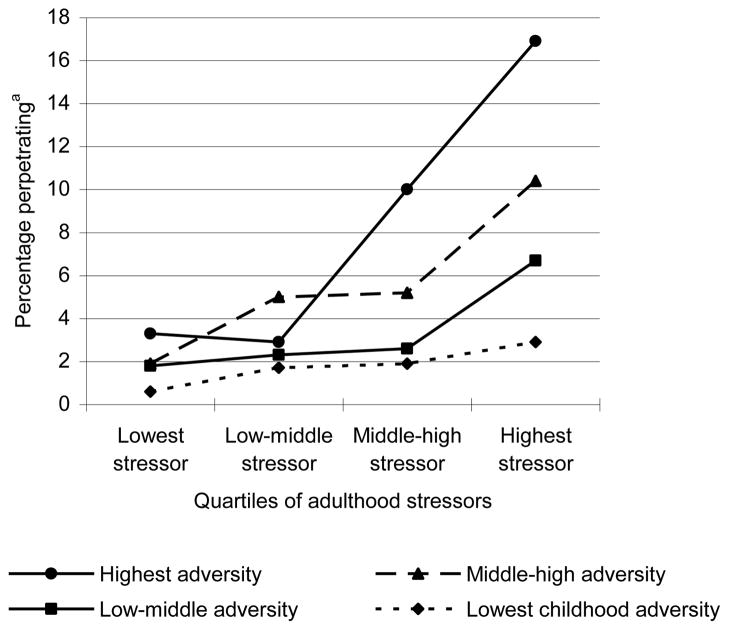
Results: There was a significant stress sensitization effect. For men with high-level childhood adversity, past-year stressors were associated with an 8.8 percentage point (pp) increased risk of perpetrating compared to a 2.3 pp increased risk among men with low-level adversity. Women with high-level childhood adversity had a 14.3 pp increased risk compared with a 2.5 pp increased risk in the low-level adversity group.
Conclusions: Individuals with recent stressors and histories of childhood adversity are at particularly elevated risk of IPV perpetration; therefore, prevention efforts should target this population. Treatment programs for IPV perpetrators, which have not been effective in reducing risk of perpetrating, may benefit from further investigating the role of stress and stress reactivity in perpetration.
Copyright © 2011 American Journal of Preventive Medicine. Published by Elsevier Inc. All rights reserved.
Conflict of interest statement
The authors have no conflicts of interest.
Figures
References
-
- Tjaden P, Thoennes N. Extent, nature, and consequences of intimate partner violence: Findings from the national violence against women survey. Washington, D.C: U.S. Department of Justice, Office of Justice Programs, National Institute of Justice; 2000.
-
- Campbell JC. Health consequences of intimate partner violence. Lancet. 2002;359(9314):1331–1336. - PubMed
-
- Breiding MJ, Black MC, Ryan GW. Chronic disease and health risk behaviors associated with intimate partner violence—18 U.S. states/territories, 2005. Ann Epidemiol. 2008;18(7):538–544. - PubMed
-
- Baker MW, LaCroix AZ, Wu CY, Cochrane BB, Wallace R, Woods NF. Mortality Risk Associated with Physical and Verbal Abuse in Women Aged 50 to 79. J Am Geriatrics Soc. 2009;57(10):1799–1809. - PubMed
-
- Coker AL, Watkins KW, Smith PH, Brandt HM. Social support reduces the impact of partner violence on health: application of structural equation models. Prev Med. 2003;37(3):259–267. - PubMed
Publication types
MeSH terms
Grants and funding
LinkOut - more resources
Full Text Sources
Medical
Miscellaneous
