


Review
doi: 10.1104/pp.110.170969.
Epub 2011 Jan 14.
Plastid biotechnology: food, fuel, and medicine for the 21st century
Affiliations
- PMID: 21239622
- PMCID: PMC3091108
- DOI: 10.1104/pp.110.170969
Item in Clipboard
Review
Plastid biotechnology: food, fuel, and medicine for the 21st century
Plant Physiol.
2011 Apr.
No abstract available
Figures
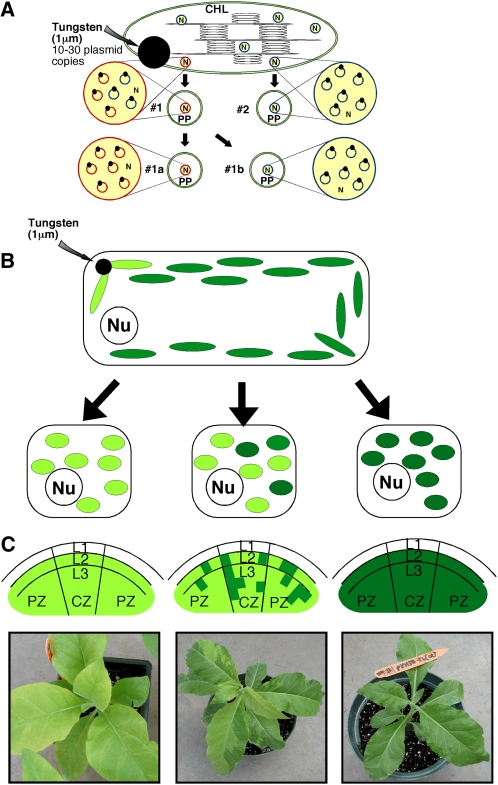
Sorting of T-ptDNA at the organelle and cellular levels yields homoplastomic plants. A, Replication and sorting of T-ptDNA at the organelle level yields homoplastomic organelles. Sorting is facilitated by the conversion of chloroplasts (CHL) to proplastids (PP), which contain only one to two nucleoids instead of 10. Wild-type ptDNA and T-ptDNA (blue circles and red circles, respectively) are anchored to membranes by proteins (black dots) in nucleoids (N). Sorting of ptDNA and T-ptDNA in heteroplastomic nucleoids (#1) yields nucleoids with only T-ptDNA (#1a) and wild-type ptDNA (#1b). For details, see Maliga (2004). B, Division and sorting of plastids yields genetically stable transplastomic plants. Sorting is accelerated by reduction from approximately 100 chloroplasts in leaf cells to approximately 10 to 14 proplastids in meristematic cells. In the cells, the nucleus (Nu) is also marked. C, The plastid genotype of long-term stem cells in the three layers (L1, L2, L3) of the shoot apex determines the plastid genotype in leaves. PZ and CZ are the peripheral and central zones, respectively. On the left is a shoot apex with T-ptDNA in all three layers and a homoplastomic plant carrying only T-ptDNA encoding the aurea spectinomycin resistance (aadA) gene. The variegated plant in the middle has cells with wild-type ptDNA and T-ptDNA in its shoot apex. The regenerated plant on the right has only wild-type ptDNA. C is modified from Lutz and Maliga (2008); the plants were described by Tungsuchat-Huang et al. (2011).
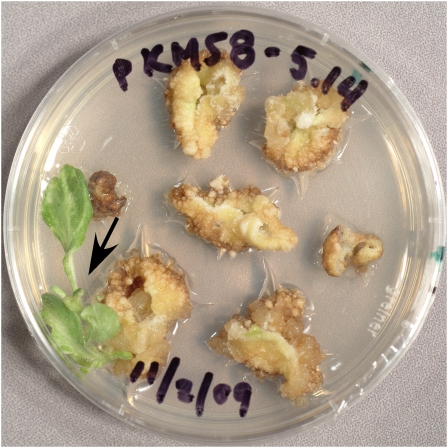
Transplastomic clones are identified as green shoots in bombarded tobacco leaf culture on spectinomycin medium. The aurea aadAau gene (Tungsuchat-Huang et al., 2011) enables greening and shoot regeneration in the culture shown here and causes intense golden-yellow leaf pigmentation in plants (Fig. 1C).
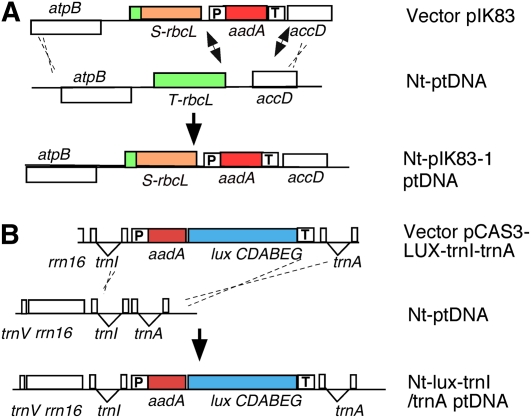
Plastid genome manipulation is based on homologous recombination between ptDNA and the targeting regions in the vector. A, Replacement of the tobacco rbcL gene (T-rbcL) with the sunflower homolog (S-rbcL). The sunflower S-rbcL is incorporated in the tobacco ptDNA only if recombination is via the atpB and accD genes (dotted lines). Recombination adjacent to aadA (arrows) confers spectinomycin resistance, but the tobacco T-rbcL is retained. Out of six transplastomic lines, three carried aadA only, two incorporated S-rbcL, and one had recombination within rbcL (Kanevski et al., 1999). B, Insertion of the lux operon in the trnI/trnA intergenic region. Note that the lux operon is transcribed from the aadA promoter and the gene cluster has only a single 3′ UTR (Krichevsky et al., 2010).
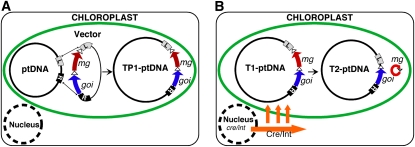
Excision of marker genes by site-specific recombinase enzymes. A, Marker genes in the plastid transformation vectors are flanked by loxP or attP/attB sequences (triangles) that are the targets for site-specific recombinases. B, The marker genes are efficiently removed when a gene encoding a plastid-targeted Cre or Int recombinase is introduced into the nucleus by transformation or pollination (Lutz and Maliga, 2007). T1-ptDNA and T2-ptDNA refer to the marker-containing and marker-free transplastomes.
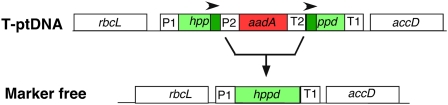
Marker-free plastids by repeat-mediated deletion of the marker gene. In the transplastome (T-ptDNA), the aadA marker gene, expressed in the P2/T2 cassette, disrupts the hppd herbicide tolerance gene encoding 4-hydroxyphenylpyruvate dioxygenase (HPPD), an enzyme in the tocopherol biosynthetic pathway. The hppd coding region is flanked by the P1/T1 cassette but is not expressed due to disruption by aadA. Note the 403-nucleotide duplicated segment (darker color) flanking the aadA. Deletion of aadA via the 403-nucleotide repeats (arrowheads) reconstitutes a functional hppd gene enabling the expression of herbicide resistance in seedlings (Dufourmantel et al., 2007; for review, see Kode et al., 2006).
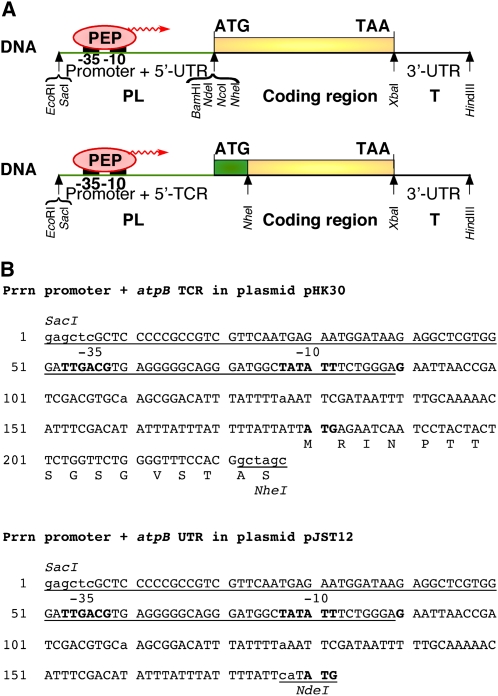
Transgene assembly in cassettes for protein expression. A, Shown are schematic maps of transgenes transcribed from a PL-UTR (top) and a PL-TCR (bottom) cassette. BamHI (GGATCC), NcoI (CCATGG), and NheI (GCTAGC) restriction sites may be present in the same cassette (GGATTCC ATG G CTAGC), while the NcoI and NdeI (CATATG) sites, each of which includes the translation initiation codon (ATG; in boldface), are incompatible. B, DNA sequence of the Prrn promoter with the atpB UTR (plasmid pJST12; Tregoning et al., 2003) and TCR (plasmid pHK30; Kuroda and Maliga, 2001b). Note that expression in the PL-TCR cassette yields a fusion protein with 14 amino acids derived from the plastid atpB gene and two amino acids encoded in the NheI restriction site, whereas the PL-UTR transgene encodes an unmodified protein. In boldface are shown the Prrn promoter conserved −35 (TTGACG) and −10 (TATATT) promoter elements.
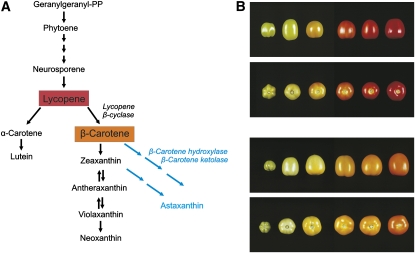
Metabolic engineering of the carotenoid pathway in transplastomic plants. A, Schematic overview of the carotenoid biosynthetic pathway. Lycopene, the major storage carotenoid in tomato, is indicated in red, and β-carotene (provitamin A) is indicated in orange. Enzymes that have been used for plastid genome engineering are given in italics. Parts of the pathway not occurring in higher plants are shown in blue. Multiple arrows denote conversions involving multiple enzymatic steps. The reversible reactions of the xanthophyll cycle are indicated by double arrows. B, Phenotypes of fruits from transplastomic tomato plants expressing a lycopene β-cyclase transgene from daffodil. Fruits from a wild-type plant (top two panels) and a transplastomic line (bottom two panels) were harvested at different ripening stages and photographed from the side and from the bottom. The orange color of the ripe transplastomic tomatoes comes from the efficient conversion of the red storage carotenoid lycopene into the orange provitamin A (β-carotene). The provitamin A levels reached 1 mg g−1 dry weight, while wild-type fruits had less than 200 ng provitamin A g−1. This figure is modified from Apel and Bock (2009).
References
-
- Bock R. (2007) Plastid biotechnology: prospects for herbicide and insect resistance, metabolic engineering and molecular farming. Curr Opin Biotechnol 18: 100–106 - PubMed
-
- Bock R, Warzecha H. (2010) Solar-powered factories for new vaccines and antibiotics. Trends Biotechnol 28: 246–252 - PubMed
-
- Boynton JE, Gillham NW, Harris EH, Hosler JP, Johnson AM, Jones AR, Randolph-Anderson BL, Robertson D, Klein TM, Shark KB, et al. (1988) Chloroplast transformation in Chlamydomonas with high velocity microprojectiles. Science 240: 1534–1538 - PubMed
Publication types
MeSH terms
Substances
LinkOut - more resources
Full Text Sources
Other Literature Sources
