


Utility of ELISA optical density values and clinical scores for the diagnosis of and thrombosis prediction in heparin-induced thrombocytopenia
- PMID: 21239863
- PMCID: PMC3111042
- DOI: 10.3343/kjlm.2011.31.1.1
Utility of ELISA optical density values and clinical scores for the diagnosis of and thrombosis prediction in heparin-induced thrombocytopenia
Abstract
Background: Heparin-induced thrombocytopenia (HIT) is an adverse drug reaction caused by antibodies to the heparin/platelet factor 4 (PF4) complex, resulting in thrombocytopenia and prothrombotic state. HIT diagnosis is challenging and depends on clinical presentation and laboratory tests. We investigated the usefulness of clinical scores and heparin/PF4 ELISA optical density (OD) as a diagnostic marker and thrombosis predictor in HIT.
Methods: We analyzed 92 patients with suspected HIT. The heparin/PF4 antibody was measured using a commercial ELISA kit (GTI, USA). For each patient, the 4 T's score and Chong's score were calculated.
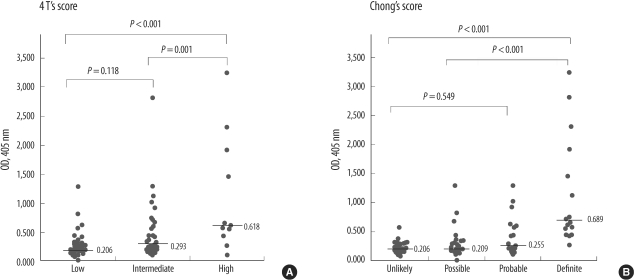
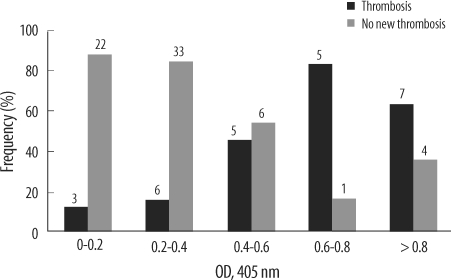
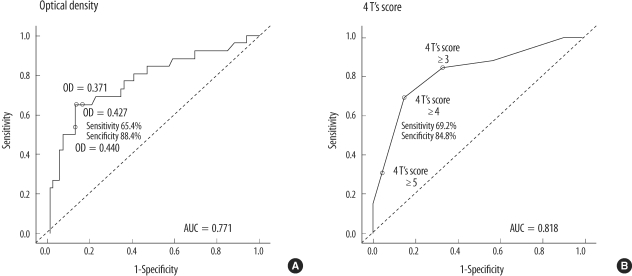
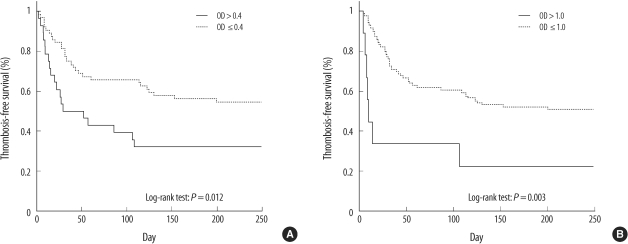
Results: Of the 92 patients, 28 were anti-heparin/PF4-seropositive. The 4 T's score and Chong's score showed good correlation (r=0.874). The 4 T's score and OD values showed good performance for diagnosis of the definite and unlikely HIT groups; however, OD levels showed better sensitivity (93.8%) than the 4 T's score used alone (62.5%). Of the 92 patients, 26 developed thrombosis. The OD values were significantly higher in patients with thrombosis than in those without thrombosis (0.52 vs. 0.22, P<0.001). Patients with high OD values (OD>0.4) had an increased risk of thrombosis (adjusted odds ratio 9.44 [3.35-26.6], P<0.001) and a shorter 250-day thrombosis-free survival (32.1% vs. 54.7%, P=0.012).
Conclusions: ELISA OD values in combination with clinical scoring can improve the diagnosis of and thrombosis prediction in HIT. More attention should be paid to the use of clinical scores and OD values as thrombosis predictors in HIT.
Conflict of interest statement
No potential conflict of interest relevant to this article was reported.
Figures
References
-
- Greinacher A, Warkentin TE. Recognition, treatment, and prevention of heparin-induced thrombocytopenia: review and update. Thromb Res. 2006;118:165–176. - PubMed
-
- Chong BH, Chong JJ. Heparin-induced thrombocytopenia. Expert Rev Cardiovasc Ther. 2004;2:547–559. - PubMed
-
- Warkentin TE, Heddle NM. Laboratory diagnosis of immune heparin-induced thrombocytopenia. Curr Hematol Rep. 2003;2:148–157. - PubMed
-
- Lo GK, Juhl D, Warkentin TE, Sigouin CS, Eichler P, Greinacher A. Evaluation of pretest clinical score (4 T's) for the diagnosis of heparin-induced thrombocytopenia in two clinical settings. J Thromb Haemost. 2006;4:759–765. - PubMed
-
- Greinacher A, Juhl D, Strobel U, Wessel A, Lubenow N, Selleng K, et al. Heparin-induced thrombocytopenia: a prospective study on the incidence, platelet-activating capacity and clinical significance of antiplatelet factor 4/heparin antibodies of the IgG, IgM, and IgA classes. J Thromb Haemost. 2007;5:1666–1673. - PubMed
Publication types
MeSH terms
Substances
LinkOut - more resources
Full Text Sources
Medical
Miscellaneous