Review
. 2011 Mar;13(1):99-110.
doi: 10.1208/s12248-011-9251-3. Epub 2011 Jan 15.

Bioanalytical approaches to quantify "total" and "free" therapeutic antibodies and their targets: technical challenges and PK/PD applications over the course of drug development

Affiliations
Review

Bioanalytical approaches to quantify "total" and "free" therapeutic antibodies and their targets: technical challenges and PK/PD applications over the course of drug development

Jean W Lee et al. AAPS J. 2011 Mar.

Abstract

The predominant driver of bioanalysis in supporting drug development is the intended use of the data. Ligand-binding assays (LBA) are widely used for the analysis of protein biotherapeutics and target ligands (L) to support pharmacokinetics/pharmacodynamics (PK/PD) and safety assessments. For monoclonal antibody drugs (mAb), in particular, which non-covalently bind to L, multiple forms of mAb and L can exist in vivo, including free mAb, free L, and mono- and/or bivalent complexes of mAb and L. Given the complexity of the dynamic binding equilibrium occurring in the body after dosing and multiple sources of perturbation of the equilibrium during bioanalysis, it is clear that ex vivo quantification of the forms of interest (free, bound, or total mAb and L) may differ from the actual ones in vivo. LBA reagents and assay formats can be designed in principle to measure the total or free forms of mAb and L. However, confirmation of the forms being measured under the specified conditions can be technically challenging. The assay forms and issues must be clearly communicated and understood appropriately by all stakeholders as the program proceeds through the development process. This paper focuses on monoclonal antibody biotherapeutics and their circulatory L that are either secreted as soluble forms or shed from membrane receptors. It presents an investigation into the theoretical and practical considerations for total/free analyte assessment to increase awareness in the scientific community and offer bioanalytical approaches to provide appropriate PK/PD information required at specific phases of drug development.


Figures
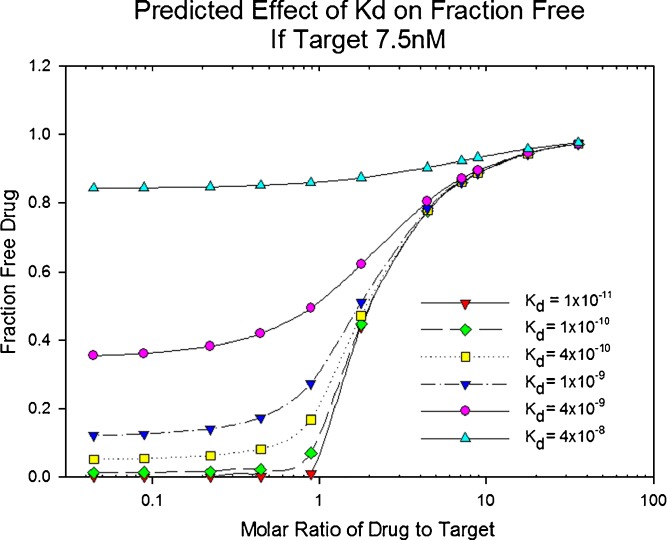
Fig. 1
Fig. 1
Effect of mAb–L affinity on mAbfree over a range of molar ratios of mAb to L. The concentration of L was fixed at a constant for simulated calculation of mAbfree. The molar ratio in this example assumes one binding site per mole of drug for ease of interpretation; for monoclonal antibodies, there would be two sites per mole of drug
Fig. 2
Fig. 2
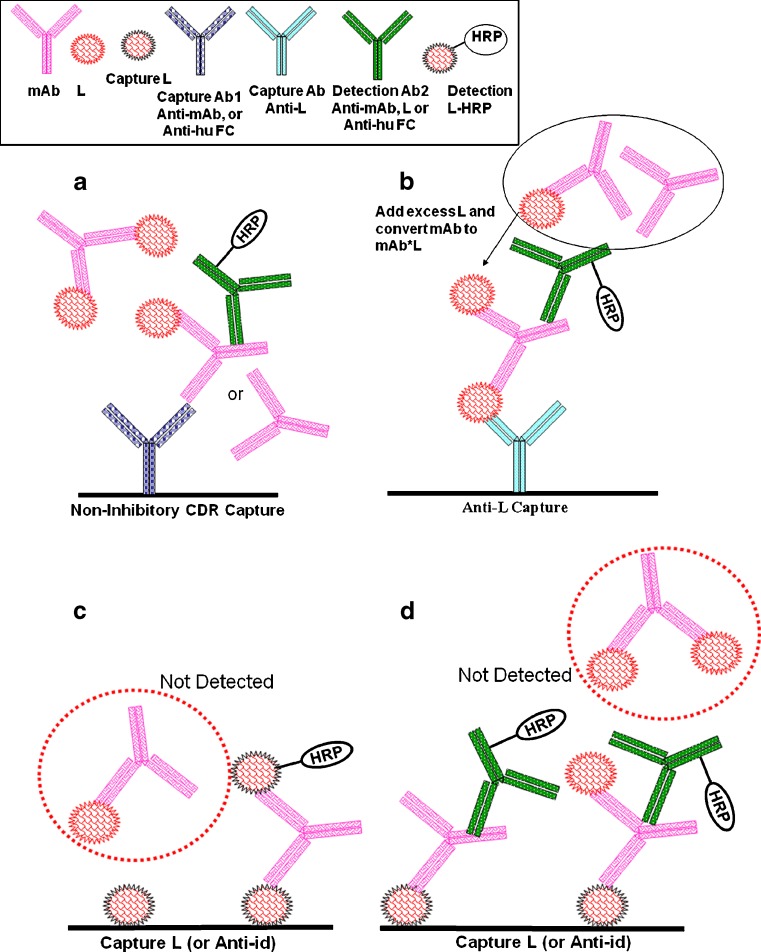
Schematics of typical ELISA for total and free mAb. Symbols for mAb and L, capture and detection reagents are shown in the inset of (a) and (b). Total drug assays: a mAbtotal: non-inhibitory anti-CDR capture, anti-hu IgG detection. b mAbtotal: preincubate with L to convert to mAb*L, followed by non-inhibitory anti-L capture and anti-human IgG or non-inhibitory anti-CDR detection. Free drug assays: c For bivalent mAbfree: bridging assay with L capture and detection. d For bivalent and monovalent mAbfree–L capture and antibody detection
Fig. 3
Fig. 3
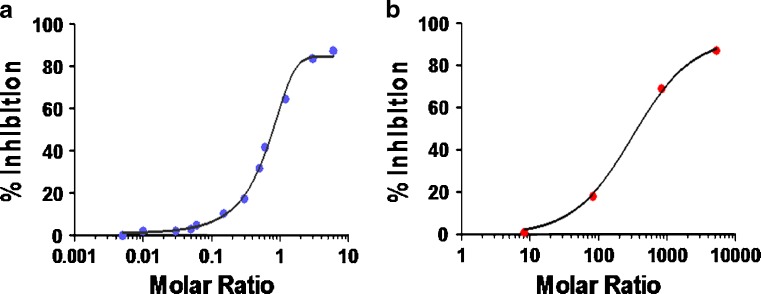
Interference test of a mAb by L. The recombinant L and the mAb were co-incubated at 37°C at various molar ratios and followed by ELISA determination of mAb. The X axis represents the molar ratio of L/mAb and the Y axis represents the percent inhibition for binding assay of mAb. a Example of a mAbfree assay that showed 50% inhibition at molar ratio of approximately 0.7. b Example of a essentially mAbtotal assay that showed 50% inhibition at a L/mAb molar ratio of approximately 300
Fig. 4
Fig. 4
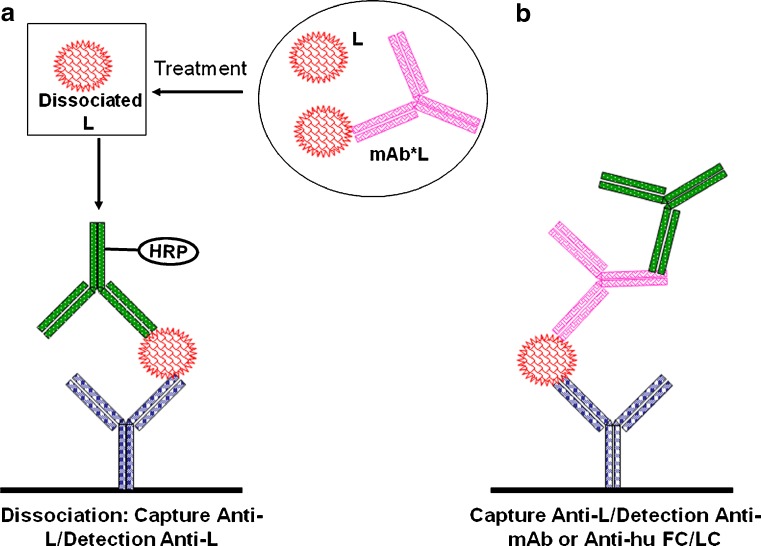
Schematic of typical sandwich ELISA for Ltotal. a Pre-treatment to dissociate mAb*L complex before assay. b No pre-treatment to dissociate. Symbols are the same as in Fig. 2a, b
Fig. 5
Fig. 5
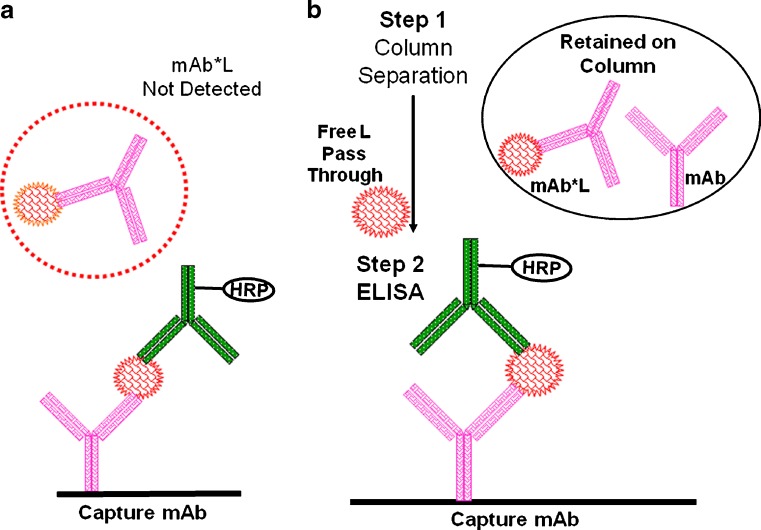
Schematic of typical sandwich ELISA for Lfree. a No pre-treatment for separation; b Use μ-affinity column to separate free from bound before ELISA. Symbols are the same as in Fig. 2a, b

References

    1. Wang W, Wang EQ, Balthasar JP. Monoclonal antibody pharmacokinetics and pharmacodynamics. Clin Pharmacol Ther. 2008;84(5):548–58. doi: 10.1038/clpt.2008.170. - DOI - PubMed
    1. DeSilva B, Smith W, Weiner R, Kelley M, Smolec J, Lee B, et al. Recommendations for the bioanalytical method validation of ligand-binding assays to support pharmacokinetic assessments of macromolecules. Pharm Res. 2003;20(11):1885–900. doi: 10.1023/B:PHAM.0000003390.51761.3d. - DOI - PubMed
    1. Lee JW, Devanarayan V, Barrett YC, Weiner R, Allinson J, Fountain S, et al. Fit-for-purpose method development and validation for successful biomarker measurement. Pharm Res. 2006;23(2):312–28. doi: 10.1007/s11095-005-9045-3. - DOI - PubMed
    1. Betts AM, Clark TH, Yang J, Treadway JL, Li M, Giovanelli MA, et al. The application of target information and preclinical pharmacokinetic/pharmacodynamic modeling in predicting clinical doses of a Dickkopf-1 antibody for osteoporosis. J Pharmacol Exp Ther. 2010;333(1):2–13. doi: 10.1124/jpet.109.164129. - DOI - PubMed
    1. Kuang B, King L, Wang H. Therapeutic monoclonal antibody concentration monitoring: free or total? Bioanalysis. 2010;2(6):1125–40. doi: 10.4155/bio.10.64. - DOI - PubMed

LinkOut - more resources