


Essential fatty acids for premenstrual syndrome and their effect on prolactin and total cholesterol levels: a randomized, double blind, placebo-controlled study
- PMID: 21241460
- PMCID: PMC3033240
- DOI: 10.1186/1742-4755-8-2
Essential fatty acids for premenstrual syndrome and their effect on prolactin and total cholesterol levels: a randomized, double blind, placebo-controlled study
Abstract
Objective: To evaluate the effectiveness and safety of polyunsaturated fatty acids for the treatment of the premenstrual syndrome (PMS) using a graded symptom scale and to assess the effect of this treatment on basal plasma levels of prolactin and total cholesterol.
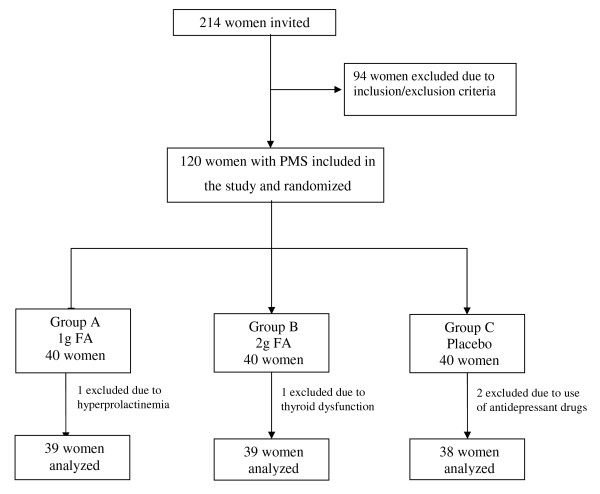
Methods: A randomized, double-blind, placebo-controlled study was conducted with 120 women with PMS divided into three groups and treated with 1 or 2 grams of the medication or placebo. Symptoms were recorded over a 6-month period using the Prospective Record of the Impact and Severity of Menstruation (PRISM) calendar. Total cholesterol and prolactin levels were measured. Analysis of variance (ANOVA), Pearson's chi-square test, Wilcoxon's nonparametric signed-rank test for paired samples and the Mann-Whitney nonparametric test for independent samples were used in the statistical analysis.
Results: There were no differences in age, marital status, schooling or ethnicity between the groups. In the group treated with 1 gram of the medication, a significant reduction was found when the median PRISM score recorded in the luteal phase at baseline (99) was compared with the median score recorded in the 3rd month (58) and in the 6th month of evaluation (35). In the 2-gram group, these differences were even more significant (baseline score: 98; 3rd month: 48; 6th month: 28). In the placebo group, there was a significant reduction at the 3rd but not at the 6th month (baseline: 96.5; 3rd month: 63.5; 6th month: 62). The difference between the phases of the menstrual cycle was greater in the 2-gram group compared to the group treated with 1 gram of the medication. There were no statistically significant differences in prolactin or total cholesterol levels between baseline values and those recorded after six months of treatment.
Conclusion: The difference between the groups using the medication and the placebo group with respect to the improvement in symptomatology appears to indicate the effectiveness of the drug. Improvement in symptoms was higher when the 2-gram dose was used. This medication was not associated with any changes in prolactin or total cholesterol levels in these women.
Figures
References
-
- American Psychiatric Association (APA) Diagnostic and Statistical Manual of Mental Disorders. 4. Washington, DC; 1994.
Publication types
MeSH terms
Substances
LinkOut - more resources
Full Text Sources
Other Literature Sources
Medical
