


Fine mapping and replication of QTL in outbred chicken advanced intercross lines
- PMID: 21241486
- PMCID: PMC3034666
- DOI: 10.1186/1297-9686-43-3
Fine mapping and replication of QTL in outbred chicken advanced intercross lines
Abstract
Background: Linkage mapping is used to identify genomic regions affecting the expression of complex traits. However, when experimental crosses such as F(2) populations or backcrosses are used to map regions containing a Quantitative Trait Locus (QTL), the size of the regions identified remains quite large, i.e. 10 or more Mb. Thus, other experimental strategies are needed to refine the QTL locations. Advanced Intercross Lines (AIL) are produced by repeated intercrossing of F(2) animals and successive generations, which decrease linkage disequilibrium in a controlled manner. Although this approach is seen as promising, both to replicate QTL analyses and fine-map QTL, only a few AIL datasets, all originating from inbred founders, have been reported in the literature.
Methods: We have produced a nine-generation AIL pedigree (n = 1529) from two outbred chicken lines divergently selected for body weight at eight weeks of age. All animals were weighed at eight weeks of age and genotyped for SNP located in nine genomic regions where significant or suggestive QTL had previously been detected in the F(2) population. In parallel, we have developed a novel strategy to analyse the data that uses both genotype and pedigree information of all AIL individuals to replicate the detection of and fine-map QTL affecting juvenile body weight.
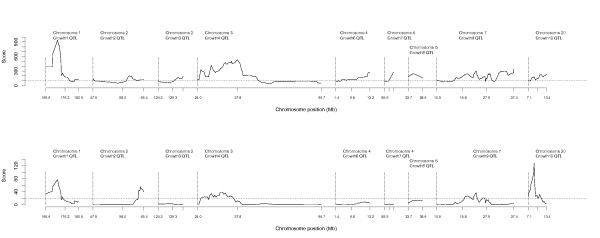
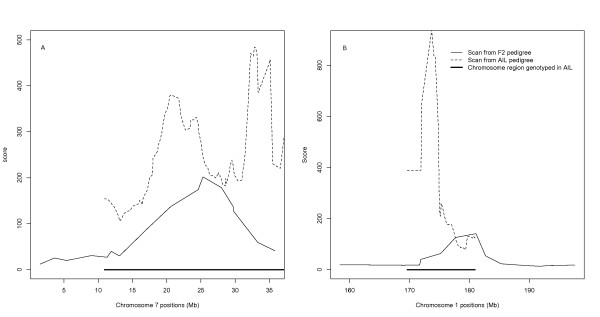
Results: Five of the nine QTL detected with the original F(2) population were confirmed and fine-mapped with the AIL, while for the remaining four, only suggestive evidence of their existence was obtained. All original QTL were confirmed as a single locus, except for one, which split into two linked QTL.
Conclusions: Our results indicate that many of the QTL, which are genome-wide significant or suggestive in the analyses of large intercross populations, are true effects that can be replicated and fine-mapped using AIL. Key factors for success are the use of large populations and powerful statistical tools. Moreover, we believe that the statistical methods we have developed to efficiently study outbred AIL populations will increase the number of organisms for which in-depth complex traits can be analyzed.
Figures
References
-
- Lynch M, Walsh B. Genetics and analysis of quantitative traits. Sinauer Associates Inc., Sunderland, UK; 1998.
Publication types
MeSH terms
LinkOut - more resources
Full Text Sources
Miscellaneous
