


Comment
doi: 10.1016/j.cell.2011.01.005.
Rallying the exocyst as an autophagy scaffold
Affiliations
- PMID: 21241888
- PMCID: PMC3030914
- DOI: 10.1016/j.cell.2011.01.005
Item in Clipboard
Comment
Rallying the exocyst as an autophagy scaffold
Cell.
.
Erratum in
- Cell. 2011 Mar 4;144(5):824
Abstract
Protein scaffolds coordinate the assembly of many multicomponent signaling complexes. Bodemann et al. (2011) now show that the exocyst, a protein complex involved in tethering transport vesicles to the plasma membrane, provides an assembly and activation platform for components of the autophagy machinery via a process requiring the GTPase RalB.
Copyright © 2011 Elsevier Inc. All rights reserved.
Figures
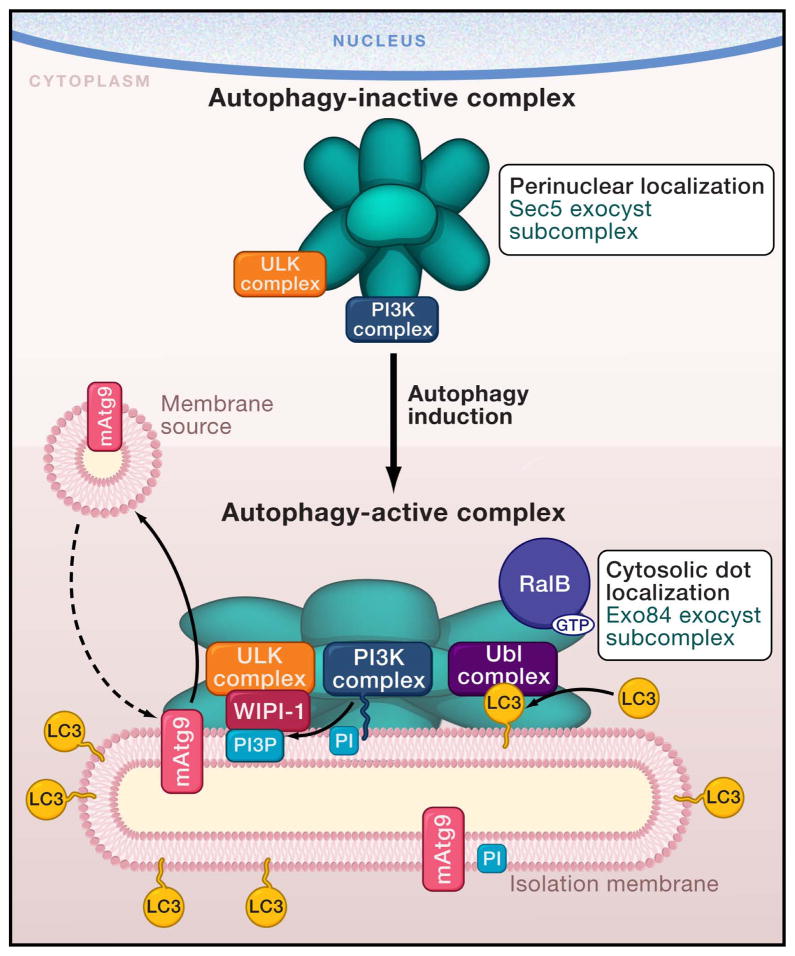
A model for exocyst function in autophagy. Bodemann et al. (2011) provide evidence that the exocyst, a protein complex involved in post-Golgi protein traffic, may function as a scaffold for the assembly of autophagy complexes. The authors suggest the following model for activation of autophagy. Under nutrient-rich conditions, an exocyst subcomplex containing the Sec5 protein associates with the ULK (Unc-51 like kinase) and phosphatidylinositol-3 kinase (PI3K) complexes at the perinuclear region forming an autophagy-inactive complex. Induction of autophagy (e.g. in response to starvation) leads to the activation of the Ras-like small GTPase, RalB. The activated RalB interacts with the exocyst, promoting the replacement of Sec5 by another exocyst component, Exo84, and formation of an active autophagy complex that includes the ubiquitin-like (Ubl) conjugation system and the ubiquitin-like molecule LC3. This autophagy-active complex localizes in cytosolic dots that could correspond to the isolation membrane. The Exo84 exocyst subcomplex may bring together complexes of the core autophagic machinery or facilitate their concerted action. The exact subunit compositions of the autophagy-inactive and autophagy-active exocyst subcomplexes remain unknown. PI3P: phosphatidylinositol 3- phosphate, PI: phosphatidylinositol, WIPI-1 is a WD40 repeat autophagy protein that interacts with phosphoinositides such as PI3P.
Comment on
-
RalB and the exocyst mediate the cellular starvation response by direct activation of autophagosome assembly.Cell. 2011 Jan 21;144(2):253-67. doi: 10.1016/j.cell.2010.12.018. Cell. 2011. PMID: 21241894 Free PMC article.
References
Publication types
Grants and funding
LinkOut - more resources
Full Text Sources
