


Relationship between muscle sympathetic nerve activity and aortic wave reflection characteristics in young men and women
- PMID: 21242459
- PMCID: PMC3060610
- DOI: 10.1161/HYPERTENSIONAHA.110.164517
Relationship between muscle sympathetic nerve activity and aortic wave reflection characteristics in young men and women
Abstract
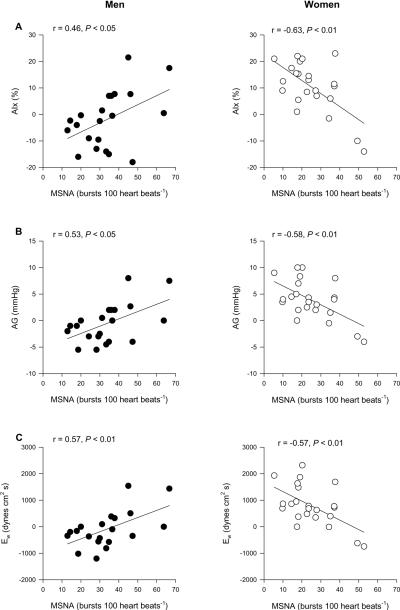
Increased arterial stiffness is associated with higher levels of aortic wave reflection and aortic blood pressure. Recent evidence suggests a link between muscle sympathetic nerve activity and indices of arterial stiffness. Therefore, the aims of this study were to examine the relationship between resting muscle sympathetic nerve activity and characteristics of aortic pressure wave reflection and the influence of sex on these relationships. In 44 subjects (23 females and 21 males; 25 ± 1 years of age), we measured muscle sympathetic nerve activity via peroneal microneurography. In addition, noninvasive aortic pressure waveforms were synthesized from radial pressure waveforms obtained from applanation tonometry. Aortic blood pressure, augmentation index, wave reflection amplitude, and wasted left ventricular energy were calculated. Resting sympathetic activity (bursts/100 heart beats) was not associated with any of the aortic pressure wave reflection characteristics for all patients. However, there was a positive relationship between sympathetic activity and augmentation index (r = 0.46; P = 0.05) in men. Further, sympathetic activity in men was related to wave reflection amplitude (r = 0.53; P<0.05) and wasted left ventricular energy (r = 0.57; P<0.01). In contrast to men, women demonstrated strong inverse relationships between sympathetic activity and augmentation index (r = -0.63), wave reflection amplitude ( r = -0.59), and wasted left ventricular energy (r = -0.58; P<0.01 for all). Our results suggest another possible mechanism by which young women are protected against the development of cardiovascular disease.
Figures
References
-
- Nichols WW, Singh BM. Augmentation index as a measure of peripheral vascular disease state. Current opinion in cardiology. 2002;17:543–551. - PubMed
-
- Manisty C, Mayet J, Tapp RJ, Parker KH, Sever P, Poulter NH, Thom SA, Hughes AD. Wave reflection predicts cardiovascular events in hypertensive individuals independent of blood pressure and other cardiovascular risk factors: an ASCOT (Anglo-Scandinavian Cardiac Outcome Trial) substudy. Journal of the American College of Cardiology. 2010;56:24–30. - PubMed
Publication types
MeSH terms
Grants and funding
LinkOut - more resources
Full Text Sources
Other Literature Sources
Medical
