Autosomal dominant progressive sensorineural hearing loss due to a novel mutation in the KCNQ4 gene
- PMID: 21242547
- PMCID: PMC3278911
- DOI: 10.1001/archoto.2010.234
Autosomal dominant progressive sensorineural hearing loss due to a novel mutation in the KCNQ4 gene
Erratum in
- Arch Otolaryngol Head Neck Surg. 2011 Jul;137(7):711
Abstract
Objective: To identify the genetic etiology in a family with autosomal dominant progressive sensorineural hearing loss.
Design: Prospective molecular genetic research study.
Setting: Academic genetic research laboratory.
Participants: Seventeen members of a family with dominant progressive nonsyndromic sensorineural hearing loss: 9 affected, 6 unaffected, and 2 spouses.
Interventions: Clinical data from questionnaires, interviews, serial audiograms, and medical records; genetic data from genome-wide linkage analysis and candidate gene mutation analysis.
Main outcome measures: Symptoms, age at onset, serial audiometric data, and the presence or absence of a deafness-associated mutation.
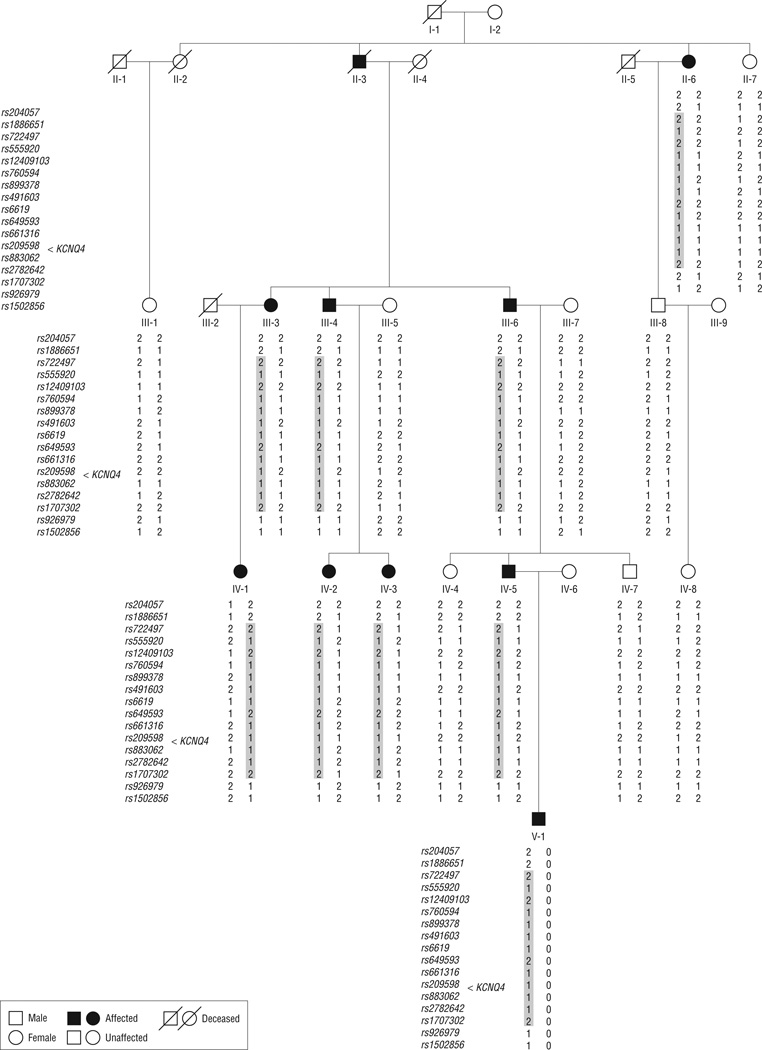
Results: Affected individuals in this family presented with autosomal dominant nonsyndromic high-frequency progressive sensorineural hearing loss, with age at onset ranging from 1 to 21 years. Genome-wide linkage analysis of single-nucleotide polymorphisms yielded evidence of linkage to an 18.9-Mb region on chromosome 1p34-p36, with a multipoint logarithm of odds score of 3.6. This interval contains a known deafness gene, KCNQ4, which underlies DNFA2 deafness. Sequencing of the 14 coding exons and intron-exon junctions of KCNQ4 revealed a novel heterozygous missense mutation, c.859G>C, p.Gly287Arg. The mutation disrupts the highly conserved GYG motif (glycine-tyrosine-glycine) of the phosphate-binding loop, hypothesized to be critical in maintaining pore structure and function. All 274 controls were negative for the mutation.
Conclusions: Autosomal dominant high-frequency hearing loss is genetically heterogeneous, and linkage analysis is an efficient means of identifying the etiology in larger families. Deafness in this family is caused by a novel mutation in KCNQ4.
Figures

References
-
- Brown SD, Hardisty-Hughes RE, Mburu P. Quiet as a mouse: dissecting the molecular and genetic basis of hearing. Nat Rev Genet. 2008;9(4):277–290. - PubMed
-
- Coucke P, Van Camp G, Djoyodiharjo B, et al. Linkage of autosomal dominant hearing loss to the short arm of chromosome 1 in two families. N Engl J Med. 1994;331(7):425–431. - PubMed
-
- Kubisch C, Schroeder BC, Friedrich T, et al. KCNQ4, a novel potassium channel expressed in sensory outer hair cells, is mutated in dominant deafness. Cell. 1999;96(3):437–446. - PubMed
-
- Coucke PJ, Van Hauwe P, Kelley PM, et al. Mutations in the KCNQ4 gene are responsible for autosomal dominant deafness in four DFNA2 families. Hum Mol Genet. 1999;8(7):1321–1328. - PubMed
Publication types
MeSH terms
Substances
Grants and funding
LinkOut - more resources
Full Text Sources
Molecular Biology Databases
Miscellaneous