


Course of Antisocial Behavior during Emerging Adulthood: Developmental Differences in Personality
- PMID: 21243066
- PMCID: PMC3020098
- DOI: 10.1016/j.jrp.2010.08.008
Course of Antisocial Behavior during Emerging Adulthood: Developmental Differences in Personality
Abstract
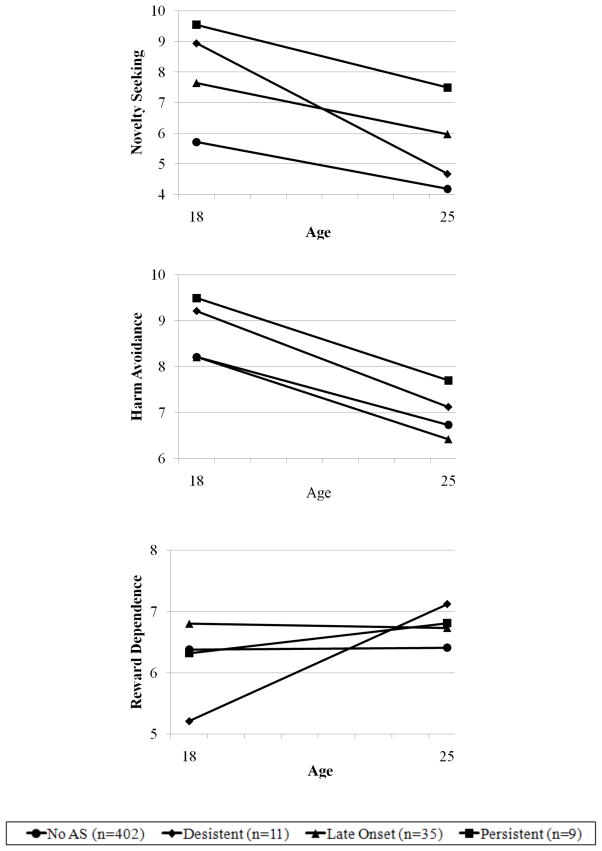
Despite similar normative changes in antisocial behavior (AB) and traits of disinhibition and negative emotionality during "emerging adulthood," few studies have tested if there are developmental differences in personality over this period for distinct courses of AB. In a college cohort assessed at ages 18 and 25, we examined if mean-level changes on traits from the Tridimensional Personality Questionnaire varied by course of AB. Compared to persisters, those who desisted in AB from 18 to 25 exhibited a larger decrease on novelty seeking and larger increase on reward dependence. A significant mean-level decline was observed for harm avoidance, but was unrelated to AB course. Findings support theories of the co-development of personality and AB during emerging adulthood.
Figures
References
-
- Arnett JJ. Emerging adulthood: A theory of development from the late teens through the twenties. American Psychologist. 2000;55:469–480. - PubMed
-
- Blonigen DM. Explaining the relationship between age and crime: Contributions from the developmental literature on personality. Clinical Psychology Review. 2010;30:89–100. - PubMed
-
- Caspi A, Roberts BW, Shiner RL. Personality development: Stability and change. Annual Review of Psychology. 2005;56:453–484. - PubMed
-
- Cloninger CR. A systematic method for clinical description and classification of personality variants. Archives of General Psychiatry. 1987;44:573–588. - PubMed
Grants and funding
LinkOut - more resources
Full Text Sources