


CHARACTERIZATION OF PARTICULATE MATTER EMISSION FROM OPEN BURNING OF RICE STRAW
- PMID: 21243095
- PMCID: PMC3018782
- DOI: 10.1016/j.atmosenv.2010.09.023
CHARACTERIZATION OF PARTICULATE MATTER EMISSION FROM OPEN BURNING OF RICE STRAW
Abstract
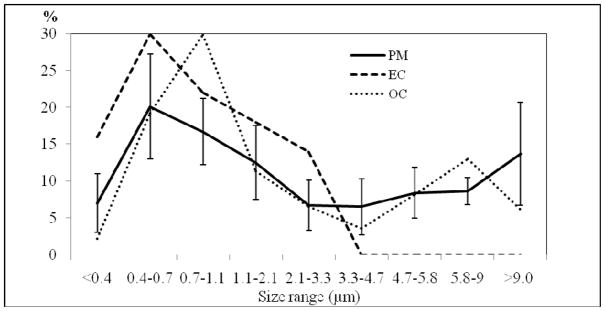
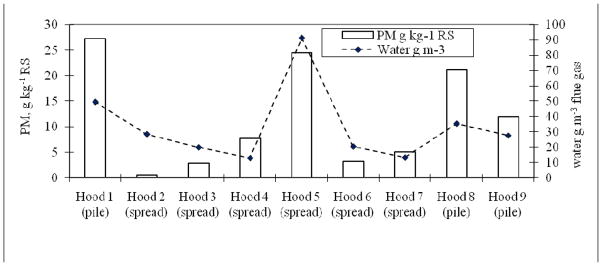
Emission from field burning of crop residue, a common practice in many parts of the world today, has potential effects on air quality, atmosphere and climate. This study provides a comprehensive size and compositional characterization of particulate matter (PM) emission from rice straw (RS) burning using both in situ experiments (11 spread field burning) and laboratory hood experiments (3 pile and 6 spread burning) that were conducted during 2003-2006 in Thailand. The carbon balance and emission ratio method was used to determine PM emission factors (EF) in the field experiments. The obtained EFs varied from field to hood experiments reflecting multiple factors affecting combustion and emission. In the hood experiments, EFs were found to be depending on the burning types (spread or pile), moisture content and the combustion efficiency. In addition, in the field experiments, burning rate and EF were also influenced by weather conditions, i.e. wind. Hood pile burning produced significantly higher EF (20±8 g kg(-1) RS) than hood spread burning (4.7±2.2 g kg(-1) RS). The majority of PM emitted from the field burning was PM(2.5) with EF of 5.1±0.7 g m(-2) or 8.3±2.7 g kg(-1) RS burned. The coarse PM fraction (PM(10-2.5)) was mainly generated by fire attention activities and was relatively small, hence the resulting EF of PM(10) (9.4±3.5 g kg(-1) RS) was not significantly higher than PM(2.5). PM size distribution was measured across 8 size ranges (from <0.4 μm to >9.0 μm). The largest fractions of PM, EC and OC were associated with PM(1.1). The most significant components in PM(2.5) and PM(10) include OC, water soluble ions and levoglucosan. Relative abundance of some methoxyphenols (e.g., acetylsyringone), PAHs (e.g., fluoranthene and pyrene), organochlorine pesticides and PCBs may also serve as additional signatures for the PM emission. Presence of these toxic compounds in PM of burning smoke increases the potential toxic effects of the emission. For illustration, an estimation of the annual RS field burning in Thailand was made using the obtained in situ field burning EFs and preliminary burning activity data.
Figures
References
-
- Andreae MO, Merlet P. Emission of trace gases and aerosols from biomass burning. Global Biogeochemical cycles. 2001;15(4):955–966.
-
- ASTM standard D5373-02. Standard Test Methods for Instrumental Determination of Carbon, Hydrogen, and Nitrogen in Laboratory Samples of Coal. ASTM International; West Conshohocken, PA: 2008. Available on http://www.astm.org.
-
- Bond TC, Streets DG, Yarber KF, Nelson SM, Woo J-H, Klimont ZA. Technology-based global inventory of black and organic carbon emissions from combustion. Journal of Geophysical Research. 2004;109(D14203) doi: 10.1029/2003JD003697. - DOI
-
- Dhammapala R, Claiborn C, Simpson C, Jimenez J. Emission factors from wheat and Kentucky bluegrass stubble burning: Comparison of field and simulated burn experiments. Atmospheric Environment. 2007;41:1512–1520.
-
- FDA. Thailand’s National Chemicals Management Profile (2005) Chemical Safety Group Thailand Focal Point for WHO/IPCS, and IFCS, Food and Drug Administration, Ministry of Public Health of Thailand. 2007. available on http://ipcs.fda.moph.go.th/e_ipcs/profile/2005/summary.
Grants and funding
LinkOut - more resources
Full Text Sources