Review
. 2011 Jan 24;12(2):299-307.
doi: 10.1002/cbic.201000474. Epub 2010 Oct 29.

Dynamic interplay between histone H3 modifications and protein interpreters: emerging evidence for a "histone language"

Affiliations
Review

Dynamic interplay between histone H3 modifications and protein interpreters: emerging evidence for a "histone language"

Samuel S Oliver et al. Chembiochem. .

Abstract

Histone proteins organize DNA into dynamic chromatin structures and regulate processes such as transcription, repair, and replication. Control of chromatin function and structure is mediated in part by reversible post-translational modifications (PTMs) on histones. The most N-terminal region of histone H3 contains a high density of modifiable residues. Here we focus on the dynamic interplay between histone modification states on the H3 N terminus and the binding modules that recognize these states. Specifically, we discuss the effect of auxiliary modifications to H3K4unmod/me3 binding modules (specifically H3R2 methylation, H3T3 phosphorylation, and H3T6 phosphorylation). Emerging evidence suggests that histone PTMs behave less like a strict "code", but more like a "language", which better illustrates the importance of context. Using androgen-receptor-mediated gene activation as an example, we propose a model of how the combinatorial natures of PTMs on the H3 N terminus and the complexes that recognize these epigenetic modifications control gene expression.


Figures

Figure 1
Figure 1
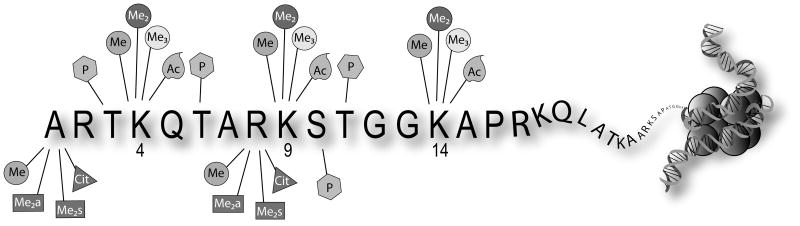
Representation of possible modification states on the most N-terminal region of histone H3.
Figure 2
Figure 2
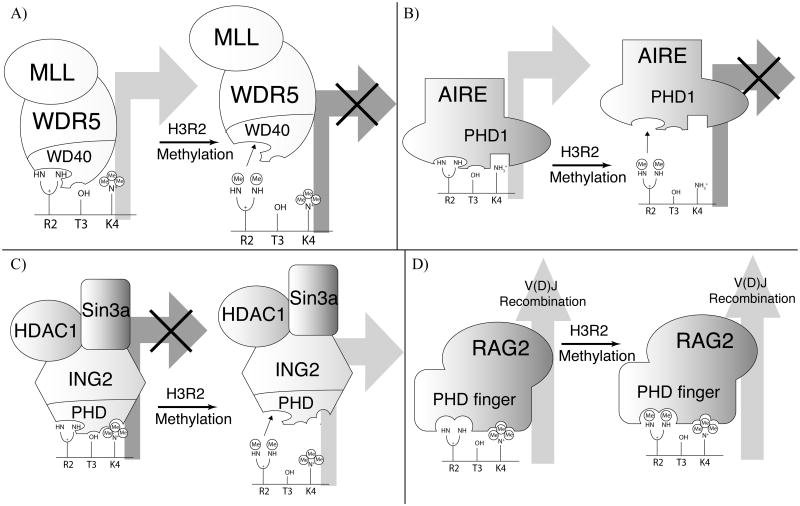
Effect of H3R2 methylation on chromatin binding modules. A) WD40-repeat of WDR5 displays sensitivity to H3R2 methylation and the transcriptional consequence is repression. B) The PHD-finger of ING2 recognizes H3K4me3 but is antagonized by H3R2 methylation, leading to transcriptional activation. C) AIRE-PHD1 recognizes H3K4unmod and is sensitive to H3R2 methylation, which leads to transcriptional repression. D) RAG2-PHD, which recognizes H3K4me3, is insensitive to methylation at H3R2 and V(D)J recombination is unaffected by this epigenetic modification.
Figure 3
Figure 3
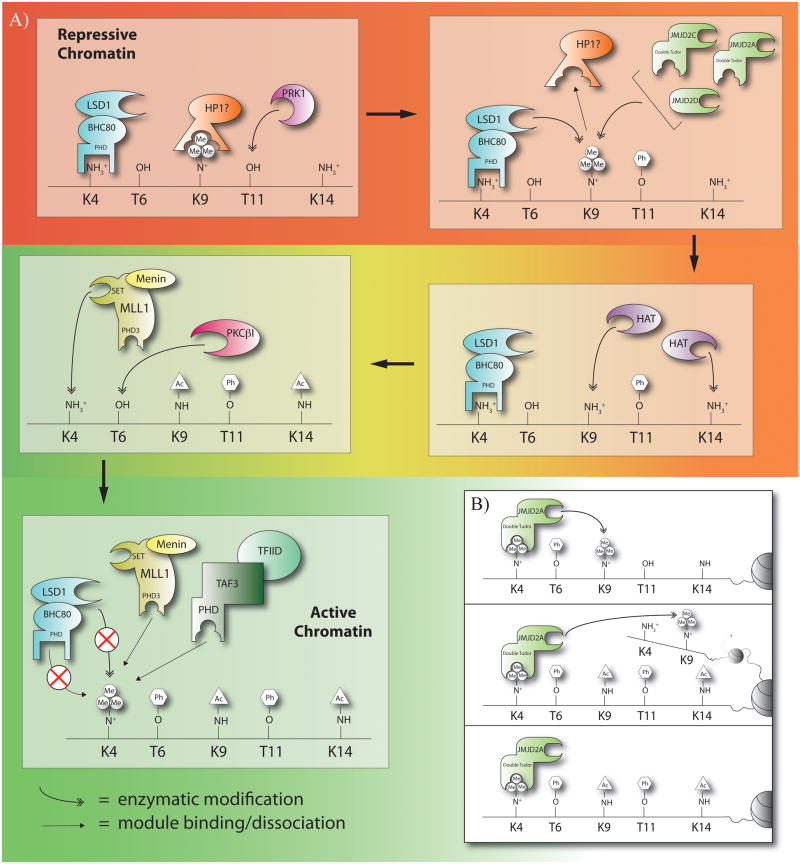
Epigenetic control of androgen receptor activation. A) The transition from repressive to active chromatin. B) Three different models for JMJD2A/C-DTD recognition of H3K4me3in the presence of H3T6ph. Top panel, JMJD2A/C facilitates demethylation of H3K9me3 at sites where H3T6ph is already present (“intra-tail” activation). Middle panel, JMJD2A/C interacts with active chromatin containing H3K4me3/T6ph and facilitates the start of activation (“inter-tail” activation). Bottom panel, JMJD2A/C remains localized to the active chromatin via the DTD in order to maintain demethylated H3K9.

References

    1. Luger K, Mader AW, Richmond RK, Sargent DF, Richmond TJ. Nature. 1997;389:251. - PubMed
    1. Taverna SD, Li H, Ruthenburg AJ, Allis CD, Patel DJ. Nat Struct Mol Biol. 2007;14:1025. - PMC - PubMed
    1. Kouzarides T. Cell. 2007;128:693. - PubMed
    1. Shogren-Knaak M, Ishii H, Sun JM, Pazin MJ, Davie JR, Peterson CL. Science. 2006;311:844. - PubMed
    1. Ruthenburg AJ, Allis CD, Wysocka J. Mol Cell. 2007;25:15. - PubMed

Publication types

LinkOut - more resources