Relationship of personality disorders to the course of major depressive disorder in a nationally representative sample
- PMID: 21245088
- PMCID: PMC3202962
- DOI: 10.1176/appi.ajp.2010.10050695
Relationship of personality disorders to the course of major depressive disorder in a nationally representative sample
Abstract
Objective: The purpose of this study was to examine the effects of specific personality disorder comorbidity on the course of major depressive disorder in a nationally representative sample.
Method: Data were drawn from 1,996 participants in a national survey. Participants who met criteria for major depressive disorder at baseline in face-to-face interviews (in 2001-2002) were reinterviewed 3 years later (in 2004-2005) to determine persistence and recurrence. Predictors included all DSM-IV personality disorders. Control variables included demographic characteristics, other axis I disorders, family and treatment histories, and previously established predictors of the course of major depressive disorder.
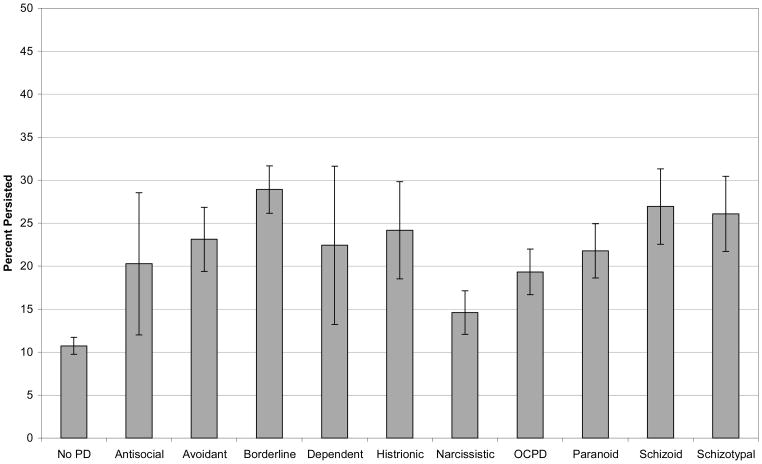
Results: A total of 15.1% of participants had persistent major depressive disorder, and 7.3% of those who remitted had a recurrence. Univariate analyses indicated that avoidant, borderline, histrionic, paranoid, schizoid, and schizotypal personality disorders all elevated the risk for persistence. With axis I comorbidity controlled, all personality disorders except histrionic personality disorder remained significant. With all other personality disorders controlled, borderline and schizotypal disorders remained significant predictors. In final, multivariate analyses that controlled for age at onset of major depressive disorder, the number of previous episodes, duration of the current episode, family history, and treatment, borderline personality disorder remained a robust predictor of major depressive disorder persistence. Neither personality disorders nor other clinical variables predicted recurrence.
Conclusions: In this nationally representative sample of adults with major depressive disorder, borderline personality disorder robustly predicted persistence, a finding that converges with recent clinical studies. Personality psychopathology, particularly borderline personality disorder, should be assessed in all patients with major depressive disorder, considered in prognosis, and addressed in treatment.
Figures
Comment in
-
Can epidemiology translate into understanding major depression with borderline personality disorder?Am J Psychiatry. 2011 Mar;168(3):231-3. doi: 10.1176/appi.ajp.2010.10121737. Am J Psychiatry. 2011. PMID: 21368301 Free PMC article. No abstract available.
References
-
- Hasin DS, Goodwin RD, Stinson FS, Grant BF. Epidemiology of major depressive disorder: results from the National Epidemiologic Survey on Alcoholism and Related Conditions. Arch Gen Psychiatry. 2005;62:1097–1106. - PubMed
-
- Lopez AD, Mathers CD, Ezzati M, Jamison DT, Murray CJ. Global and regional burden of disease and risk factors, 2001: systematic análysis of population heath data. Lancet. 2006;367:1747–1757. - PubMed
-
- Mueller TI, Leon AC, Keller MB, Solomon DA, Endicott J, Coryell W, Warshaw M, Maser JD. Recurrence after recovery from major depressive disorder during 15 years of observational follow-up. Am J Psychiatry. 1999;156:1000–1006. - PubMed
-
- Solomon DA, Keller MB, Leon AC, Mueller TI, Shea MT, Warshaw M, Maser JD, Coryell W, Endicott J. Recovery from major depression: a 10-year prospective follow-up across multiple episodes. Arch Gen Psychiatry. 1997;54:1001–1006. - PubMed
Publication types
MeSH terms
Grants and funding
LinkOut - more resources
Full Text Sources
Other Literature Sources
Medical
Miscellaneous