Review
doi: 10.1101/gad.2018811.
The genomic landscapes of inflammation
Affiliations
- PMID: 21245163
- PMCID: PMC3022255
- DOI: 10.1101/gad.2018811
Item in Clipboard
Review
The genomic landscapes of inflammation
Genes Dev.
.
Abstract
Inflammation involves the activation of a highly coordinated gene expression program that is specific for the initial stimulus and occurs in a different manner in bystander parenchymal cells and professional immune system cells recruited to the inflamed site. Recent data demonstrate that developmental transcription factors like the macrophage fate-determining Pu.1 set the stage for the activity of ubiquitous transcription factors activated by inflammatory stimuli, like NF-kB, AP-1, and interferon regulatory factors (IRFs). The intersection of lineage-determining and stimulus-activated transcription factors at enhancers explains cell type specificity in inflammatory responses.
Figures
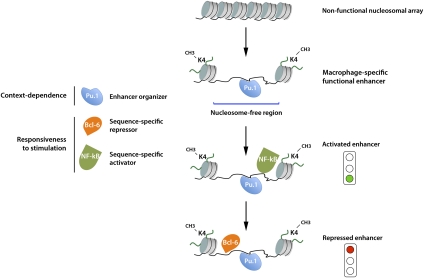
Organization and function of macrophage-specific enhancers responsive to inflammatory stimuli. The essential macrophage fate-determining TF Pu.1 activates as enhancers the genomic regions it binds. Enhancer organization entails both the formation of a nucleosome-free region centered on the Pu.1-binding site and the deposition of histone modifications like H3K4me1. A fraction of the macrophage-specific enhancers contains binding sites for TFs activated by inflammatory stimuli (like NF-kB), which are recruited in response to stimulation. Binding sites for sequence-specific transcriptional repressors (e.g., Bcl-6) are involved in negative regulation of enhancer activity. Bcl-6 association with most genomic regions it binds is attenuated or completely eliminated in response to inflammatory stimuli.
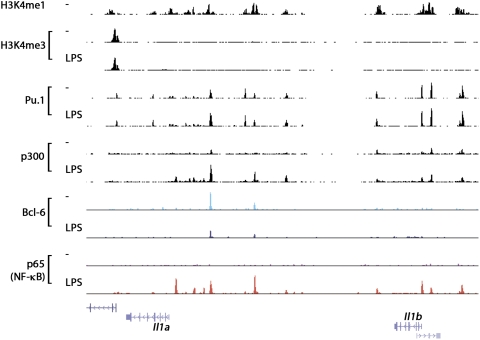
A canonical genomic landscape of inflammation. A macrophage genomic region is shown that contains multiple potential enhancer elements marked by high constitutive H3K4me1 levels. These enhancers are constitutively associated with the macrophage lineage commitment and identity factor Pu.1, and recruit inflammatory TFs like NF-kB in response to microbial stimulation. In turn, inflammatory TFs promote the recruitment of the histone acetyltransferase p300. In some cases, enhancers are also constitutively bound by Bcl-6, a sequence-specific transcriptional repressor that is in part released upon microbial stimulation. Data sets used for the figure were from Barish et al. (2010), Ghisletti et al. (2010), and De Santa et al. (2010).
References
-
- Baccala R, Gonzalez-Quintial R, Lawson BR, Stern ME, Kono DH, Beutler B, Theofilopoulos AN 2009. Sensors of the innate immune system: Their mode of action. Nat Rev Rheumatol 5: 448–456 - PubMed
-
- Basso K, Dalla-Favera R 2010. BCL6: Master regulator of the germinal center reaction and key oncogene in B cell lymphomagenesis. Adv Immunol 105: 193–210 - PubMed
-
- Beg AA, Sha WC, Bronson RT, Baltimore D 1995. Constitutive NF-κ B activation, enhanced granulopoiesis, and neonatal lethality in IκBα-deficient mice. Genes Dev 9: 2736–2746 - PubMed