


Membrane lipidome of an epithelial cell line
- PMID: 21245337
- PMCID: PMC3033259
- DOI: 10.1073/pnas.1019267108
Membrane lipidome of an epithelial cell line
Abstract
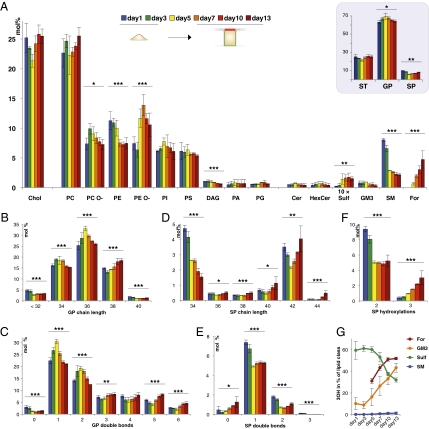
Tissue differentiation is an important process that involves major cellular membrane remodeling. We used Madin-Darby canine kidney cells as a model for epithelium formation and investigated the remodeling of the total cell membrane lipidome during the transition from a nonpolarized morphology to an epithelial morphology and vice versa. To achieve this, we developed a shotgun-based lipidomics workflow that enabled the absolute quantification of mammalian membrane lipidomes with minimal sample processing from low sample amounts. Epithelial morphogenesis was accompanied by a major shift from sphingomyelin to glycosphingolipid, together with an increase in plasmalogen, phosphatidylethanolamine, and cholesterol content, whereas the opposite changes took place during an epithelial-to-mesenchymal transition. Moreover, during polarization, the sphingolipids became longer, more saturated, and more hydroxylated as required to generate an apical membrane domain that serves as a protective barrier for the epithelial sheet.
Conflict of interest statement
The authors declare no conflict of interest.
Figures


References
-
- Thiery JP, Acloque H, Huang RYJ, Nieto MA. Epithelial-mesenchymal transitions in development and disease. Cell. 2009;139:871–890. - PubMed
-
- Leighton J, Estes LW, Mansukhani S, Brada Z. A cell line derived from normal dog kidney (MDCK) exhibiting qualities of papillary adenocarcinoma and of renal tubular epithelium. Cancer. 1970;26:1022–1028. - PubMed
-
- Lever JE. Regulation of dome formation in differentiated epithelial cell cultures. J Supramol Struct. 1979;12:259–272. - PubMed
Publication types
MeSH terms
Substances
LinkOut - more resources
Full Text Sources
Other Literature Sources
