. 2011 Jun;31(6):1412-23.
doi: 10.1038/jcbfm.2010.230. Epub 2011 Jan 19.

Prophylactic neuroprotection against stroke: low-dose, prolonged treatment with deferoxamine or deferasirox establishes prolonged neuroprotection independent of HIF-1 function

Affiliations

Prophylactic neuroprotection against stroke: low-dose, prolonged treatment with deferoxamine or deferasirox establishes prolonged neuroprotection independent of HIF-1 function

Yanxin Zhao et al. J Cereb Blood Flow Metab. 2011 Jun.

Abstract

Prophylactic neuroprotection against stroke could reduce stroke burden in thousands of patients at high risk of stroke, including those with recent transient ischemic attacks (TIAs). Prolyl hydroxylase inhibitors (PHIs), such as deferoxamine (DFO), reduce stroke volume when administered at high doses in the peristroke period, which is largely mediated by the hypoxia-inducible transcription factor (HIF-1). Yet, in vitro experiments suggest that PHIs may also induce neuroprotection independent of HIF-1. In this study, we examine chronic, prophylactic, low-dose treatment with DFO, or another iron chelator deferasirox (DFR), to determine whether they are neuroprotective with this paradigm and mediate their effects through a HIF-1-dependent mechanism. In fact, prophylactic administration of low-dose DFO or DFR significantly reduces stroke volume. Surprisingly, DFO remained neuroprotective in mice haploinsufficient for HIF-1 (HIF-1+/-) and transgenic mice with conditional loss of HIF-1 function in neurons and astrocytes. Similarly, DFR was neuroprotective in HIF-1+/- mice. Neither DFO nor DFR induced expression of HIF-1 targets. Thus, low-dose chronic administration of DFO or DFR induced a prolonged neuroprotective state independent of HIF-1 function. As DFR is an orally administered and well-tolerated medication in clinical use, it has promise for prophylaxis against stroke in patients at high risk of stroke.


Figures
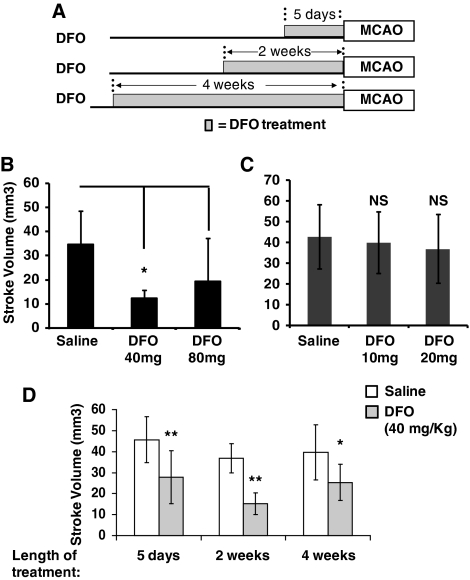
Figure 1
Figure 1
Low-dose, prolonged treatment with deferoxamine (DFO) reduces stroke volume. (A) A schematic diagram of the experimental protocols used demonstrating the different time periods of DFO treatment. (B) Two weeks of treatment with 40 mg/kg per day of DFO significantly reduced stroke volume, whereas the more modest reduction in stroke volume with 80 mg/kg per day was not significant (one-way analysis of variance (ANOVA) with Bonferroni's multiple comparison test, n=7 to 8 mice in each group). (C) Two weeks of treatment with 10 to 20 mg/kg per day of DFO did not reduced stroke volume (one-way ANOVA with Bonferroni's multiple comparison test, n=6 to 9 mice in each group). (D) Treatment with 40 mg/kg per day of DFO for 5 days, 2 weeks, or 4 weeks all significantly reduces stroke volume compared with saline controls (two-way ANOVA with Bonferroni's posttest analysis, n=5 to 9 mice in each group). For clarity of the comparisons, the same data for the 2-week time point that is plotted in (B) is also plotted in (C). (The error bars=s.d. in all figures; *P<0.05, **P<0.01, and ***P<0.001 in all figures).
Figure 2
Figure 2
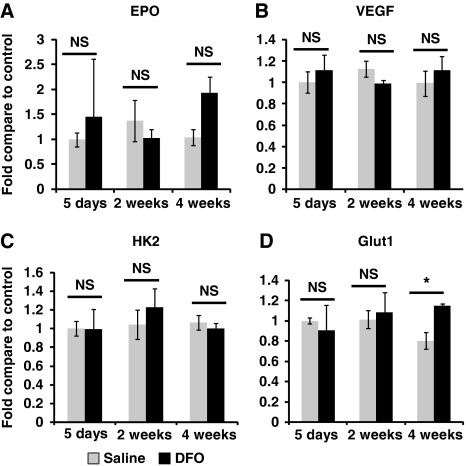
Low-dose, prolonged treatment with deferoxamine (DFO) does not induce hypoxia-inducible factor (HIF) targets. (AD) The HIF targets erythropoietin (EPO), vascular endothelial growth factor (VEGF), hexokinase 2 (HK2), and glucose transporter 1 (Glut-1) were not consistently induced by DFO (40 mg/kg per day) treatment for 5 days, 2 weeks, or 4 weeks (two-way analysis of variance (ANOVA) with Bonferroni's posttest analysis, n=6 mice in each group).
Figure 3
Figure 3
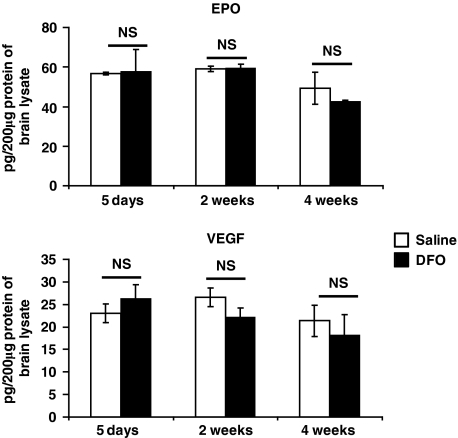
Low-dose, prolonged treatment with deferoxamine (DFO) does not induce erythropoietin (EPO) or vascular endothelial growth factor (VEGF) protein abundance in brain as measured by enzyme-linked immunosorbent assay (ELISA) (two-way analysis of variance (ANOVA) with Bonferroni's posttest analysis, n=3 mice in each group).
Figure 4
Figure 4
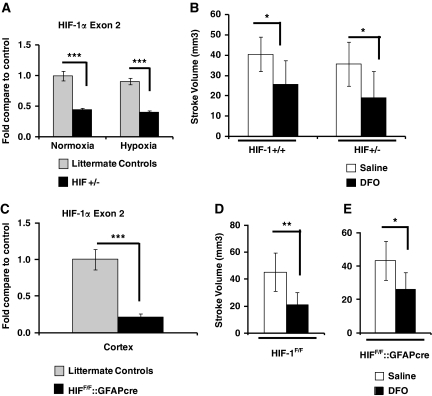
Deferoxamine (DFO) remains protective when hypoxia-inducible factor 1 (HIF-1) function is reduced in all tissue (HIF-1+/− mice) or lost selectively in neurons and astrocytes (HIF-1F/F∷hGFAPcre mice). (A) As expected, the abundance of HIF-1 transcript (exon2) is significantly reduced to ∼50% of control levels in brain cortex of HIF-1+/− mice (two-way analysis of variance (ANOVA) with Bonferroni's posttest analysis, n=4 mice in each group). (B) Despite the loss of HIF-1 transcript, low-dose, prolonged DFO (40 mg/kg per day for 2 weeks) significantly reduces stroke volume in HIF-1+/− mice and their littermate controls (two-way ANOVA with Bonferroni's posttest analysis, n=8 to 11 mice in each group). (C) HIF-1 transcript in the cortex of HIF-1F/F∷hGFAPcre mice is reduced by 79% compared with sibling controls (HIF-1F/F mice) (independent t-tests, n=10 to 14 mice in each group). (D) DFO significantly reduces stroke volume in HIF-1F/F mice (retain HIF-1 function) (independent t-tests, n=5 to 7 mice in each group). (E) DFO significantly reduces stroke volume with loss of HIF-1 function in neurons/astrocytes in HIF-1F/F∷hGFAPcre mice (independent t-tests, n=5 to 7 mice in each group).
Figure 5
Figure 5
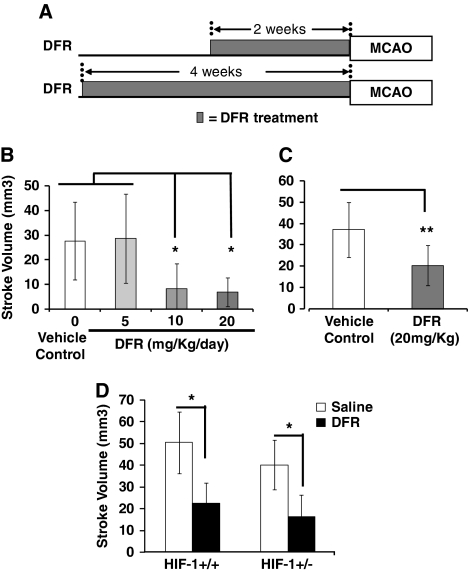
Low-dose, prolonged administration of deferasirox (DFR) reduces stroke volume. (A) Schematic diagram of experimental paradigm. (B) DFR administered for 2 weeks reduces stroke volume when administered at 10 or 20 mg/kg per day, but not at 5 mg/kg per day (one-way analysis of variance (ANOVA) with Bonferroni's posttest analysis, n=6 to 10 mice in each group). (C) DFR (20 mg/kg per day) remains effective at reducing stroke volume when administered for 4 weeks (independent t-tests, n=9 to 12 mice in each group). (D) DFR (20 mg/kg per day for 2 weeks) significantly reduces stroke volume in HIF-1+/+ (sibling controls) and HIF-1+/− mice (two-way ANOVA with Bonferroni's posttest analysis, n=6 to 8 mice in each group). HIF-1, hypoxia-inducible factor 1.
Figure 6
Figure 6
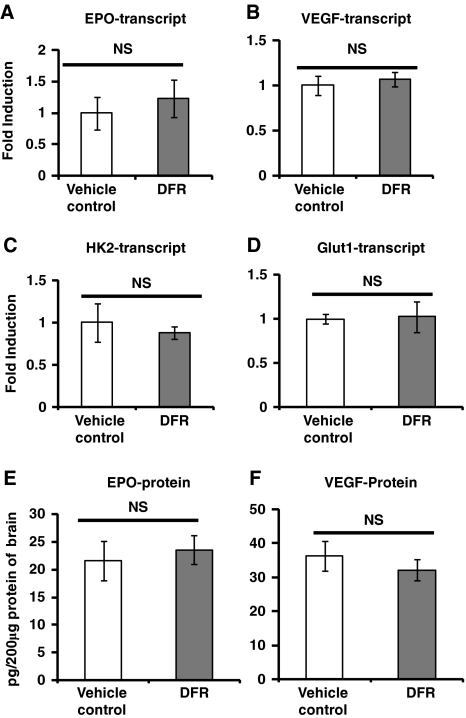
Low-dose, prolonged treatment with deferasirox (DFR) does not induce hypoxia-inducible factor (HIF) target transcripts in brain or erythropoietin (EPO)/vascular endothelial growth factor (VEGF) protein in brain. (AD) The HIF targets EPO, VEGF, hexokinase 2 (HK2), and glucose transporter 1 (Glut-1) were not induced by treatment with 20 mg/kg per day of DFR for 2 weeks (independent t-tests, n=4 to 5 mice in each group). (E, F) DFR does not induce EPO or VEGF protein in brain (independent t-tests, n=6 mice in each group).
Figure 7
Figure 7
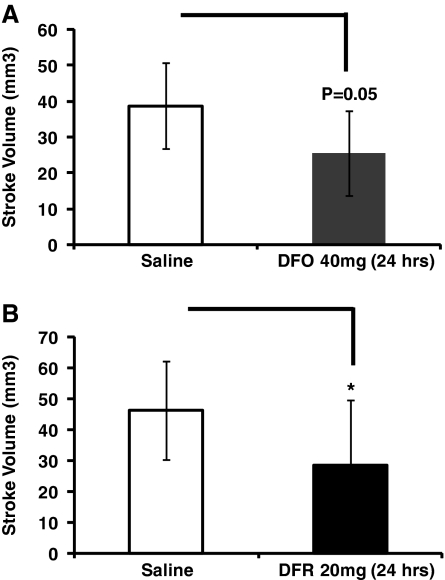
Low-dose treatment with deferoxamine (DFO) or deferasirox (DFR) for 24 hours reduces stroke volumes. (A) Treatment with DFO (40 mg/kg) for 24 hours reduces stroke volume compared with saline controls (independent t-tests, n=7 to 8 mice in each group). (B) Treatment with DFR (20 mg/kg) for 24 hours significantly reduces stroke volume compared with mice control mice (independent t-tests, n=10 to 11 mice in each group).

References

    1. Amin-Hanjani S, Stagliano NE, Yamada M, Huang PL, Liao JK, Moskowitz MA. Mevastatin, an HMG-CoA reductase inhibitor, reduces stroke damage and upregulates endothelial nitric oxide synthase in mice. Stroke. 2001;32:980–986. - PubMed
    1. Baranova O, Miranda LF, Pichiule P, Dragatsis I, Johnson RS, Chavez JC. Neuron-specific inactivation of the hypoxia inducible factor 1 alpha increases brain injury in a mouse model of transient focal cerebral ischemia. J Neurosci. 2007;27:6320–6332. - PMC - PubMed
    1. Bruin GJ, Faller T, Wiegand H, Schweitzer A, Nick H, Schneider J, Boernsen KO, Waldmeier F. Pharmacokinetics, distribution, metabolism, and excretion of deferasirox and its iron complex in rats. Drug Metab Dispos. 2008;36:2523–2538. - PubMed
    1. Cai Z, Zhong H, Bosch-Marce M, Fox-Talbot K, Wang L, Wei C, Trush MA, Semenza GL. Complete loss of ischaemic preconditioning-induced cardioprotection in mice with partial deficiency of HIF-1 alpha. Cardiovasc Res. 2008;77:463–470. - PubMed
    1. Cappellini MD. Long-term efficacy and safety of deferasirox. Blood Rev. 2008;22 (Suppl 2:S35–S41. - PubMed

Publication types

MeSH terms