


Silicon phthalocyanine (Pc 4) photodynamic therapy is a safe modality for cutaneous neoplasms: results of a phase 1 clinical trial
- PMID: 21246576
- PMCID: PMC3149858
- DOI: 10.1002/lsm.20984
Silicon phthalocyanine (Pc 4) photodynamic therapy is a safe modality for cutaneous neoplasms: results of a phase 1 clinical trial
Abstract
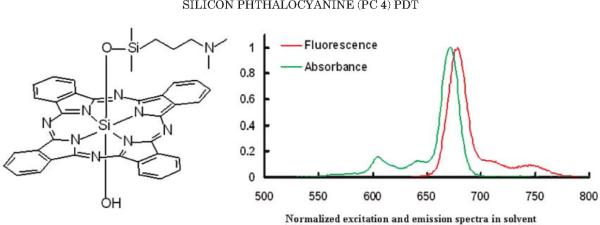
Background: Photodynamic therapy (PDT) is a non-invasive treatment for non-melanoma skin cancer. However, PDT systems currently used clinically have limitations such as pain and superficial tissue penetration. The silicon phthalocyanine Pc 4 is a second-generation photosensitizer with peak absorption in the far red at 675 nm.
Objective: To assess the safety and tolerability of topically applied Pc 4 followed by red light (Pc 4-PDT) in treating cutaneous neoplasms.
Study design/materials and methods: Forty three adults with a diagnosis of neoplasms including actinic keratoses, Bowen's disease, squamous cell carcinoma, basal cell carcinoma, or mycosis fungoides were treated with a single administration of Pc 4-PDT and followed for 14 days. The study utilized a light and Pc 4 dose escalation design in sequential groups of three subjects each.
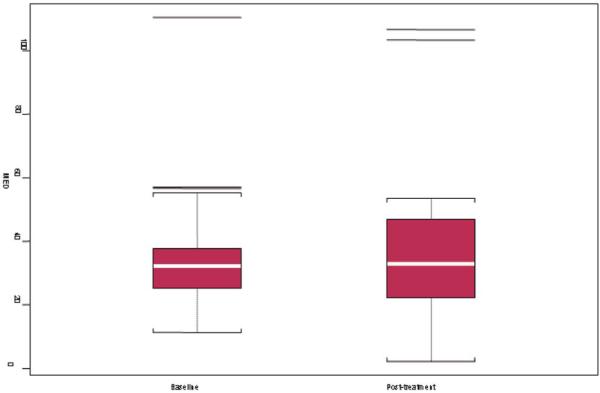
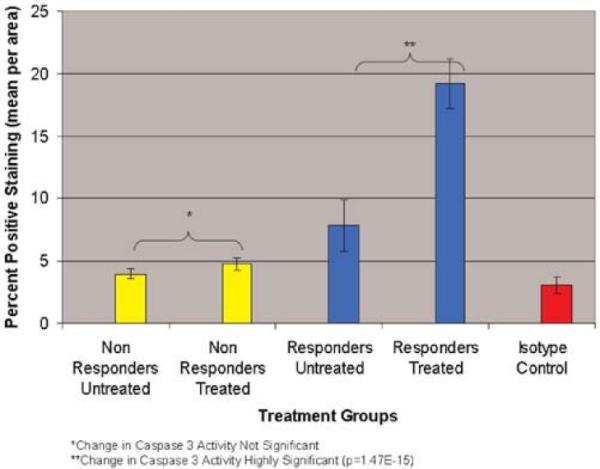
Results: Pc 4-PDT was well tolerated with no significant local toxicity or increased photosensitivity. It has promising biologic effects, particularly in mycosis fungoides where 14 of 35 subjects demonstrated a clinical response, which correlates with Pc 4-PDT-induced apoptosis, as measured by increased active caspase-3 in the treated skin lesions.
Conclusions: Pc 4-PDT is a safe and tolerable treatment modality that effectively triggers apoptosis in cutaneous neoplasms such as mycosis fungoides.
Copyright © 2010 Wiley-Liss, Inc.
Figures
References
-
- Braathen LR, Szeimies RM, Basset-Seguin N, Bissonnette R, Foley P, Pariser D, Roelandts R, Wennberg AM, Morton CA. Guidelines on the use of photodynamic therapy for nonmelanoma skin caner: An international consensus. International Society for Photodynamic Therapy in Dermatology, 2005. J Am Acad Dermatol. 2007;56:125–143. - PubMed
-
- Morton C, Campbell S, Gupta G, Keohane S, Lear J, Zaki I, Walton S, Kerrouche N, Thomas G, Soto P, AKtion Investigators Intraindividual, right-left comparison of topical methyl aminolaevulinate-photodynamic therapy and cryo-therapy in subjects with actinic keratoses: A multicentre, randomized controlled study. Br J Dermatol. 2006;1:66–71. - PubMed
-
- Steinbauer JM, Schremi S, Babilas P, Zeman F, Karrer S, Landthaler M, Szeimies RM. Topical photodynamic therapy with porphyrin precursors-assessment of treatment-associated pain in a retrospective study. Photochem Photobiol Sci. 2009;8:1111–1116. - PubMed
-
- Grapengiesser S, Gudmundsson F, Larkö O, Ericson M, Rosén A, Wennberg A-M. Pain caused by photodynamic therapy of skin cancer. Clin Exp Dermatol. 2002;27:493–497. - PubMed
-
- He J, Larkin HE, Li Y, Rihter BS, Zaidi S, Rodgers M, Mukhtar H, Kenney ME, Oleinick NL. The synthesis, photophysical and photobiological properties and in vitro structure—Activity relationships of a set of silicon phthalocyanine PDT photosensitizers. Photochem Photobiol. 1997;65:581–586. - PubMed
Publication types
MeSH terms
Substances
Grants and funding
LinkOut - more resources
Full Text Sources
Other Literature Sources
Medical
Research Materials
