


doi: 10.1021/ja1087369.
Epub 2011 Jan 19.
Metabolites from the induced expression of cryptic single operons found in the genome of Burkholderia pseudomallei
Affiliations
- PMID: 21247113
- PMCID: PMC4872597
- DOI: 10.1021/ja1087369
Item in Clipboard
Metabolites from the induced expression of cryptic single operons found in the genome of Burkholderia pseudomallei
J Am Chem Soc.
.
Abstract
Bacterial genome sequencing projects routinely uncover gene clusters that are predicted to encode the biosynthesis of uncharacterized small molecules. A subset of these cryptic genetic elements appears as individual operons. Here we investigate potential single-operon biosynthetic systems found in the genome of the pathogenic bacterium Burkholderia pseudomallei . Placing these operons under the control of an inducible promoter led to the production of seven new metabolites. Among the molecules we identified are inhibitors of type-4 phosphodiesterases, suggesting that previously cryptic biosynthetic operons may encode metabolites that could contribute to microbial virulence by disrupting host signaling pathways.
Figures

It should be possible to produce metabolites encoded by tightly regulated cryptic single operon biosynthetic systems using well-controlled inducible promoters in model heterologous hosts.
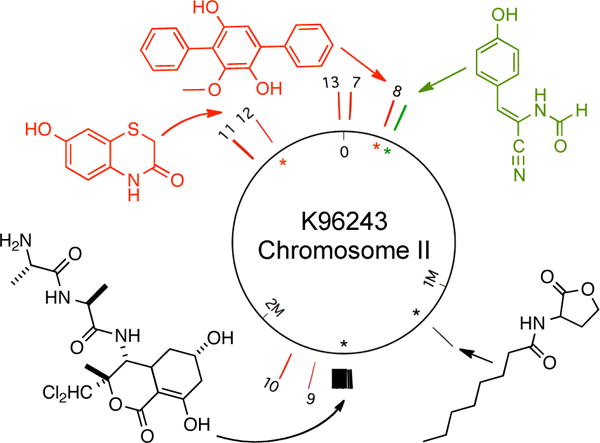
The positions of potential single operon biosynthetic systems examined in this study are mapped onto chromosome II of B. pseudomallei K96243. Chromosome I did not yield any metabolites and is not shown. Compounds identified in this study are shown in red. Gene clusters either known to be, or predicted to be, associated with the production of structurally characterized metabolites in B. pseudomallei are tagged with the metabolites they encode (black).– A metabolite identified in heterologous expression experiments in E. coli using a previously cryptic B. pseudomallei operon appears in green.
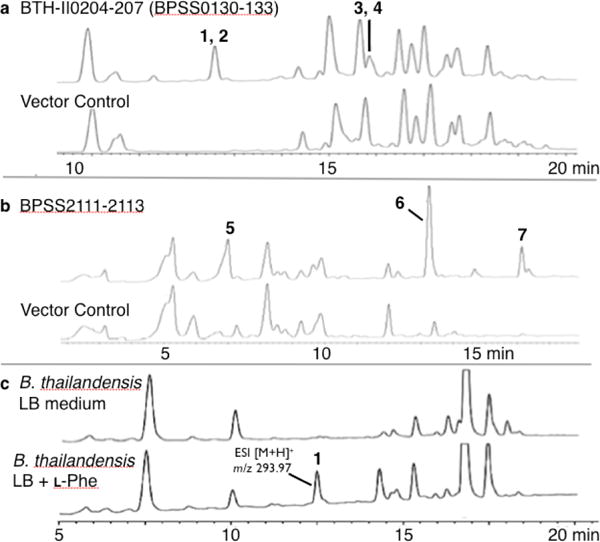
IPTG induced expression of either the BTH-II0204-207BPSS0130-133 operon (a) or the BPSS2111-2113 operon (b) leads to the production of clone specific metabolites in P. aeruginosa. In each case the control extract is derived from cultures of P. aeruginosa transformed with the empty expression vector. (c) B. thailandesis E264 grown in LB broth with and without phenylalanine.
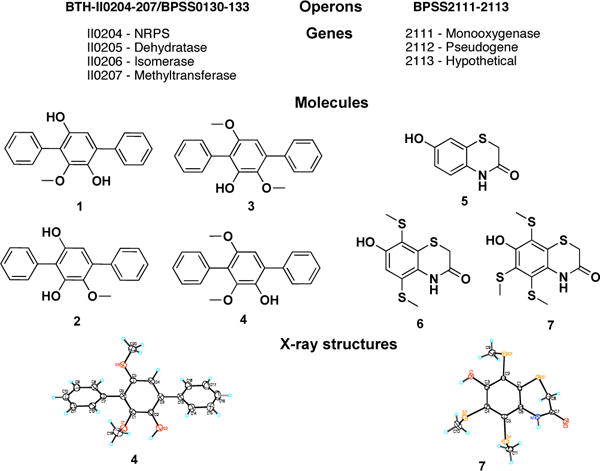
Clone-specific molecules identified in culture broths of P. aeruginosa transformed with potential cryptic biosynthetic operons from Burkholderia spp.
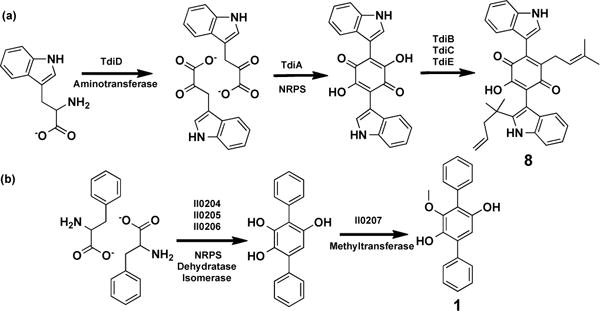
(a) Initial steps in the biosynthesis of the fungal metabolite terrequinone (8). (b) Predicted general biosynthetic scheme for 1. Promiscuity of the methyltransferase would account for the varied methylation patterns. The exact role of the predicted dehydratase and isomerase enzymes remains to be determined.
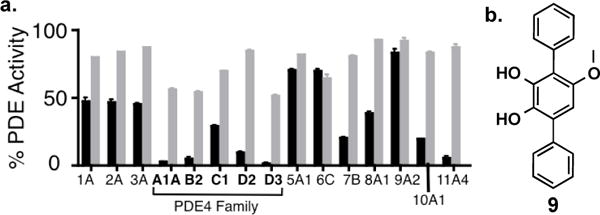
a. Percent activity of a spectrum of phosphodiesterases in the presence of either 100 μM of either compound 1 (black) or compound 3 (gray). b. Terferol (9).
References
-
- Bassler BL, Losick R. Cell. 2006;125:237–46. - PubMed
-
- Zerikly M, Challis GL. ChemBioChem. 2009;10:625–33. - PubMed
- Hertweck C. Nat Chem Biol. 2009;5:450–2. - PubMed
- Li MH, Ung PM, Zajkowski J, Garneau-Tsodikova S, Sherman DH. BMC Bioinformatics. 2009;10:185. - PMC - PubMed
- Van Lanen SG, Shen B. Curr Opin Microbiol. 2006;9:252–60. - PubMed
- Bode HB, Muller R. Angew Chem Int Ed. 2005;44:6828–6846. - PubMed
- Peric-Concha N, Long PF. Drug Discov Today. 2003;8:1078–84. - PubMed
-
- Adler NR, Govan B, Cullinane M, Harper M, Adler B, Boyce JD. FEMS Microbiol Rev. 2009;33:1079–99. - PubMed
Publication types
MeSH terms
Grants and funding
LinkOut - more resources
Full Text Sources
Other Literature Sources
