Review
. 2011 Jan 19:4:5.
doi: 10.1186/1756-6606-4-5.

DNA methylation-mediated control of learning and memory

Affiliations
Review

DNA methylation-mediated control of learning and memory

Nam-Kyung Yu et al. Mol Brain. .

Abstract

Animals constantly receive and respond to external or internal stimuli, and these experiences are learned and memorized in their brains. In animals, this is a crucial feature for survival, by making it possible for them to adapt their behavioral patterns to the ever-changing environment. For this learning and memory process, nerve cells in the brain undergo enormous molecular and cellular changes, not only in the input-output-related local subcellular compartments but also in the central nucleus. Interestingly, the DNA methylation pattern, which is normally stable in a terminally differentiated cell and defines the cell type identity, is emerging as an important regulatory mechanism of behavioral plasticity. The elucidation of how this covalent modification of DNA, which is known to be the most stable epigenetic mark, contributes to the complex orchestration of animal behavior is a fascinating new research area. We will overview the current understanding of the mechanism of modifying the methyl code on DNA and its impact on learning and memory.


Figures
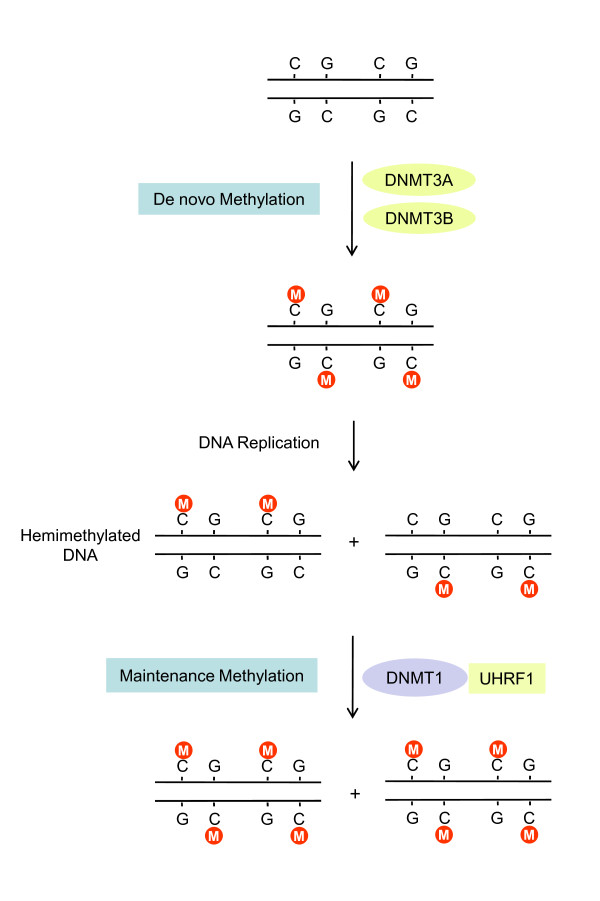
Figure 1
Figure 1
Overview of mammalian cytosine methylation. In mammals, cytosine methylation is necessary for regulation of DNA sequences and the following gene expression patterns. DNMT1 is active on hemimethylated DNA, which assists the maintenance of genomic methylation. The recruitment of DNMT1 to hemimethylated DNA is mediated through its interaction with UHRF1. DNMT3A and DNMT3B function as de novo methyltransferases, and they methylate the cytosine of previously unmethylated CpG dinucleotides on both strands.
Figure 2
Figure 2
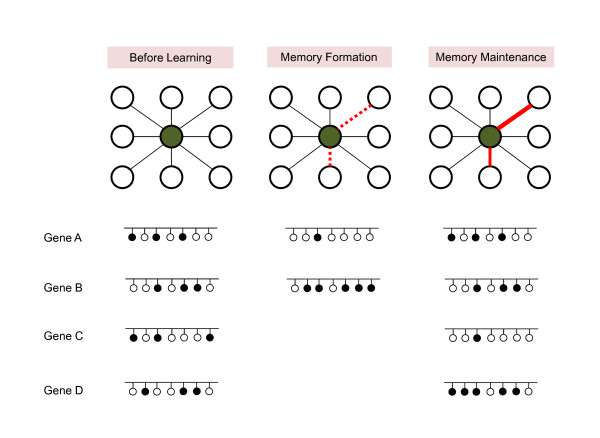
DNA methylation in learning and memory. Upper: One neuron (central green circle) has a number of connections with other neurons (peripheral circles). Lower: Each small circle represents a CpG site in a regulatory element of the gene. Filled circles indicate methylated CpGs and the white circles unmethylated CpGs. When the animal has a new experience ("Memory formation" state), some connections are activated (red dashed lines). Transient waves of gene upregulation or downregulation are required for memory formation and could be mediated by temporal modifications of DNA methylation. Memory suppressor genes (Gene B), such as PP1, are transcriptionally downregulated through DNA methylation, and plasticity-inducing genes, such as BDNF or reelin (Gene A), are upregulated with DNA demethylation. The methylation states of these genes are restored to the baseline level after memory consolidation. When the memory has been stabilized ("Memory maintenance" state), the neurons exhibit an altered profile of connection strength (compared to "Before learning" state in upper panel). We expect that the gene expression patterns in neurons need to be different from those before learning in order to maintain this modified combination of connection strengths. Maintaining this altered gene expression pattern might involve a stable change in DNA methylation. Calcineurin is a known example for Gene D that is increased in cytosine methylation and decreased in mRNA level. However, Gene C with decreased methylation and increased mRNA level that is associated with learning and memory has not been discovered in adult animals.

References

    1. Bird A. DNA methylation patterns and epigenetic memory. Genes and Development. 2002;16:6–21. doi: 10.1101/gad.947102. - DOI - PubMed
    1. Robertson KD. DNA methylation and human disease. Nature Reviews Genetics. 2005;6:597–610. doi: 10.1038/nrg1655. - DOI - PubMed
    1. Bestor TH. The DNA methyltransferases of mammals. Human Molecular Genetics. 2000;9:2395–2402. doi: 10.1093/hmg/9.16.2395. - DOI - PubMed
    1. Rottach A, Leonhardt H, Spada F. DNA methylation-mediated epigenetic control. Journal of Cellular Biochemistry. 2009;108:43–51. doi: 10.1002/jcb.22253. - DOI - PubMed
    1. Chuang LSH, Ian HI, Koh TW, Ng HH, Xu G, Li BFL. Human DNA-(cytosine-5) methyltransferase-PCNA complex as a target for p21(WAF1) Science. 1997;277:1996–2000. doi: 10.1126/science.277.5334.1996. - DOI - PubMed

Publication types