


Innate immunity in the small intestine
- PMID: 21248635
- PMCID: PMC3502877
- DOI: 10.1097/MOG.0b013e3283438dea
Innate immunity in the small intestine
Abstract
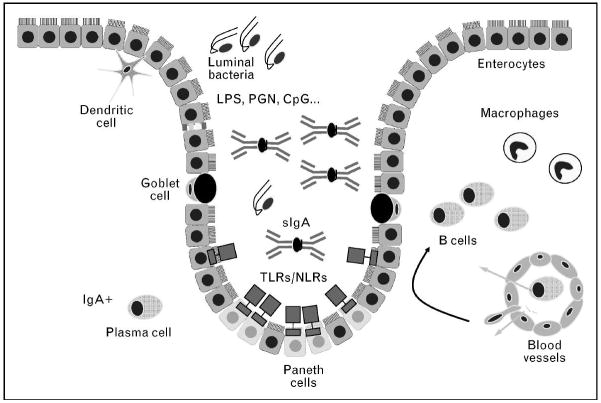
Purpose of review: In this article, we provide an update of the latest findings related to the innate immunity in the small intestine. In particular, we will focus on innate immune receptors and antimicrobial strategies that keep luminal bacteria and viral pathogens under control to avoid mucosal damage. These strategies include IgA secretion and antimicrobial peptides produced by Paneth cells, and downregulation or anergy of the innate immune receptors themselves.
Recent findings: Pattern-recognition receptors are the main target in the study of innate immunity in the intestinal mucosa due to their involvement in the regulation of host-commensal interactions. It has been shown that TLR5-deficient mice develop metabolic syndrome and have altered intestinal microbiota. On the contrary, NOD2 has been associated with the activation of autophagy and the inhibition of TLR4. Moreover, NOD2 has been described to be essential to keep a feedback loop in the host-commensal homeostasis, through the kinase Rip-2.
Summary: Innate immunity in the small intestine is mainly characterized by IgA secretion and Paneth cell antimicrobial function. In both cases pattern-recognition receptors, Toll-like receptors and nucleotide-binding and oligomerization domain-like receptors, are involved. A better understanding of the innate immunity in the small intestine would provide valuable information to develop vaccines against pathogens.
Figures
References
-
- Rescigno M. CCR6(+) dendritic cells: the gut tactical-response unit. Immunity. 2006;24:508–10. - PubMed
-
- Niess JH, Brand S, Gu X, Landsman L, Jung S, McCormick BA, Vyas JM, Boes M, Ploegh HL, Fox JG, Littman DR, Reinecker HC. CX3CR1-mediated dendritic cell access to the intestinal lumen and bacterial clearance. Science. 2005;307:254–8. - PubMed
-
- Fukata M, Vamadevan AS, Abreu MT. Toll-like receptors (TLRs) and Nod-like receptors (NLRs) in inflammatory disorders. Semin Immunol. 2009;21:242–53. - PubMed
Publication types
MeSH terms
Substances
Grants and funding
LinkOut - more resources
Full Text Sources
Other Literature Sources
Research Materials
Miscellaneous
