. 2011 Jan 13;6(1):e16187.
doi: 10.1371/journal.pone.0016187.

Creatine transporter (CrT; Slc6a8) knockout mice as a model of human CrT deficiency

Affiliations

Creatine transporter (CrT; Slc6a8) knockout mice as a model of human CrT deficiency

Matthew R Skelton et al. PLoS One. .

Abstract

Mutations in the creatine (Cr) transporter (CrT; Slc6a8) gene lead to absence of brain Cr and intellectual disabilities, loss of speech, and behavioral abnormalities. To date, no mouse model of CrT deficiency exists in which to understand and develop treatments for this condition. The purpose of this study was to generate a mouse model of human CrT deficiency. We created mice with exons 2-4 of Slc6a8 flanked by loxP sites and crossed these to Cre:CMV mice to create a line of ubiquitous CrT knockout expressing mice. Mice were tested for learning and memory deficits and assayed for Cr and neurotransmitter levels. Male CrT(⁻/y) (affected) mice lack Cr in the brain and muscle with significant reductions of Cr in other tissues including heart and testes. CrT(⁻/y) mice showed increased path length during acquisition and reversal learning in the Morris water maze. During probe trials, CrT(⁻/y) mice showed increased average distance from the platform site. CrT(⁻/y) mice showed reduced novel object recognition and conditioned fear memory compared to CrT(+/y). CrT(⁻/y) mice had increased serotonin and 5-hydroxyindole acetic acid in the hippocampus and prefrontal cortex. Ubiquitous CrT knockout mice have learning and memory deficits resembling human CrT deficiency and this model should be useful in understanding this disorder.


Conflict of interest statement

Competing Interests: The authors have declared that no competing interests exist.

Figures

Figure 1
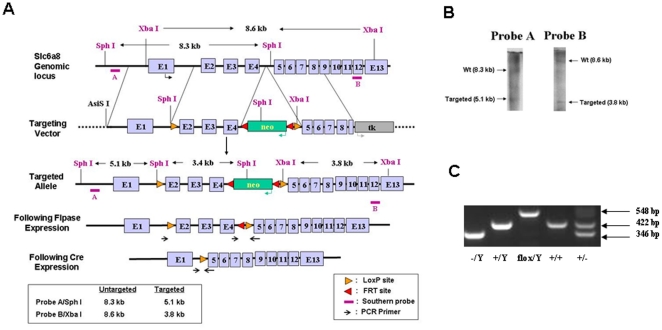
Figure 1. Generation of the CrTflox/flox mice.
(A) Schematic of mouse Slc6a8 locus (top), targeting vector (middle), and targeted locus (bottom). Exons 2-4 were flanked by LoxP sites and the neomyocin cassette was flanked by FRT sites. Neo cassette was excised prior to breeding to any Cre recombinase expressing mice. (B) Southern blot showing successful recombination in ES cells used for generation of the CrTflox mice. (C) PCR products are shown for the respective genotypes. Due to the CrT being located on the X-chromosome, males have one copy of the CrT gene and are designated as −/y (left), +/y (center-left) or flox/y (center) while females (center right and right) have two copies of the CrT. Female −/− mice are not generated as there are no CrT deficient females.
Figure 2
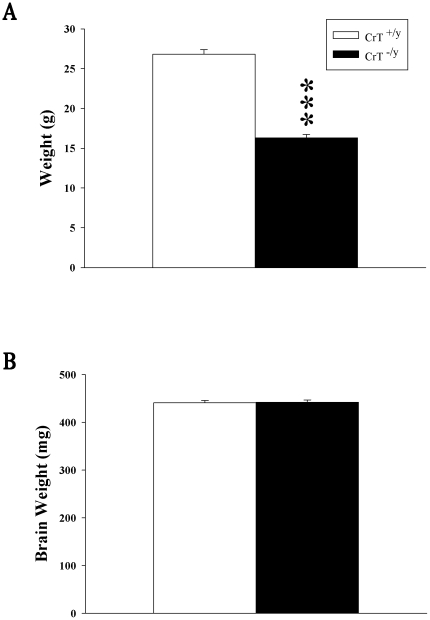
Figure 2. Body weight is reduced in CrT−/y mice while brain weights were unchanged.
(A) Body weights were collected prior to behavioral testing and (B) brain weights were collected from animals following the end of behavioral testing. Data are presented as Mean ± SEM. *** P<0.001, n = 16/genotype.
Figure 3
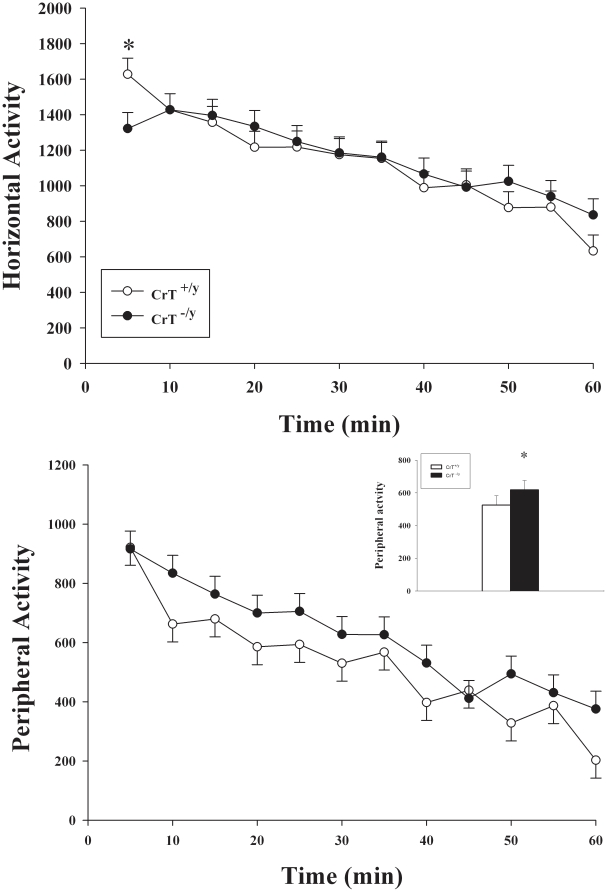
Figure 3. Initial hypoactivity and increased peripheral actvity in CrT−/y mice.
Locomotor activity was measured for 1 h in a novel environment. Top panel represents total activity; bottom panel is activity in the periphery of the locomotor chamber. The inset in the bottom panel represents the main effect of gene. Data are presented as LSMeans ± SEM. *P<0.05, n = 16/genotype.
Figure 4
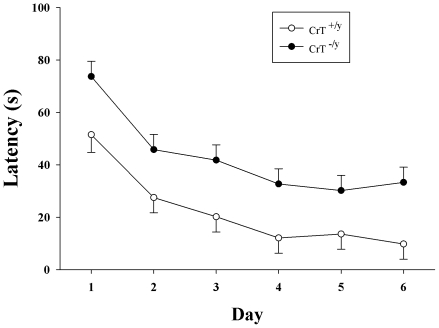
Figure 4. CrT−/y mice show deficits during the visible platform phase of the MWM.
The visible platform phase consisted of 6 trials on day 1 followed by 2 trials/day for 5 days. While the latencies were longer in CrT−/y mice for each day compared with CrT+/y mice the percent improvement across days was similar between the genotypes. Data are presented as LSMeans ± SEM. n = 16/genotype.
Figure 5
Figure 5. CrT−/y mice have spatial learning and memory deficits.
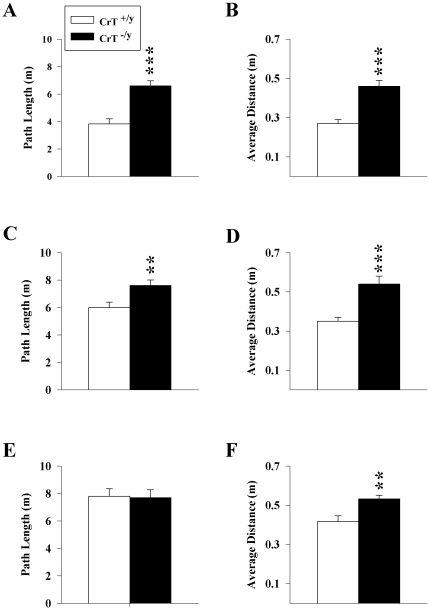
Path length for the (A) Acquisition, (C) Reversal, and (E) Shift phases of the MWM; each phase consisted of 4 (90 s) trials/day for 6 consecutive days. Probe trials of 30 s with the platform removed were conducted on the 7th day following the (B) Acquisition, (D) Reversal, and (F) Shift phases. Data are presented as LSMeans ± SEM. ***P<0.001, **P<0.01; n = 16/genotype.
Figure 6
Figure 6. CrT−/y mice show deficits in object recognition memory.
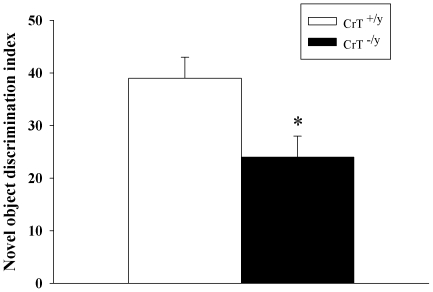
The novel object recognition test was conducted 1 h following familiarization. The novel object discrimination index was determined by subtracting the percent time with the familiar object from the percent time with the novel object. Data are Mean ± SEM. *P<0.05, n = 16/genotype.
Figure 7
Figure 7. Acoustic Startle with prepulse inhibition.
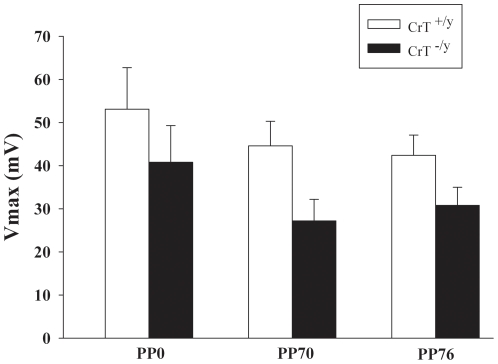
Startle response was measured following exposure to a 120 dB tone. For prepulse (PP) inhibition, tone was preceded by a softer tone of either 70 or 76 dB. As the size of the animal affects the ability to move the chamber, weight was used a covariate in the analysis of startle response. No differences were noted in startle response with weight as a covariate. Data are Mean ± SEM; n = 16/genotype.
Figure 8
Figure 8. Social preference test.
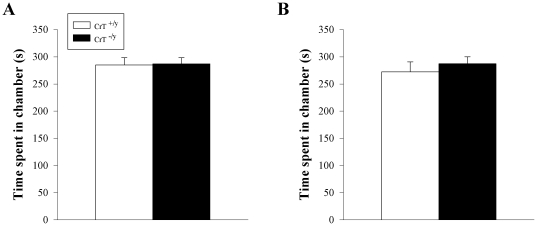
Mice were allowed to investigate a conspecific (A) inside a holding cage on one side of the apparatus versus an empty holding cage on the opposite side. Immediately afterward they were tested for social novelty (B) with a second conspecific placed in the holding cage on the opposite side from the original mouse. Mice were given 10 min to explore the arena during each test. Data are Mean ± SEM; n = 16/genotype.
Figure 9
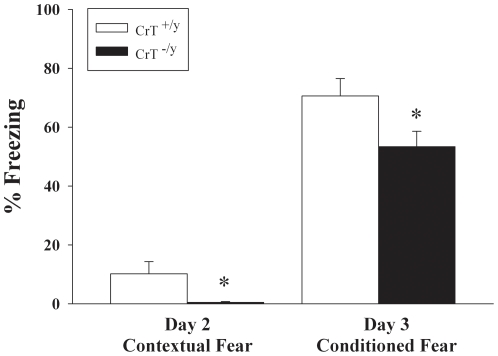
Figure 9. CrT−/y mice have reduced contextual and emotional memory compared with CrT+/y mice.
Mice were exposed to tone-shock pairings on day 1 of the conditioned fear test. On day 2 (contextual) they were tested for freezing in the same environment with no tone for 6 min. On the third day (conditioned), the floor was replaced with a novel floor. After 3 min of habituation, mice were exposed to the tone for 3 min and freezing measured. Data are presented as Mean ± SEM. *P<0.05; n = 11 CrT +/y mice, n = 13 CrT−/y mice.

References

    1. Wyss M, Kaddurah-Daouk R. Creatine and creatinine metabolism. Physiol Rev. 2000;80:1107–1213. - PubMed
    1. Gregor P, Nash SR, Caron MG, Seldin MF, Warren ST. Assignment of the creatine transporter gene (SLC6A8) to human chromosome Xq28 telomeric to G6PD. Genomics. 1995;25:332–333. - PubMed
    1. Cecil KM, Salomons GS, Ball WS, Jr, Wong B, Chuck G, et al. Irreversible brain creatine deficiency with elevated serum and urine creatine: a creatine transporter defect? Ann Neurol. 2001;49:401–404. - PubMed
    1. DeGrauw TJ, Salomons GS, Cecil KM, Chuck G, Newmeyer A, et al. Congenital creatine transporter deficiency. Neuropediatrics. 2002;33:232–238. - PubMed
    1. Anselm IA, Alkuraya FS, Salomons GS, Jakobs C, Fulton AB, et al. X-linked creatine transporter defect: a report on two unrelated boys with a severe clinical phenotype. J Inherit Metab Dis. 2006;29:214–219. - PMC - PubMed

Publication types