


Plant diversity surpasses plant functional groups and plant productivity as driver of soil biota in the long term
- PMID: 21249208
- PMCID: PMC3017561
- DOI: 10.1371/journal.pone.0016055
Plant diversity surpasses plant functional groups and plant productivity as driver of soil biota in the long term
Abstract
Background: One of the most significant consequences of contemporary global change is the rapid decline of biodiversity in many ecosystems. Knowledge of the consequences of biodiversity loss in terrestrial ecosystems is largely restricted to single ecosystem functions. Impacts of key plant functional groups on soil biota are considered to be more important than those of plant diversity; however, current knowledge mainly relies on short-term experiments.
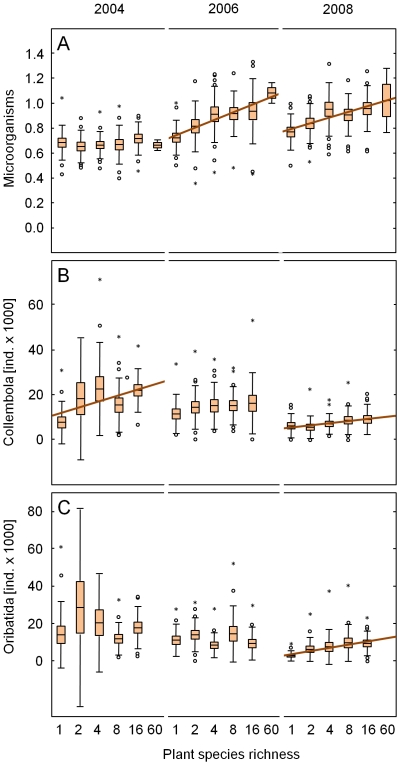
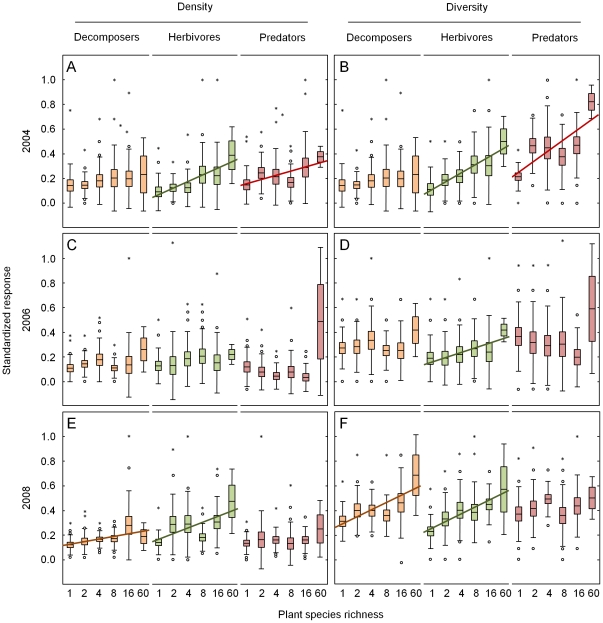
Methodology/principal findings: We studied changes in the impacts of plant diversity and presence of key functional groups on soil biota by investigating the performance of soil microorganisms and soil fauna two, four and six years after the establishment of model grasslands. The results indicate that temporal changes of plant community effects depend on the trophic affiliation of soil animals: plant diversity effects on decomposers only occurred after six years, changed little in herbivores, but occurred in predators after two years. The results suggest that plant diversity, in terms of species and functional group richness, is the most important plant community property affecting soil biota, exceeding the relevance of plant above- and belowground productivity and the presence of key plant functional groups, i.e. grasses and legumes, with the relevance of the latter decreasing in time.
Conclusions/significance: Plant diversity effects on biota are not only due to the presence of key plant functional groups or plant productivity highlighting the importance of diverse and high-quality plant derived resources, and supporting the validity of the singular hypothesis for soil biota. Our results demonstrate that in the long term plant diversity essentially drives the performance of soil biota questioning the paradigm that belowground communities are not affected by plant diversity and reinforcing the importance of biodiversity for ecosystem functioning.
Conflict of interest statement
Figures
References
-
- Karl TR, Trenberth KE. Modern global climate change. Science. 2003;302:1719–1723. - PubMed
-
- Clark CM, Tilman D. Loss of plant species after chronic low-level nitrogen deposition to prairie grasslands. Nature. 2008;451:712–715. - PubMed
-
- Vitousek PM, Mooney HA, Lubchenco J, Melillo JM. Human domination of earth's ecosystems. Science. 1997;277:494–499.
-
- Tilman D. Causes, consequences and ethics of biodiversity. Nature. 2000;405:208–211. - PubMed
-
- Loreau M, Naeem S, Inchausti P, Bengtsson J, Grime JP, et al. Biodiversity and ecosystem functioning: current knowledge and future challenges. Science. 2001;294:804–808. - PubMed
Publication types
MeSH terms
Substances
LinkOut - more resources
Full Text Sources
