


Interventions to modify sexual risk behaviours for preventing HIV in homeless youth
- PMID: 21249691
- PMCID: PMC3624078
- DOI: 10.1002/14651858.CD007501.pub2
Interventions to modify sexual risk behaviours for preventing HIV in homeless youth
Abstract
Background: Homeless youth are at high risk for HIV infection as a consequence of risky sexual behaviour. Interventions for homeless youth are challenging. Assessment of the effectiveness of interventions to modify sexual risk behaviours for preventing HIV in homeless youth is needed.
Objectives: To evaluate and summarize the effectiveness of interventions for modifying sexual risk behaviours and preventing transmission of HIV among homeless youth.
Search strategy: We searched electronic databases (CENTRAL, MEDLINE, EMBASE, AIDSearch, Gateway, PsycInfo, LILACS), reference lists of eligible articles, international health agency publication lists, and clinical trial registries. The search was updated January 2010. We contacted authors of published reports and other key role players.
Selection criteria: Randomised studies of interventions to modify sexual risk behaviour (biological, self-reporting of sexual-risk behaviour or health-seeking behaviour) in homeless youth (12-24 years).
Data collection and analysis: Data from eligible studies were extracted by two reviewers. We assessed risk of bias per the Cochrane Collaborations tool. None of the eligible studies reported any primary biological outcomes for this review. Reports of self-reporting sexual risk behaviour outcomes varied across studies precluding calculation of summary measures of effect; we present the outcomes descriptively for each study. We contacted authors for missing or ambiguous data.
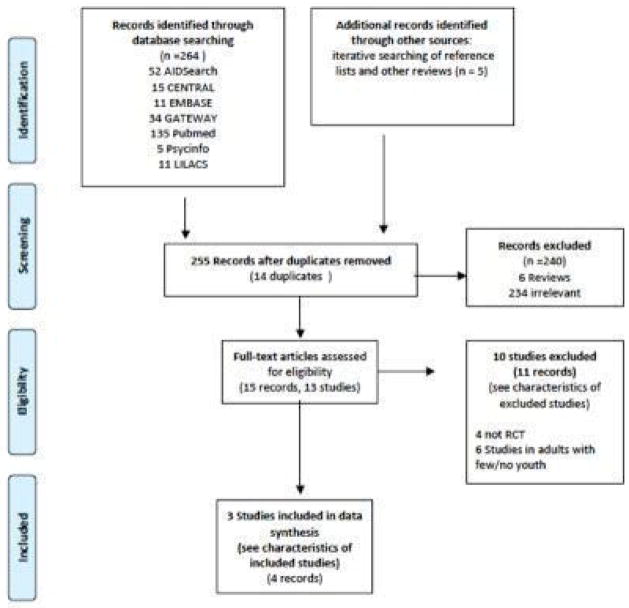
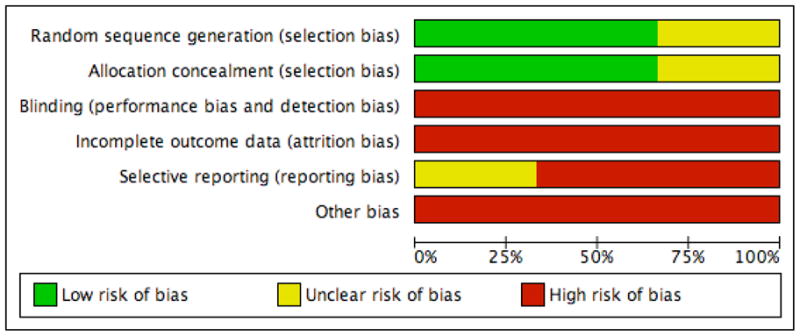
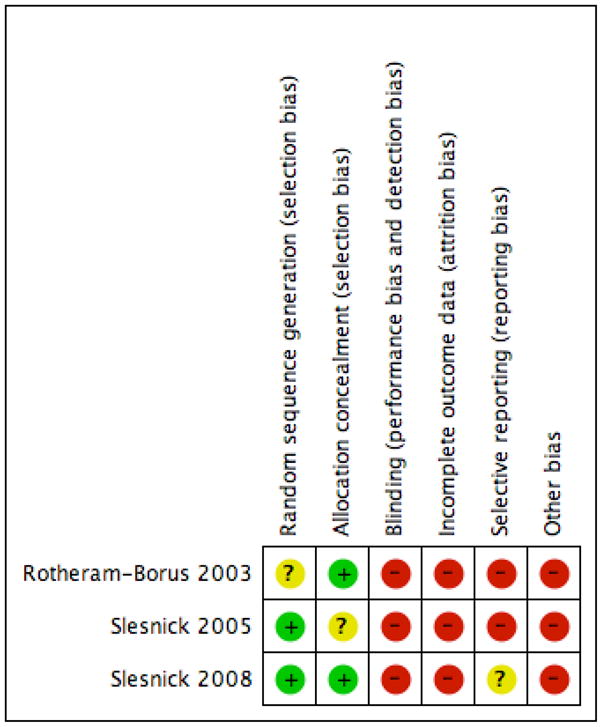
Main results: We identified three eligible studies after screening a total of 255 unique records. All three were performed in the United States of America and recruited substance-abusing male and female adolescents (total N=615) through homeless shelters into randomised controlled trials of independent and non-overlapping behavioural interventions. The three trials differed in theoretical background, delivery method, dosage (number of sessions,) content and outcome assessments. Overall, the variability in delivery and outcomes precluded estimation of summary of effect measures. We assessed the risk of bias to be high for each of the studies. Whilst some effect of the interventions on outcome measures were reported, heterogeneity and lack of robustness in these studies necessitate caution in interpreting the effectiveness of these interventions.
Authors' conclusions: The body of evidence does not permit conclusions on the impact of interventions to modify sexual risk behaviour in homeless youth; more research is required. While the psychosocial and contextual factors that fuel sexual risk behaviours among homeless youth challenge stringent methodologies of RCT's, novel ways for program delivery and trial retention are in need of development. Future trials should comply with rigorous methodology in design, delivery, outcome measurement and reporting.
Conflict of interest statement
None.
Figures
References
References to studies
Included studies
-
- Rotheram-Borus MJ, Song J, Gwadz M, Lee M, Van Rossem R, Koopman C. Reduction in HIV risk among runaway youth. Prevention science. 2003;4(3):173–87. - PubMed
-
- Slesnick N, Kang M. HIV risk reduction among substance-abusing. Proceedings of the 69th Annual Scientific Meeting of the College on Problems of Durg Dependence; June 16–21 2007; Quebec City, Canada.
- Slesnick N, Kang MJ. The impact of an integrated treatment on HIV risk behavior among homeless youth: a randomized controlled trial. Journal of behavioural medicine. 2008 Feb;31(1):45–59. doi: 10.1007/s10865-007-9132-5. - DOI - PMC - PubMed
Excluded studies
-
- Arnold EM, Walsh AK, Oldham MS, Rapp CA. strengths-based case management: implementation with high-risk youth. Families in society: the journal of contemporary social services. 2007;88(1):86–94.
-
- Booth RE, Zhang Y, Kwiatkwski CF. the challenge of changing drug and sex risk behaviors of runaway and homeless adolescents. Child abuse and neglect. 1999;23(12):1295–306. - PubMed
-
- Clements KD, Gleghorn AA, Garcia D, Sabin M, Katz M. Can street outreach effectively reach a mobile population of homeless youth?. Proceedings of International Conference on AIDS; 1996. p. 51.
- Gleghorn AA, Clements KD, Marx R, Vittinghoff E, Leee-Chu P, Katz M. The impact of intensive outreach on HIV prevention activities of homeless, runaway and street youth in San Francisco: the AIDS evaluation of street outreach project (AESOP) IDS and behaviour. 1997;1(4):261–71.
-
- Jemmott JB, Jemmott LS, Braverman PK, Fong GT. HIV/STD reduction interventions for african american and latino adolescent girls at an adolescent medicine clinic: a randomized controlled trial. Archives of pediatrics and adolescent medicine. 2005;159(4):440–9. - PubMed
-
- Kidder DP, Wolitski RJ, Royal S, Aidala A, Courtenay-Quirk C, Holtgrave DR. Access to housing as a structural intervention for homeless and unstably housed people living with HIV: rationale, methods, and implementation of the housing and health study. IDS and Behavior. 2007;11(Suppl 2):S149–161. - PubMed
Studies awaiting classification
Ongoing studies
-
- Nyamathi A and colleagues. University of California Los Angeles. An Arts Intervention for Drug-Using Homeless Youth. www.clinicaltrials.gov.
-
- Nyamathi A and colleagues, University of California, Los Angeles. Hepatitis B Virus (HBV) Prevention for Homeless at Risk for HBV/Hepatitis C Virus (HCV)/HIV. www.clinicaltrials.gov.
-
- Milburn N and colleagues. Support To Reunite Involve and Value Each Other (STRIVE) University of California, Los Angeles, Center for Community Health; www.clinicaltrials.gov.
Other references
Additional references
-
- Anarfi JK. Vulnerability to sexually transmitted disease: street children in Accra. Health Transition Review. 1997;7(Suppl):281–306. - PubMed
-
- Bailey RC, Moses S, Parker CB, Agot K, Maclean I, Krieger JN, Williams CF, Campbell RT, Ndinya-Achola JO. Male circumcision for HIV prevention in young men in Kisumu, Kenya: a randomised controlled trial. Lancet. 2007 Feb 24;369(9562):643–56. - PubMed
Publication types
MeSH terms
Grants and funding
LinkOut - more resources
Full Text Sources
Medical
