


Alkaline phosphatase normalization is associated with better prognosis in primary sclerosing cholangitis
- PMID: 21251891
- PMCID: PMC3057302
- DOI: 10.1016/j.dld.2010.12.008
Alkaline phosphatase normalization is associated with better prognosis in primary sclerosing cholangitis
Abstract
Background: Primary sclerosing cholangitis results in elevated but fluctuating serum alkaline phosphatase levels that occasionally return to normal.
Aims: To investigate the frequency of normalization of alkaline phosphatase in newly diagnosed primary sclerosing cholangitis patients and the subsequent clinical outcomes.
Methods: Records of newly diagnosed primary sclerosing cholangitis patients were examined retrospectively for laboratory values and clinical end points (cholangiocarcinoma, liver transplantation and death) within 10 years of diagnosis. Data from a recent prospective ursodeoxycholic acid treatment trial were also studied.
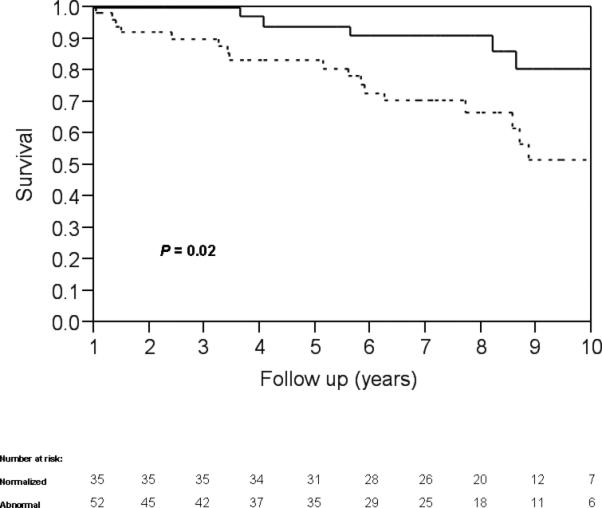
Results: Eighty-seven patients met the inclusion criteria. Normalization of alkaline phosphatase was seen in 35 (40%) patients. Five (14%) patients with normalization reached an end point whereas 17 (33%) of the patients with persistent elevation reached an end point (P = 0.02). Ursodeoxycholic acid was used similarly by both groups. When the investigative criteria were applied to a prospective trial, there was again a significant relationship between normalization of alkaline phosphatase and survival in patients receiving ursodeoxycholic acid (P < 0.01) and the placebo group (P = 0.02).
Conclusions: Serum alkaline phosphatase was found to normalize in a high proportion of newly diagnosed primary sclerosing cholangitis patients. This was significantly associated with a better prognosis in a retrospective cohort and when data from a prospective treatment trial was evaluated.
Copyright © 2010 Editrice Gastroenterologica Italiana S.r.l. Published by Elsevier Ltd. All rights reserved.
Figures
Comment in
-
Primary sclerosing cholangitis is changing clinical spectrum and old biomarkers disclose an innovative role: the case of alkaline phosphatase.Dig Liver Dis. 2011 Apr;43(4):268-9. doi: 10.1016/j.dld.2011.02.006. Epub 2011 Feb 22. Dig Liver Dis. 2011. PMID: 21345755 No abstract available.
References
-
- Bambha K, Kim WR, Talwalkar J, et al. Incidence, clinical spectrum, and outcomes of primary sclerosing cholangitis in a United States community. Gastroenterology. 2003 Nov;125(5):1364–1169. - PubMed
-
- Graziadei IW, Wiesner RH, Marotta PJ, et al. Long-term results of patients undergoing liver transplantation for primary sclerosing cholangitis. Hepatology. 1999;30:1121–1127. - PubMed
-
- Kim WR, Therneau TM, Wiesner RH, et al. A revised natural history model for primary sclerosing cholangitis. Mayo Clinic Proceedings. 2000;75:688–694. - PubMed
-
- Poupon RE, Bonnand AM, Chrétien Y, et al. Ten-year survival in ursodeoxycholic acid-treated patients with primary biliary cirrhosis. The UDCA-PBC Study Group. Hepatology. 1999 Jun;29(6):1668–1671. - PubMed
Publication types
MeSH terms
Substances
Grants and funding
LinkOut - more resources
Full Text Sources
Other Literature Sources
Miscellaneous
