. 2011 Apr;24(4):489-95.
doi: 10.1038/ajh.2010.262. Epub 2011 Jan 20.

First trimester uric acid and adverse pregnancy outcomes

Affiliations

First trimester uric acid and adverse pregnancy outcomes

S Katherine Laughon et al. Am J Hypertens. 2011 Apr.

Abstract

Background: The association of elevated serum uric acid with the development of hypertension is established outside of pregnancy. We investigated whether first trimester uric acid was associated with the development of the following: gestational hypertension or pre eclampsia, these outcomes stratified by presence of hyperuricemia at delivery since this denotes more severe disease, preterm birth, or small for gestational age (SGA).

Methods: Uric acid was measured in 1,541 banked maternal plasma samples from a prior prospective cohort study that were collected at a mean gestational age of 9.0 (± 2.5) weeks. Polytomous regressions were performed and adjusted for parity and prepregnancy body mass index (BMI).

Results: First trimester uric acid in the highest quartile (>3.56 mg/dl) compared to lowest three quartiles was associated with an increased risk of developing pre-eclampsia (adjusted odds ratio (OR) = 1.82; 95% confidence interval (CI), 1.03-3.21) but not gestational hypertension. In women with hypertensive disease complicated by hyperuricemia at delivery, high first trimester uric acid was associated with a 3.22-fold increased risk of hyperuricemic gestational hypertension (HU) and a 3.65-fold increased risk of hyperuricemic pre-eclampsia (HPU). High first trimester uric acid was not associated with gestational hypertension or pre-eclampsia without hyperuricemia (H or HP) at delivery, preterm birth, or SGA. In women who developed hypertensive disease, elevated uric acid at delivery was only partly explained by elevated uric acid in the first trimester (r(2) = 0.23).

Conclusions: First trimester elevated uric acid was associated with later pre-eclampsia and more strongly with pre-eclampsia and gestational hypertension with hyperuricemia.


Conflict of interest statement

Conflict of interest statement: We have no conflicts of interest to disclose.

Figures

Figure 1
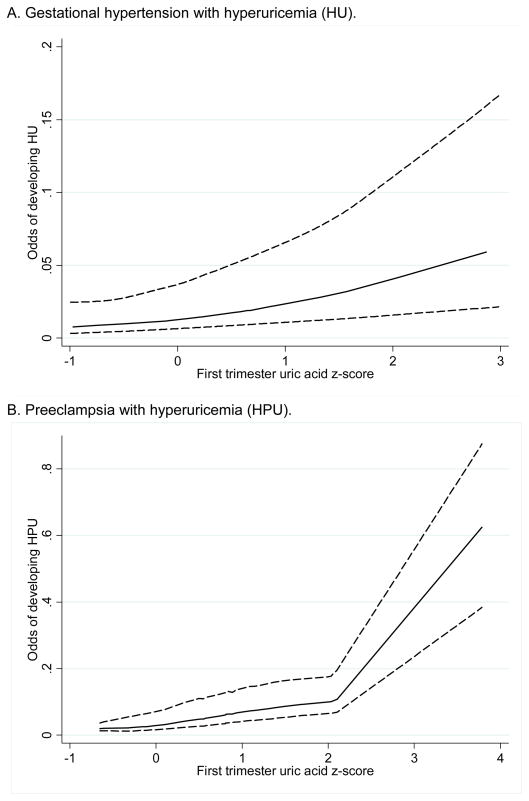
Figure 1. First trimester uric acid z score and the odds of developing A. hyperuricemic gestational hypertension, or B. hyperuricemic preeclampsia
Uric acid and neonatal outcomes. Association between first trimester uric acid z score and the odds of developing A. hyperuricemic gestational hypertension (HU); or B. hyperuricemic preeclampsia (HPU) compared to remaining normotensive, adjusted for parity and pregestational body mass index. Of note the estimates were imprecise beyond a z score of 2 in figure 2b. because there was only one data point. The solid lines indicate point estimates; the upper and lower dashed lines indicate 95% confidence bands by nonparametric smoothing with locally weighted regression (lowess).
Figure 2
Figure 2
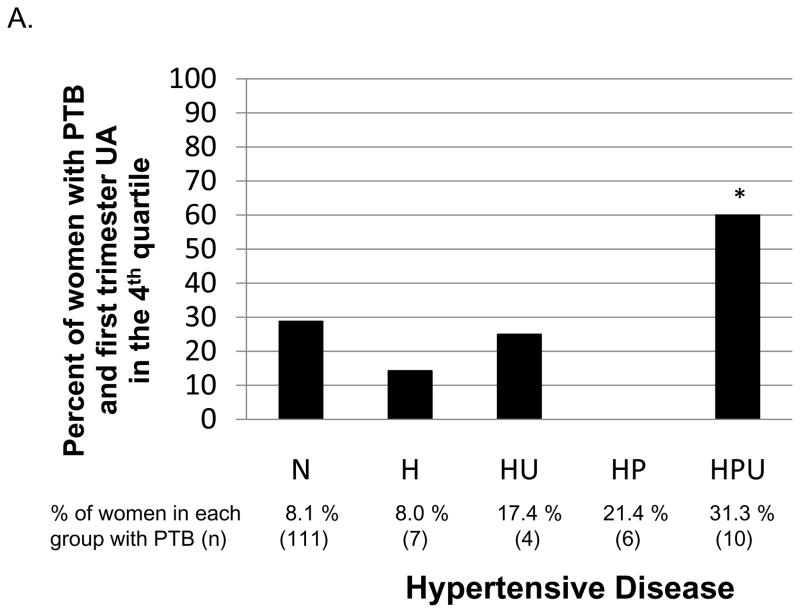
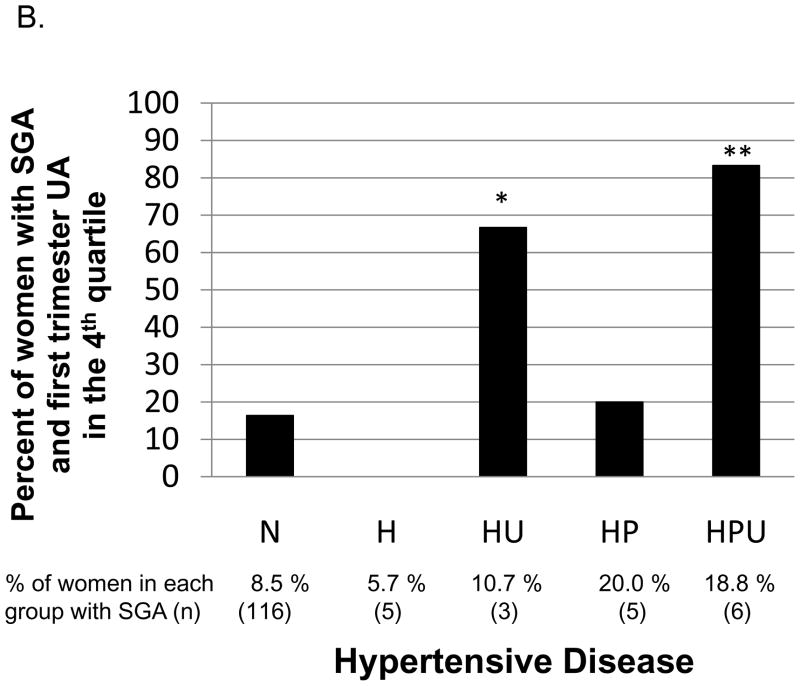
Figure 2A. For women who had a preterm birth, percent with first trimester uric acid concentration in the fourth quartile. The reference category is for women who remained normotensive (N). In women who developed hypertensive disease (H=gestational hypertension, HU= hyperuricemic gestational hypertension, HP= preeclampsia, or HPU= hyperuricemic preeclampsia), only women who developed HPU had a significantly higher proportion of first trimester uric acid concentration in the fourth quartile (P = .04)*. B. For women who had a small for gestational age infant, percent with first trimester uric acid concentration in the fourth quartile. The reference category is for women who remained normotensive (N). In women who developed hypertensive disease (H, HU, HP or HPU), only women who developed HU or HPU had a significantly higher proportion of first trimester uric acid concentration in the fourth quartile (P = .02*and P = .001**, respectively).
Figure 2
Figure 2
Figure 2A. For women who had a preterm birth, percent with first trimester uric acid concentration in the fourth quartile. The reference category is for women who remained normotensive (N). In women who developed hypertensive disease (H=gestational hypertension, HU= hyperuricemic gestational hypertension, HP= preeclampsia, or HPU= hyperuricemic preeclampsia), only women who developed HPU had a significantly higher proportion of first trimester uric acid concentration in the fourth quartile (P = .04)*. B. For women who had a small for gestational age infant, percent with first trimester uric acid concentration in the fourth quartile. The reference category is for women who remained normotensive (N). In women who developed hypertensive disease (H, HU, HP or HPU), only women who developed HU or HPU had a significantly higher proportion of first trimester uric acid concentration in the fourth quartile (P = .02*and P = .001**, respectively).
Figure 3
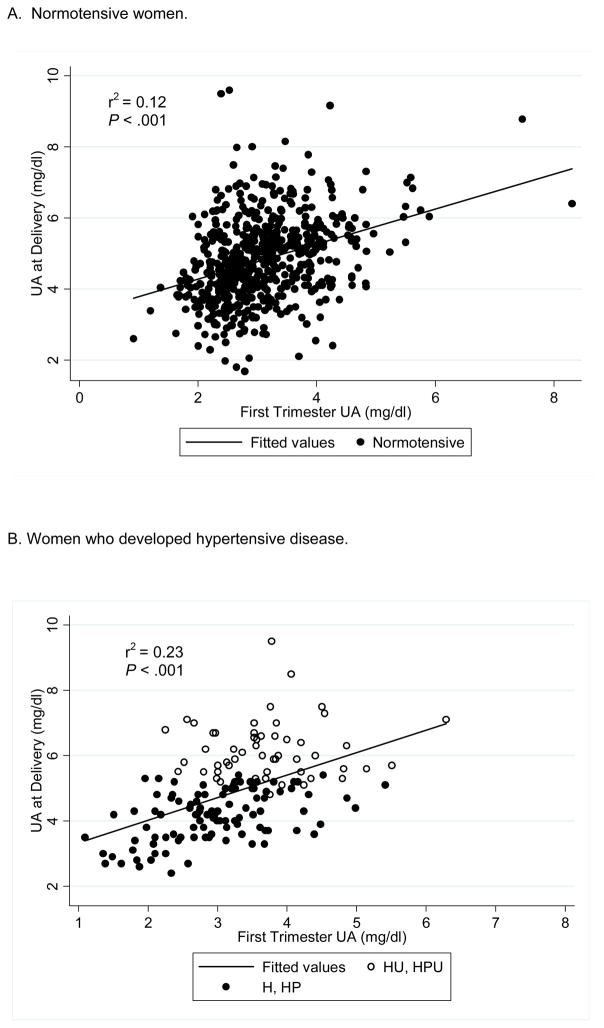
Figure 3. Uric acid in the first trimester compared to uric acid at delivery in women who A. remained normotensive, or B. developed hypertensive disease
Figure 3A. In women who remained normotensive, 12% of the variance of uric acid at delivery was explained by uric acid in the first trimester; B. In women who developed hypertensive disease (H=gestational hypertension, HP= preeclampsia, HU= hyperuricemic gestational hypertension, and HPU= hyperuricemic preeclampsia), 23% of the variance of uric acid at delivery was explained by uric acid in the first trimester. The closed circles represent women who developed H or HP and the open circles represent women who developed HU or HPU.

References

    1. Feig DI, Kang DH, Johnson RJ. Uric acid and cardiovascular risk. The New England journal of medicine. 2008;359(17):1811–21. - PMC - PubMed
    1. Sibai BM, Gordon T, Thom E, Caritis SN, Klebanoff M, McNellis D, Paul RH. Risk factors for preeclampsia in healthy nulliparous women: a prospective multicenter study. The National Institute of Child Health and Human Development Network of Maternal-Fetal Medicine Units. American journal of obstetrics and gynecology. 1995;172(2 Pt 1):642–8. - PubMed
    1. Johnson RJ, Segal MS, Srinivas T, Ejaz A, Mu W, Roncal C, Sanchez-Lozada LG, Gersch M, Rodriguez-Iturbe B, Kang DH, Acosta JH. Essential hypertension, progressive renal disease, and uric acid: a pathogenetic link? J Am Soc Nephrol. 2005;16(7):1909–19. - PubMed
    1. Powers RW, Bodnar LM, Ness RB, Cooper KM, Gallaher MJ, Frank MP, Daftary AR, Roberts JM. Uric acid concentrations in early pregnancy among preeclamptic women with gestational hyperuricemia at delivery. American journal of obstetrics and gynecology. 2006;194(1):160. - PubMed
    1. Bainbridge SA, Roberts JM. Uric acid as a pathogenic factor in preeclampsia. Placenta. 2008;29 (Suppl A):S67–72. - PMC - PubMed

Publication types