Review
. 2011 Feb;12(2):113-22.
doi: 10.1038/embor.2010.216. Epub 2011 Jan 21.

Tracking adult stem cells

Affiliations
Review

Tracking adult stem cells

Hugo J Snippert et al. EMBO Rep. 2011 Feb.

Abstract

The maintenance of stem-cell-driven tissue homeostasis requires a balance between the generation and loss of cell mass. Adult stem cells have a close relationship with the surrounding tissue--known as their niche--and thus, stem-cell studies should preferably be performed in a physiological context, rather than outside their natural environment. The mouse is an attractive model in which to study adult mammalian stem cells, as numerous experimental systems and genetic tools are available. In this review, we describe strategies commonly used to identify and functionally characterize adult stem cells in mice and discuss their potential, limitations and interpretations, as well as how they have informed our understanding of adult stem-cell biology. An accurate interpretation of physiologically relevant stem-cell assays is crucial to identify adult stem cells and elucidate how they self-renew and give rise to differentiated progeny.


Conflict of interest statement

The authors declare that they have no conflict of interest.

Figures
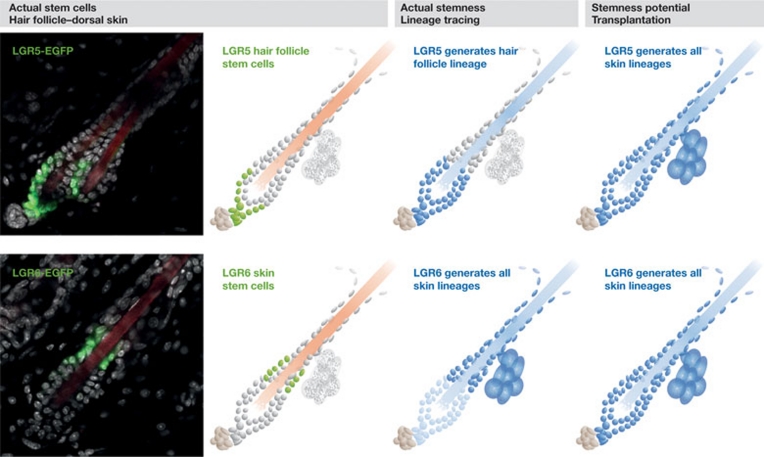
Figure 1
Figure 1
Actual stemness compared with stemness potential in the skin. LGR5 and LGR6 indicate different stem-cell populations along hair follicles. Stem cells (green), nuclei (grey) and hair follicles (red) are shown in confocal pictures (left) and in the cartoon panels (second from the left). Lineage tracing reveals the actual stemness of a population. LGR5 stem cells generate progeny that repopulate the hair follicle (blue), whereas LGR6 stem cells predominantly generate progeny for sebaceous gland and IFE (blue) and, to a lesser extent, hair follicle (light blue). Transplantation of both stem-cell populations reveals equal stemness potential towards all lineages (blue). EGFP, enhanced green fluorescent protein; IFE, interfollicular epidermis.
Figure 2
Figure 2
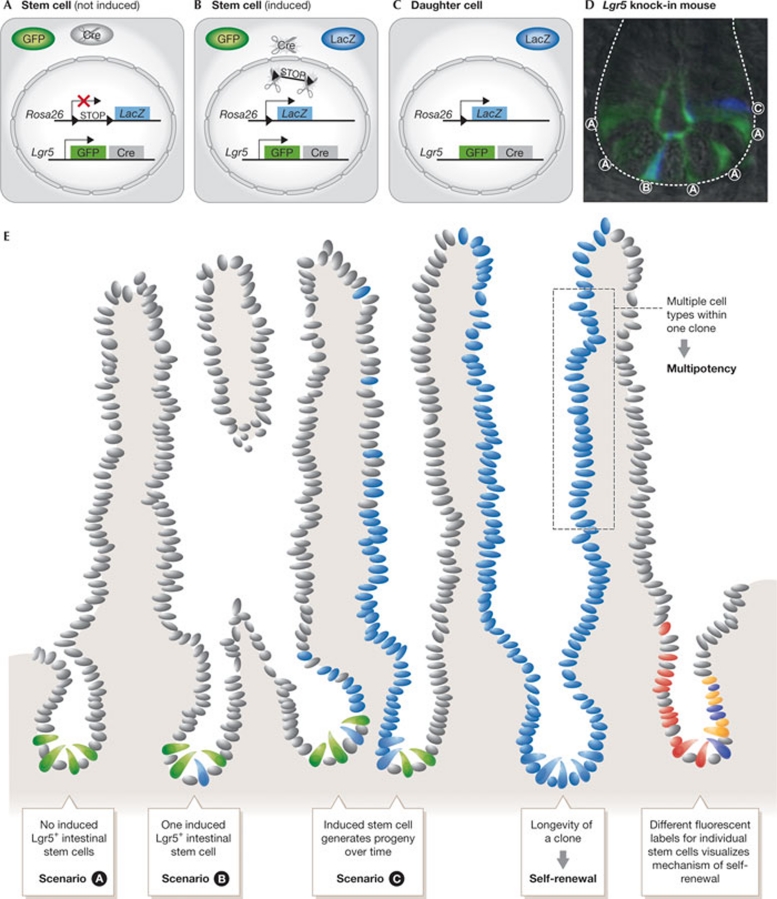
In vivo lineage tracing in the small intestine. (A) Stem cells exclusively express GFP and the inactive version of Cre. (B) On activation of Cre, LacZ can be transcribed. (C) After cells differentiate, the GFP and inducible Cre are no longer produced. LacZ expression will be maintained. (D) In vivo small intestinal crypt of Lgr5-EGFP-Ires-CreERT2 mouse with all of the above scenarios. (E) Cartoon of small intestine in which lineage tracings (blue) are visualized at different stages originating from LGR5+ISCs (green; Barker et al, 2007). Over time, true stem cells generate clones that are long-lived (self-renewal) and contain different cell types (multipotency). The crypt to the right shows lineage tracing with R26R-Confetti in which stem cells, and subsequently their progeny, are marked with different colours (Snippert et al, 2010b). EGFP, enhanced green fluorescent protein; GFP, green fluorescent protein; ISC, intestinal stem cell; LGR5, leucine-rich repeat-containing G protein coupled receptor 5.

References

    1. Ahn S, Joyner AL (2005) In vivo analysis of quiescent adult neural stem cells responding to Sonic hedgehog. Nature 437: 894–897 - PubMed
    1. Arai F, Suda T (2007) Maintenance of quiescent hematopoietic stem cells in the osteoblastic niche. Ann NY Acad Sci 1106: 41–53 - PubMed
    1. Bai L, Rohrschneider LR (2010) s-SHIP promoter expression marks activated stem cells in developing mouse mammary tissue. Genes Dev 24: 1882–1892 - PMC - PubMed
    1. Barker N et al. (2007) Identification of stem cells in small intestine and colon by marker gene Lgr5. Nature 449: 1003–1007 - PubMed
    1. Barker N et al. (2010) Lgr5(+ve) stem cells drive self-renewal in the stomach and build long-lived gastric units in vitro. Cell Stem Cell 6: 25–36 - PubMed