


The role of changes in activity as a function of perceived available and expended energy in nonpharmacological treatment outcomes for ME/CFS
- PMID: 21254053
- PMCID: PMC3164291
- DOI: 10.1002/jclp.20744
The role of changes in activity as a function of perceived available and expended energy in nonpharmacological treatment outcomes for ME/CFS
Abstract
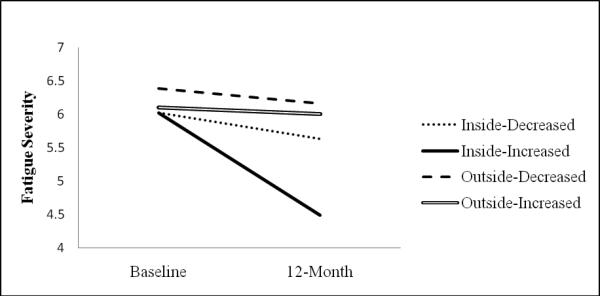
Nonpharmacological interventions for myalgic encephalomyelitis/chronic fatigue syndrome (ME/CFS) often emphasize gradual increases in activity to promote improvement in physical functioning and fatigue. The energy envelope theory may provide a framework for understanding the relationship between changes in activity level and outcomes for patients with ME/CFS. This study examined the relationship between energy envelope and changes in activity after nonpharmacological interventions in a sample of 44 adults with ME/CFS. Results showed that those who were within their energy envelope before treatment showed more improvement in physical functioning and fatigue compared with those outside of their energy envelope. These findings suggest that an assessment of perceived available and expended energy could help guide the development of individualized nonpharmacological interventions for people with ME/CFS.
© 2010 Wiley Periodicals, Inc.
Figures
References
-
- Edmonds M, McGuire H, Price J. The Cochrane Library. John Wiley & Sons, Ltd.; Chichester, UK: 2004. Exercise therapy for chronic fatigue syndrome (Cochrane Review). - PubMed
-
- Friedberg F, Sohl S. Cognitive-Behavior Therapy in Chronic Fatigue Syndrome: Is Improvement Related to Increased Physical Activity? Journal of Clinical Psychology. 2009;65:423–442. doi: 10.1002/jclp.20551. - PubMed
-
- Hawk C, Jason LA, Torres-Harding S. Reliability of a chronic fatigue syndrome questionnaire. Journal of Chronic Fatigue Syndrome. 2007;13:41–66. doi: 10.1300/J092v13n04_05.
Publication types
MeSH terms
Grants and funding
LinkOut - more resources
Full Text Sources
Medical
