


Absence of preference for social novelty and increased grooming in integrin β3 knockout mice: initial studies and future directions
- PMID: 21254450
- PMCID: PMC3073711
- DOI: 10.1002/aur.180
Absence of preference for social novelty and increased grooming in integrin β3 knockout mice: initial studies and future directions
Abstract
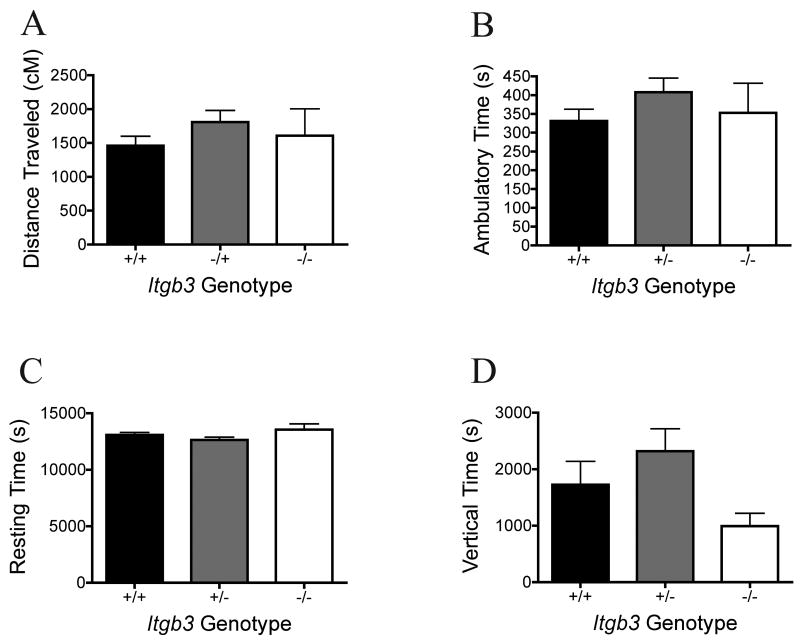
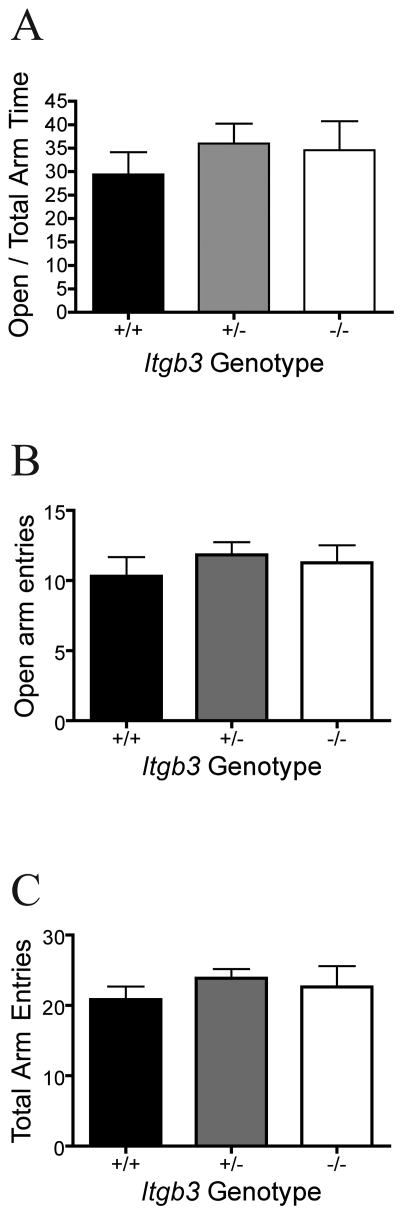
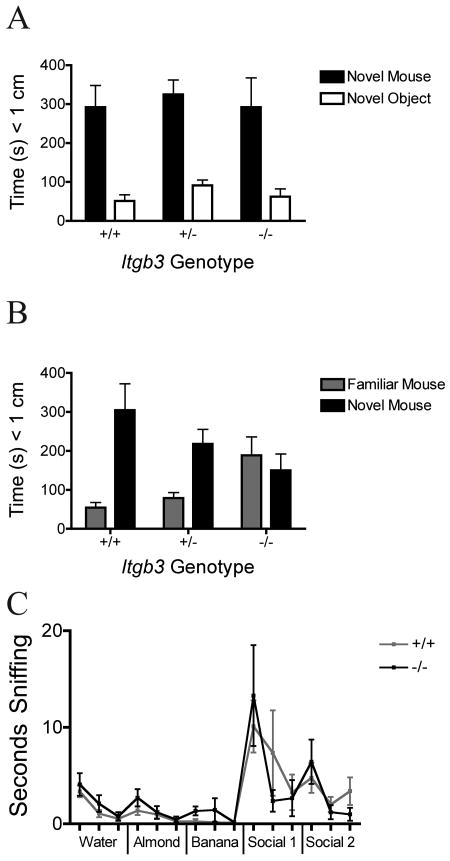
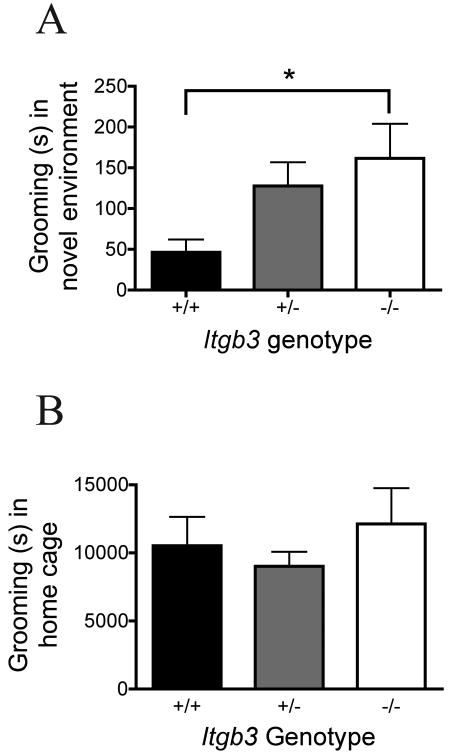
Elevated whole blood serotonin 5-HT, or hyperserotonemia, is a common biomarker in autism spectrum disorder (ASD). The integrin β3 receptor subunit gene (ITGB3) is a quantitative trait locus for whole blood 5-HT levels. Recent work shows that integrin β3 interacts with the serotonin transporter (SERT) in both platelets and in the midbrain. Furthermore, multiple studies have now reported gene-gene interaction between the integrin β3 and SERT genes in association with ASD. Given the lack of previous data on the impact of integrin β3 on brain or behavioral phenotypes, we sought to compare mice with decreased or absent expression of the integrin β3 receptor subunit (Itgb3 +/- and -/-) with wildtype littermate controls in behavioral tasks relevant to ASD. These mice did not show deficits in activity level in the open field or anxiety-like behavior on the elevated plus maze, two potential confounds in the evaluation of mouse social behavior. In the three-chamber social test, mice lacking integrin β3 were shown to have normal sociability but did not show a preference for social novelty. Importantly, the absence of integrin β3 did not impair olfaction or the ability to recall familiar social odors. Additionally, mice lacking integrin β3 showed increased grooming behavior in novel environments. These preliminary studies reveal altered social and repetitive behavior in these mice, which suggests that the integrin β3 subunit may be involved in brain systems relevant to ASD. Further work is needed to fully characterize these behavioral changes and the underlying brain mechanisms.
Copyright © 2011, International Society for Autism Research, Wiley Periodicals, Inc.
Figures
Comment in
-
Commentary for special issue of Autism research on mouse models in ASD: a clinical perspective.Autism Res. 2011 Feb;4(1):1-4. doi: 10.1002/aur.185. Autism Res. 2011. PMID: 21328567 No abstract available.
References
-
- Abramoff MD, Magalhaes PJ, Ram SJ. Image Processing with ImageJ. Biophotonics International. 2004;11:36–42.
-
- Abramson RK, Wright HH, Carpenter R, Brennan W, Lumpuy O, Cole E, et al. Elevated blood serotonin in autistic probands and their first-degree relatives. Journal of Autism and Developmental Disorders. 1989;19:397–407. - PubMed
-
- American Psychiatric Association . Diagnostic and Statistical Manual of Mental Disorders-Text Revision (DSM-IV-TR) 4th. Washington, D.C.: American Psychiatric Association Press Inc.; 2000.
Publication types
MeSH terms
Substances
Grants and funding
LinkOut - more resources
Full Text Sources
Molecular Biology Databases
