


Culex flavivirus and West Nile virus mosquito coinfection and positive ecological association in Chicago, United States
- PMID: 21254845
- PMCID: PMC3151626
- DOI: 10.1089/vbz.2010.0144
Culex flavivirus and West Nile virus mosquito coinfection and positive ecological association in Chicago, United States
Abstract
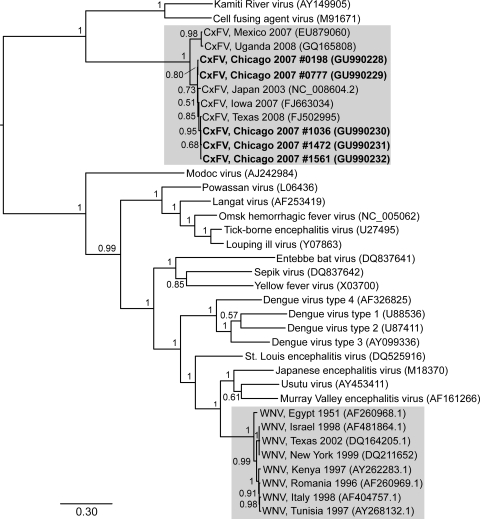
Culex flavivirus (CxFV) is an insect-specific flavivirus globally distributed in mosquitoes of the genus Culex. CxFV was positively associated with West Nile virus (WNV) infection in a case-control study of 268 mosquito pools from an endemic focus of WNV transmission in Chicago, United States. Specifically, WNV-positive Culex mosquito pools were four times more likely also to be infected with CxFV than were spatiotemporally matched WNV-negative pools. In addition, mosquito pools from residential sites characterized by dense housing and impermeable surfaces were more likely to be infected with CxFV than were pools from nearby urban green spaces. Further, 6/15 (40%) WNV-positive individual mosquitoes were also CxFV positive, demonstrating that both viruses can coinfect mosquitoes in nature. Phylogenetic analysis of CxFV from Chicago demonstrated a pattern similar to WNV, consisting of low global viral diversity and lack of geographic clustering. These results illustrate a positive ecological association between CxFV and WNV, and that coinfection of individual mosquitoes can occur naturally in areas of high flaviviral transmission. These conclusions represent a challenge to the hypothesis of super-infection exclusion in the CxFV/WNV system, whereby an established infection with one virus may interfere with secondary viral infection with a similar virus. This study suggests that infection with insect-specific flaviviruses such as CxFV may not exclude secondary infection with genetically distinct flaviviruses such as WNV, and that both viruses can naturally coinfect mosquitoes that are epidemic bridge vectors of WNV to humans.
Figures
References
-
- Andreadis TG. Thomas MC. Shepard JJ. Identification Guide to the Mosquitoes of Connecticut. New Haven, CT: The Connecticut Agricultural Experiment Station; 2005.
-
- Bertolotti L. Kitron UD. Walker ED. Ruiz MO, et al. Fine-scale genetic variation and evolution of West Nile Virus in a transmission “hot spot” in suburban Chicago, USA. Virology. 2008;374:381–389. - PubMed
-
- Biggerstaff BJ. Pooled Infection Rate, Version 3.0. Ft. Collins, CO: Center for Disease Control and Prevention; 2006.
Publication types
MeSH terms
Substances
Grants and funding
LinkOut - more resources
Full Text Sources
Medical
