Review
. 2011 Mar;7(3):267-86.
doi: 10.1517/17425255.2011.553189. Epub 2011 Jan 22.

The effect of grapefruit juice on drug disposition

Affiliations
Review

The effect of grapefruit juice on drug disposition

Michael J Hanley et al. Expert Opin Drug Metab Toxicol. 2011 Mar.

Abstract

Introduction: Since their initial discovery in 1989, grapefruit juice (GFJ)-drug interactions have received extensive interest from the scientific, medical, regulatory and lay communities. Although knowledge regarding the effects of GFJ on drug disposition continues to expand, the list of drugs studied in the clinical setting remains relatively limited.

Areas covered: This article reviews the in vitro effects of GFJ and its constituents on the activity of CYP enzymes, organic anion-transporting polypeptides (OATPs), P-glycoprotein, esterases and sulfotransferases. The translational applicability of the in vitro findings to the clinical setting is discussed for each drug metabolizing enzyme and transporter. Reported AUC ratios for available GFJ-drug interaction studies are also provided. Relevant investigations were identified by searching the PubMed electronic database from 1989 to 2010.

Expert opinion: GFJ increases the bioavailability of some orally administered drugs that are metabolized by CYP3A and normally undergo extensive presystemic extraction. In addition, GFJ can decrease the oral absorption of a few drugs that rely on OATPs in the gastrointestinal tract for their uptake. The number of drugs shown to interact with GFJ in vitro is far greater than the number of clinically relevant GFJ-drug interactions. For the majority of patients, complete avoidance of GFJ is unwarranted.


Figures
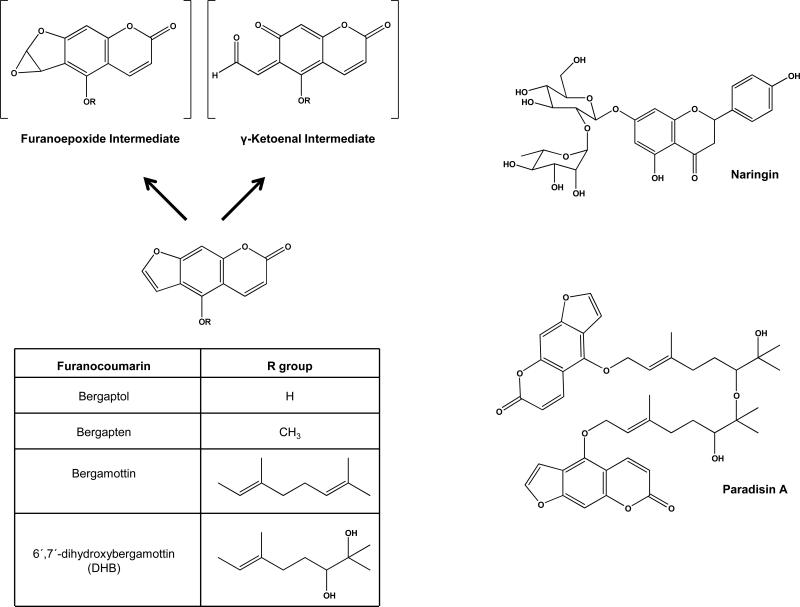
Figure 1
Figure 1
Structures of GFJ constituents implicated in clinical drug interactions. Left panel: The furanocoumarins are potent, mechanism-based, inhibitors of CYP3A. Mechanism-based inhibition of CYP3A is thought to result after binding of CYP protein to either a furanoepoxide or γ-ketoenal intermediate. Right panel: Naringin is the most abundant flavonoid in GFJ and inhibits OATP transport in vivo. Paradisin A is a representative member of a class of dimeric compounds present in GFJ formed by linkage of 6′,7′-dihydroxybergamottin to itself, or to bergamottin.
Figure 2
Figure 2
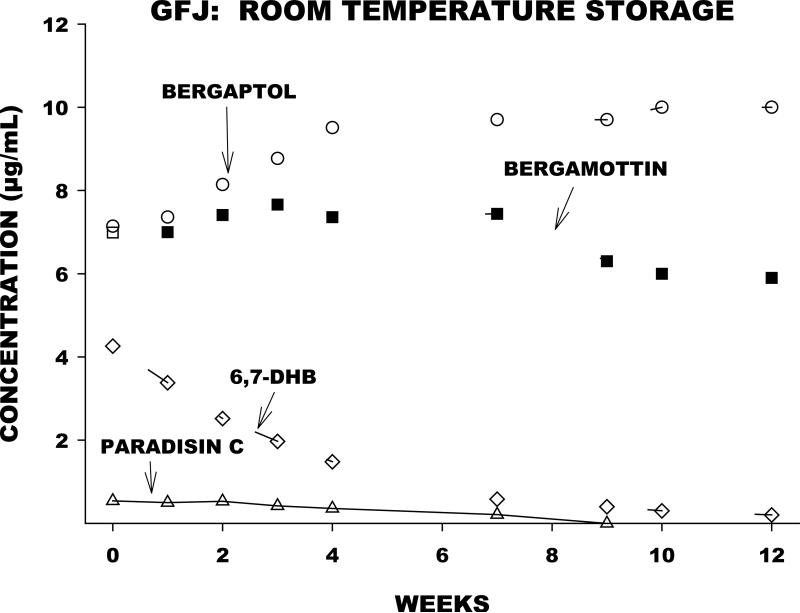
Time-dependent changes in concentrations of bergaptol, bergamottin, DHB, and paradisin C in aliquots of a GFJ sample stored at room temperature for one year.
Figure 3
Figure 3
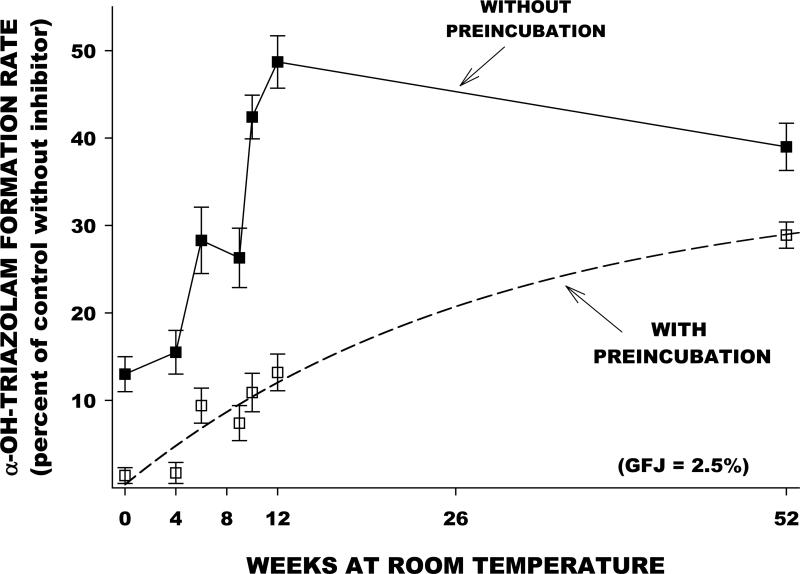
In the same GFJ sample described in Figure 2, time-dependent changes in the capacity of the aliquots to inhibit CYP3A activity – represented as triazolam hydroxylation activity – by human liver microsomes in vitro. Lower values on the y-axis indicate greater inhibitory capacity. Each point is the mean ± SE from four different human liver samples. At all time points, the irreversible component of CYP3A inhibition (indicated by the values obtained following preincubation of GFJ with microsomes prior to addition of substrate) exceeds the reversible component. Note that the irreversible component of inhibition – thought to be responsible for clinical drug interactions – decreases substantially over the one year period. For a detailed description of methodology see references [29, 68, 69].
Figure 4
Figure 4
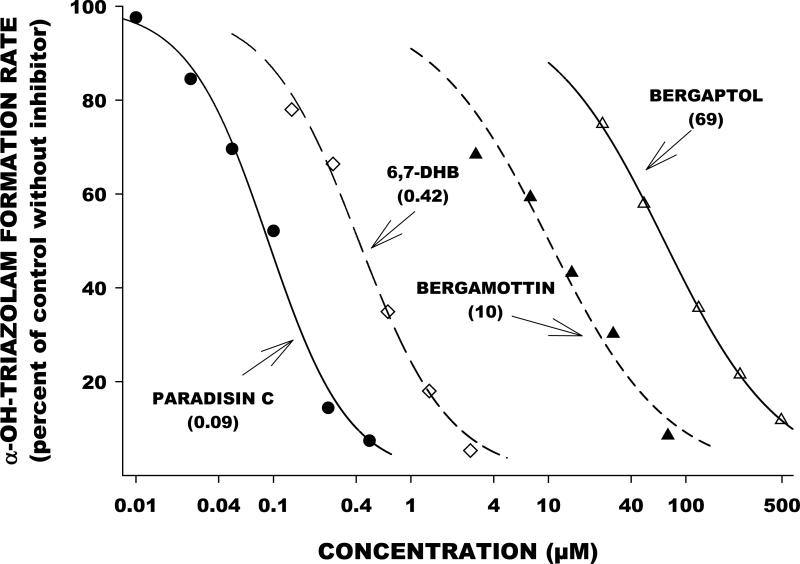
Inhibition of triazolam hydroxylation activity – an index of CYP3A activity – in human liver microsomes in relation to varying concentrations of paradisin C, DHB, bergamottin, and bergaptol. All studies represent preincubation of inhibitors with microsomal protein prior to addition of the substrate, thereby indicating irreversible (mechanism-based) inhibition. The numbers next to the inhibitor lines are the 50% inhibitory concentrations (IC50). Smaller numbers indicate greater inhibitory potency. For a detailed description of methodology see references [29, 68, 69].
Figure 5
Figure 5
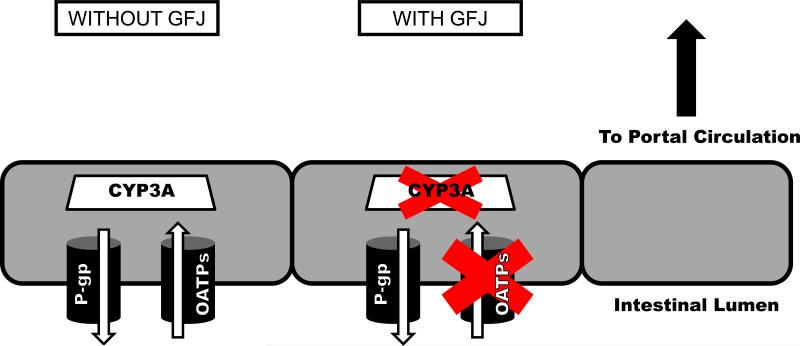
Schematic representation of intestinal enterocyte cells. In the control condition (without GFJ, left), substrate drugs in the intestinal lumen (below) may undergo uptake transport by OATPs, efflux transport by P-gp, and/or metabolism by CYP3A, all of which may influence the extent to which the drug reaches the portal circulation (above). With exposure to GFJ (middle), uptake transport by OATPs and metabolism by CYP3A are potentially inhibited.

References

    1. Bailey DG, Spence JD, Edgar B, et al. Ethanol enhances the hemodynamic effects of felodipine. Clin Invest Med. 1989 Dec;12(6):357–62. [The first report of a GFJ-drug interaction.] - PubMed
    1. Bailey DG, Malcolm J, Arnold O, Spence JD. Grapefruit juice-drug interactions. Br J Clin Pharmacol. 1998 Aug;46(2):101–10. - PMC - PubMed
    1. Paine MF, Oberlies NH. Clinical relevance of the small intestine as an organ of drug elimination: drug-fruit juice interactions. Expert Opin Drug Metab Toxicol. 2007 Feb;3(1):67–80. [This review article describes the importance of the small intestine in drug disposition.] - PubMed
    1. Mertens-Talcott SU, Zadezensky I, De Castro WV, et al. Grapefruit-drug interactions: can interactions with drugs be avoided? J Clin Pharmacol. 2006 Dec;46(12):1390–416. - PubMed
    1. Farkas D, Greenblatt DJ. Influence of fruit juices on drug disposition: discrepancies between in vitro and clinical studies. Expert Opin Drug Metab Toxicol. 2008 Apr;4(4):381–93. [This review describes the effects of various fruit juices on drug disposition and highlights the frequently observed disconnect between in vitro and in vivo studies.] - PubMed

Publication types

LinkOut - more resources