. 2011 Jan 21:11:7.
doi: 10.1186/1472-6750-11-7.

Oil accumulation in the model green alga Chlamydomonas reinhardtii: characterization, variability between common laboratory strains and relationship with starch reserves

Affiliations

Oil accumulation in the model green alga Chlamydomonas reinhardtii: characterization, variability between common laboratory strains and relationship with starch reserves

Magali Siaut et al. BMC Biotechnol. .

Abstract

Background: When cultivated under stress conditions, many microalgae species accumulate both starch and oil (triacylglycerols). The model green microalga Chlamydomonas reinhardtii has recently emerged as a model to test genetic engineering or cultivation strategies aiming at increasing lipid yields for biodiesel production. Blocking starch synthesis has been suggested as a way to boost oil accumulation. Here, we characterize the triacylglycerol (TAG) accumulation process in Chlamydomonas and quantify TAGs in various wild-type and starchless strains.

Results: In response to nitrogen deficiency, Chlamydomonas reinhardtii produced TAGs enriched in palmitic, oleic and linoleic acids that accumulated in oil-bodies. Oil synthesis was maximal between 2 and 3 days following nitrogen depletion and reached a plateau around day 5. In the first 48 hours of oil deposition, a ~80% reduction in the major plastidial membrane lipids occurred. Upon nitrogen re-supply, mobilization of TAGs started after starch degradation but was completed within 24 hours. Comparison of oil content in five common laboratory strains (CC124, CC125, cw15, CC1690 and 11-32A) revealed a high variability, from 2 μg TAG per million cell in CC124 to 11 μg in 11-32A. Quantification of TAGs on a cell basis in three mutants affected in starch synthesis (cw15sta1-2, cw15sta6 and cw15sta7-1) showed that blocking starch synthesis did not result in TAG over-accumulation compared to their direct progenitor, the arginine auxotroph strain 330. Moreover, no significant correlation was found between cellular oil and starch levels among the twenty wild-type, mutants and complemented strains tested. By contrast, cellular oil content was found to increase steeply with salt concentration in the growth medium. At 100 mM NaCl, oil level similar to nitrogen depletion conditions could be reached in CC124 strain.

Conclusion: A reference basis for future genetic studies of oil metabolism in Chlamydomonas is provided. Results highlight the importance of using direct progenitors as control strains when assessing the effect of mutations on oil content. They also suggest the existence in Chlamydomonas of complex interplays between oil synthesis, genetic background and stress conditions. Optimization of such interactions is an alternative to targeted metabolic engineering strategies in the search for high oil yields.


Figures
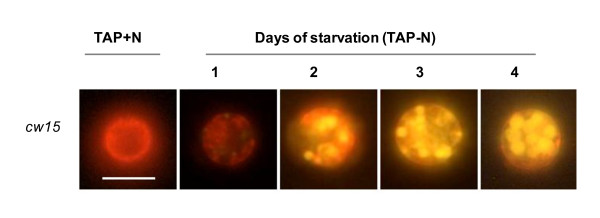
Figure 1
Figure 1
Detection of neutral lipid accumulation in cw15, a common laboratory strain of C. reinhardtii using Nile red staining. The yellow fluorescence observed in the presence of Nile red indicates the presence of neutral lipids while the red fluorescence corresponds to chlorophyll autofluorescence. TAP: standard growth medium. TAP-N: nitrogen-depleted TAP medium. Bars = 8 μm.
Figure 2
Figure 2
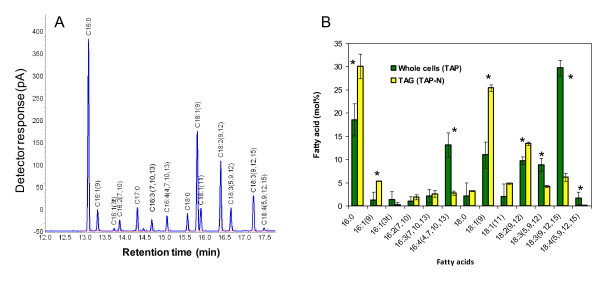
Analysis of fatty acid composition in C. reinhardtii. (A) Separation by GC-FID of fatty acid methyl esters prepared from total lipids of C. reinhardtii cw15. (B) Comparison of the fatty acid composition of the TAG fraction and total lipids. The TAG fraction was isolated from cells cultivated in TAP-N for 2 days while total lipids were from cells grown in TAP medium. Values are mean of four independent experiments ± SD. Asterisks denote a statistically significant difference (t test, two-sided P < 0.05 at least).
Figure 3
Figure 3
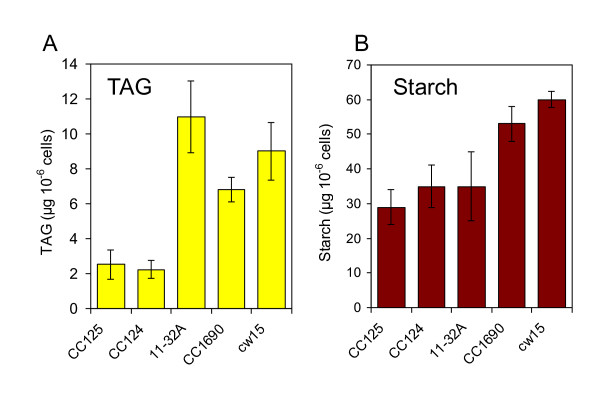
Triacylglycerol and starch accumulation in common laboratory strains of C. reinhardtii. (A) Triacylglycerols, (B) Starch. Cells were analyzed after culture in TAP-N for 2 days; values are mean ± SD, n = 4.
Figure 4
Figure 4
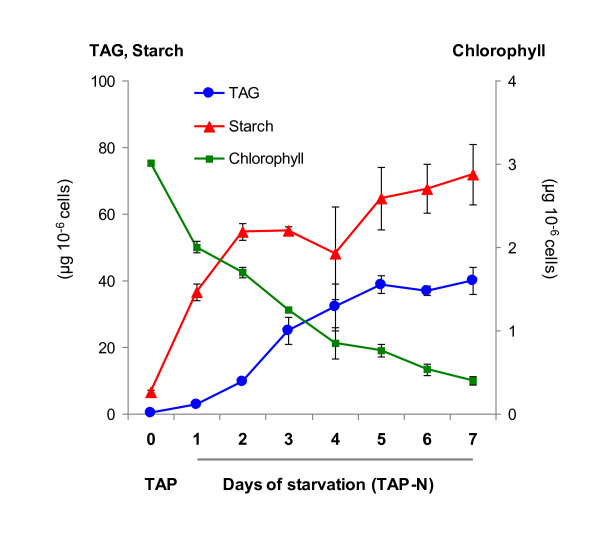
Time course of accumulation of triacylglycerols, starch and chlorophyll in C. reinhardtii in response to nitrogen depletion. Precultures of strain cw15 were grown in TAP medium for 2 days before changing medium to TAP-N (day 0). Values are mean of three independent experiments ± SD.
Figure 5
Figure 5
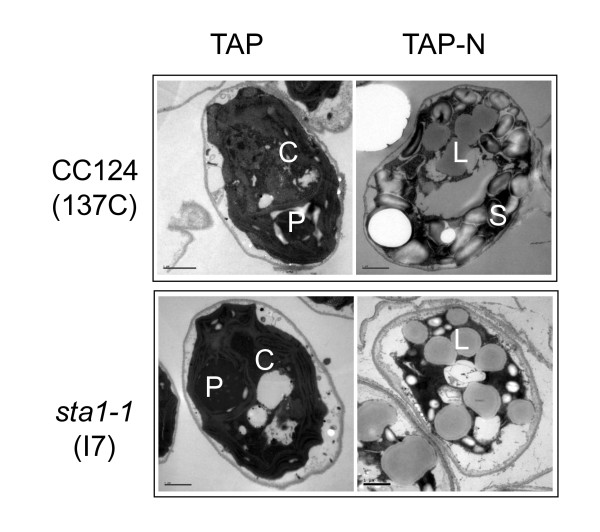
Transmission electron microscopy images of C. reinhardtii CC124 and starchless mutant sta1-1 before and after 3 days of nitrogen depletion. Bars = 1 μm. P: pyrenoid; C: chloroplast; L: lipid droplet, S: starch granule.
Figure 6
Figure 6
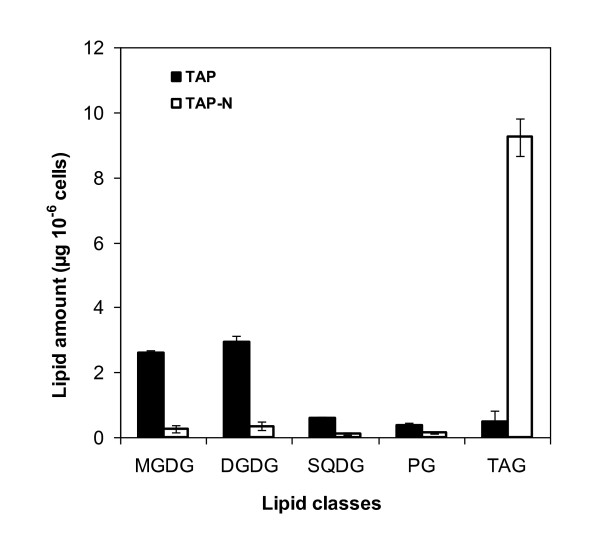
Changes in triacylglycerols and major plastidial lipid classes in nitrogen-starved cells. Cells were cultivated in TAP-N for 2 days. Values are mean of four independent experiments ± SD.
Figure 7
Figure 7
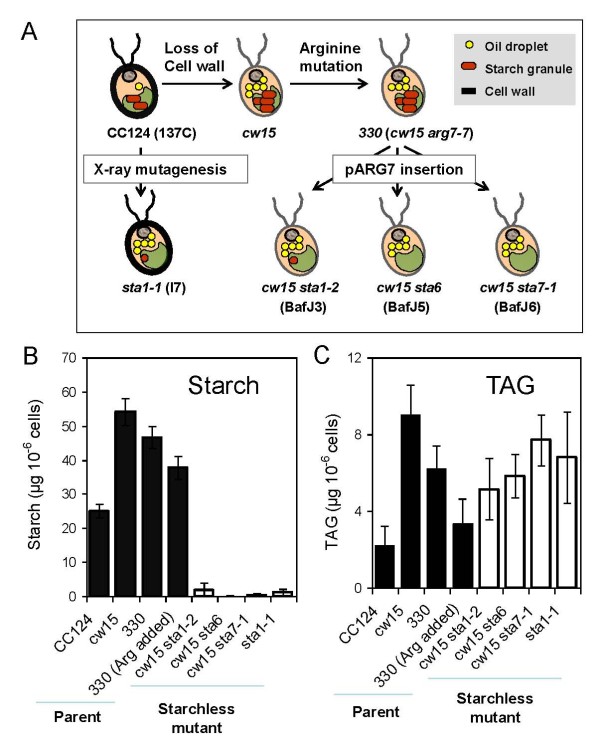
Comparison of oil and starch reserves in various strains of C. reinhardtii. (A) Relationships between the wild-type and starchless strains tested. Presence of triacylglycerol and starch reserves in N-starved cells is illustrated. Direct progenitors of the mutants are indicated. Loss of the cell wall in some strains is also highlighted. (B, C) Quantification of starch and triacylglycerol accumulation in starchless mutants (sta1-1, sta1-2, sta6, and sta7-1) and its progenitors (CC124, cw15, 330). Culture conditions: TAP-N for 2 days. Values are mean of four independent experiments ± SD.
Figure 8
Figure 8
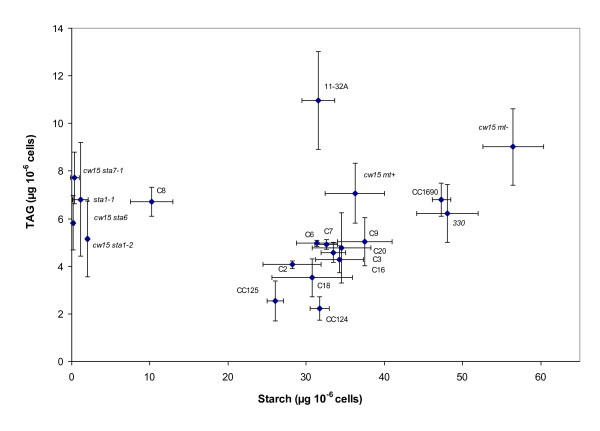
Absence of correlation between oil and starch content in various Chlamydomonas reinhardtii strains. C2,3,6,7,8,9,16,18,20 are independent lines of complementants for sta6 (BafJ5). Mean contents in starch and oil were calculated based on at least three independent experiments. Error bars indicate standard deviations. Mean content in oil and starch were subjected to a Kendall rank correlation test. The null hypothesis that oil and starch are independent cannot be rejected (tau statistics = 0.07; two-tailed p = 0.673; n = 20).
Figure 9
Figure 9
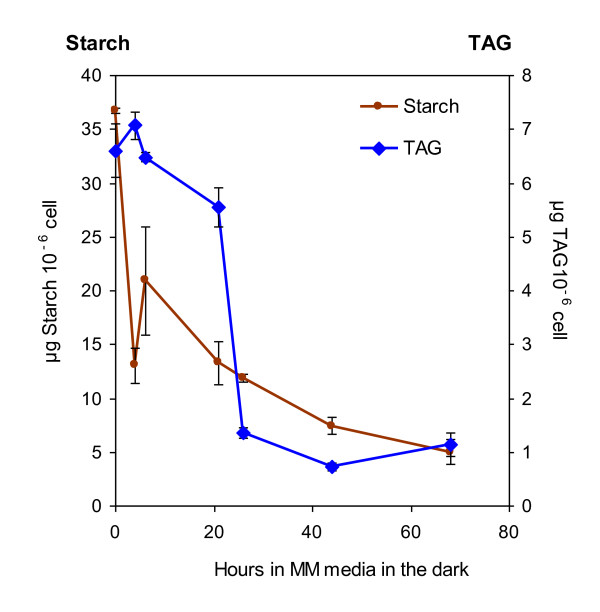
Mobilization of triacylglycerols and starch in strain 330 after re-supply with nitrogen. Cells were first cultivated in TAP medium until mid log phase, then transferred to TAP-N for 3 days under constant light and then switched to MM media in the dark. Values are mean of three independent experiments ± SD.
Figure 10
Figure 10
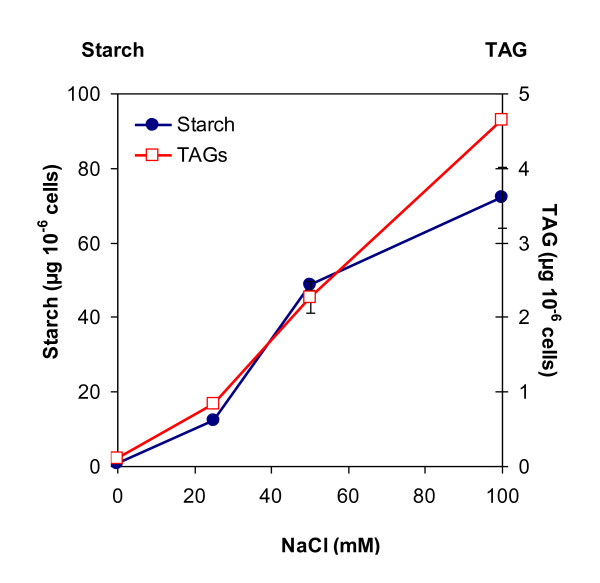
Effect of salt supplementation on starch and triacylglycerol content in C. reinhardtii. Wild-type strain CC124 was used. Cells were first cultivated in standard TAP medium reaching mid-log phase. Different NaCl amounts were then added to the cultures, which were further grown for 2 days before samples were taken for starch and lipid analyses. Values are mean of three independent experiments ± SD.
Figure 11
Figure 11
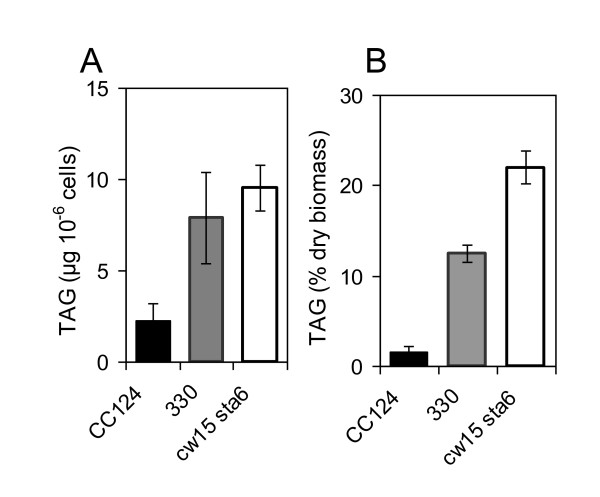
Influence of reference basis and control strains when comparing oil content. TAG amount is expressed on a μg 10-6 cells basis (A) or a % dry weight basis (B). Two reference strains, CC124 (137C) and the cell wall-less 330 (cw15arg7-7) are shown. Cells were cultured in TAP-N for 2 days. Values are mean of four independent experiments ± SD.

References

    1. Schubert C. Can biofuels finally take center stage? Nat Biotech. 2006;24(7):777–784. - PubMed
    1. Chisti Y. Biodiesel from microalgae. Biotechnol Adv. 2007;25(3):294–306. - PubMed
    1. Hu Q, Sommerfeld M, Jarvis E, Ghirardi M, Posewitz M, Seibert M, Darzins A. Microalgal triacylglycerols as feedstocks for biofuel production: perspectives and advances. Plant J. 2008;54(4):621–639. - PubMed
    1. Rodolfi L, Zittelli GC, Bassi N, Padovani G, Biondi N, Bonini G, Tredici MR. Microalgae for oil: Strain selection, induction of lipid synthesis and outdoor mass cultivation in a low-cost photobioreactor. Biotechnol Bioeng. 2009;102(1):100–112. - PubMed
    1. Hicks GR, Hironaka CM, Dauvillee D, Funke RP, D'Hulst C, Waffenschmidt S, Ball SG. When simpler is better. Unicellular green algae for discovering new genes and functions in carbohydrate metabolism. Plant Physiol. 2001;127(4):1334–1338. - PMC - PubMed

Publication types

LinkOut - more resources