


Effect of classification-specific treatment on lumbopelvic motion during hip rotation in people with low back pain
- PMID: 21256073
- PMCID: PMC3095730
- DOI: 10.1016/j.math.2010.12.007
Effect of classification-specific treatment on lumbopelvic motion during hip rotation in people with low back pain
Abstract
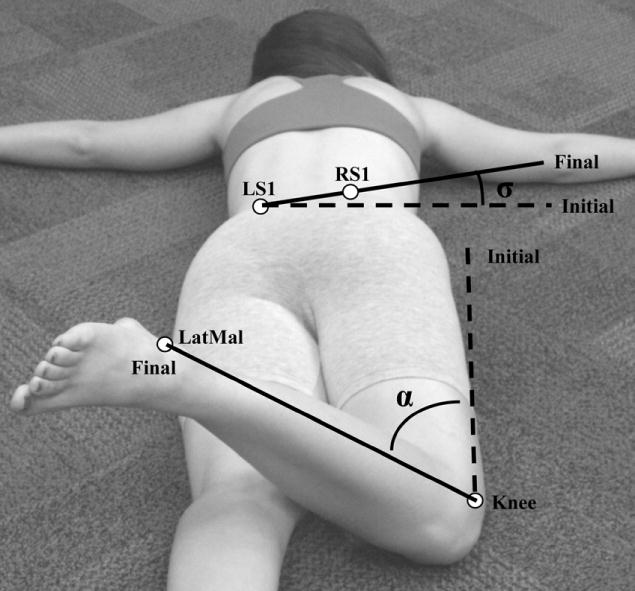
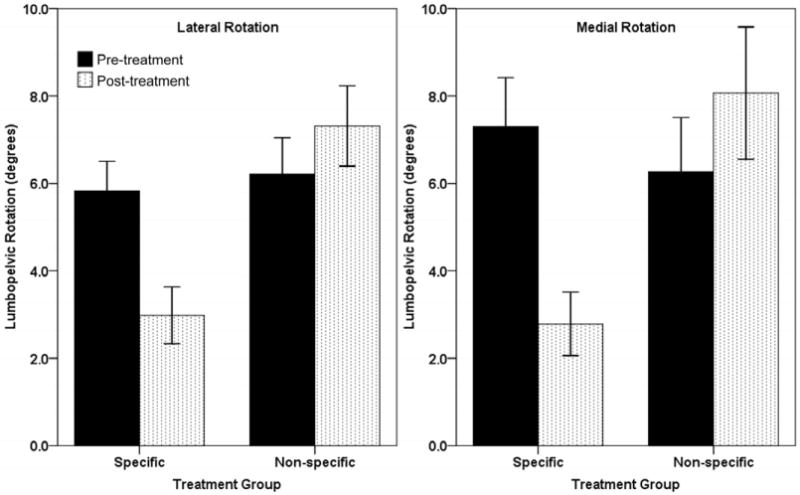
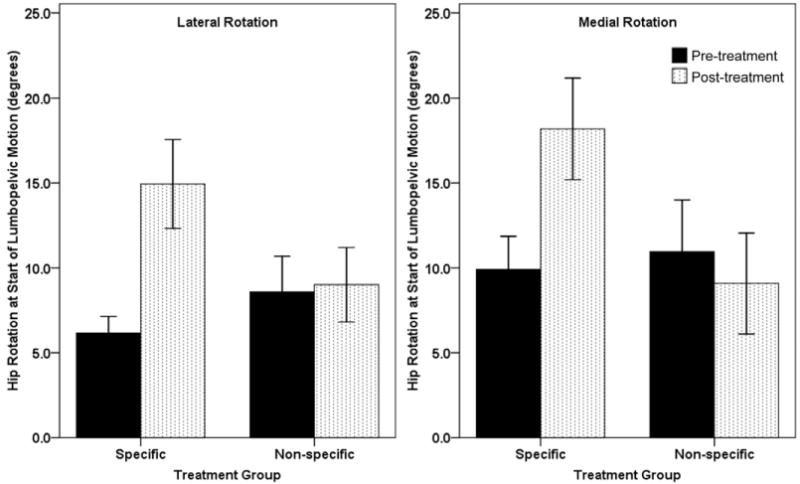
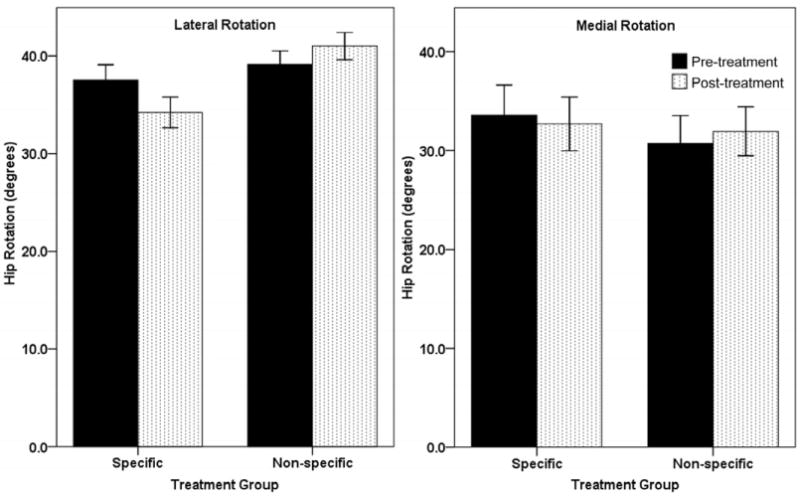
Increased and early lumbopelvic motion during trunk and limb movements is thought to contribute to low back pain (LBP). Therefore, reducing lumbopelvic motion could be an important component of physical therapy treatment. Our purpose was to examine the effects of classification-specific physical therapy treatment (Specific) based on the Movement System Impairment (MSI) model and non-specific treatment (Non-Specific) on lumbopelvic movement patterns during hip rotation in people with chronic LBP. We hypothesized that following treatment people in the Specific group would display decreased lumbopelvic rotation and achieve more hip rotation before lumbopelvic rotation began. We hypothesized that people in the Non-Specific group would display no change in these variables. Kinematic data collected before and after treatment for hip lateral and medial rotation in prone were analyzed. The Specific group (N = 16) demonstrated significantly decreased lumbopelvic rotation and achieved greater hip rotation before the onset of lumbopelvic rotation after treatment with both hip lateral and medial rotation. The Non-Specific group (N = 16) demonstrated significantly increased lumbopelvic rotation and no change in hip rotation achieved before the onset of lumbopelvic rotation. People who received treatment specific to their MSI LBP classification displayed decreased and later lumbopelvic motion with hip rotation, whereas people who received generalized non-specific treatment did not.
Copyright © 2010 Elsevier Ltd. All rights reserved.
Figures
References
-
- Adams MA, Bogduk N, Burton K, Dolan P. The Biomechanics of Back Pain. 1st. Edinburgh: Churchill Livingstone; 2002.
-
- Brumagne S, Cordo P, Lysens R, Verschueren S, Swinnen S. The role of paraspinal muscle spindles in lumbosacral position sense in individuals with and without low back pain. Spine. 2000;25(8):989–94. - PubMed
-
- Burnett AF, Cornelius MW, Dankaerts W, O'Sullivan PB. Spinal kinematics and trunk muscle activity in cyclists: a comparison between healthy controls and non-specific chronic low back pain subjects-a pilot investigation. Manual Therapy. 2004;9(4):211–9. - PubMed
-
- Cohen J. Statistical Power Analysis for the Behavioral Sciences. Hillsdale: Lawrence Erlbaum Associates, Inc.; 1988. The analysis of variance; pp. 273–406.
-
- Deyo RA, Andersson G, Bombardier C, et al. Outcome measures for studying patients with low back pain. Spine. 1994;19(18 Suppl):2032S–6S. - PubMed
Publication types
MeSH terms
Grants and funding
LinkOut - more resources
Full Text Sources
Medical
Miscellaneous
