. 2011 Mar 31:178:159-68.
doi: 10.1016/j.neuroscience.2011.01.024. Epub 2011 Jan 19.

Endocannabinoid 2-arachidonoylglycerol protects neurons against β-amyloid insults

Affiliations

Endocannabinoid 2-arachidonoylglycerol protects neurons against β-amyloid insults

X Chen et al. Neuroscience. .

Abstract

While endocannabinoid modulation of both GABAergic and glutamatergic synaptic transmission and plasticity has been extensively investigated, our understanding of the role of endocannabinoids in protecting neurons from harmful insults remains limited. 2-Arachidonoylglycerol (2-AG), the most abundant endogenous ligand and a full agonist for cannabinoid receptors, exhibits anti-inflammatory and neuroprotective effects via a CB1 receptor (CB1R)-mediated mechanism. However, it is still not clear whether 2-AG is also able to protect neurons from β-amyloid (Aβ)-induced neurodegeneration. Here, we demonstrate that exogenous application of 2-AG significantly protected hippocampal neurons in culture against Aβ-induced neurodegeneration and apoptosis. This neuroprotective effect was blocked by SR141716 (SR-1), a selective CB1R antagonist, but not by SR144528 (SR-2), a selective CB2R antagonist, or capsazepine (CAP), a selective transient receptor potential cation channels, subfamily V, member 1 (TRPV1) receptor antagonist. To determine whether endogenous 2-AG is capable of protecting neurons from Aβ insults, hippocampal neurons in culture were treated with URB602 or JZL184, selective inhibitors of monoacylglycerol lipase (MAGL), the enzyme hydrolyzing 2-AG. MAGL inhibition that elevates endogenous levels of 2-AG also significantly reduced Aβ-induced neurodegeneration and apoptosis. The 2-AG-produced neuroprotective effects appear to be mediated via CB1R-dependent suppression of extracellular signal-regulated kinases 1 and 2 (ERK1/2) and nuclear factor-κB (NF-κB) phosphorylation and cyclooxygenase-2 (COX-2) expression. Our results suggest that elevation of endogenous 2-AG by inhibiting its hydrolysis has potential as a novel efficacious therapeutic approach for preventing, ameliorating or treating Alzheimer's disease.


Figures

Figure 1
Figure 1
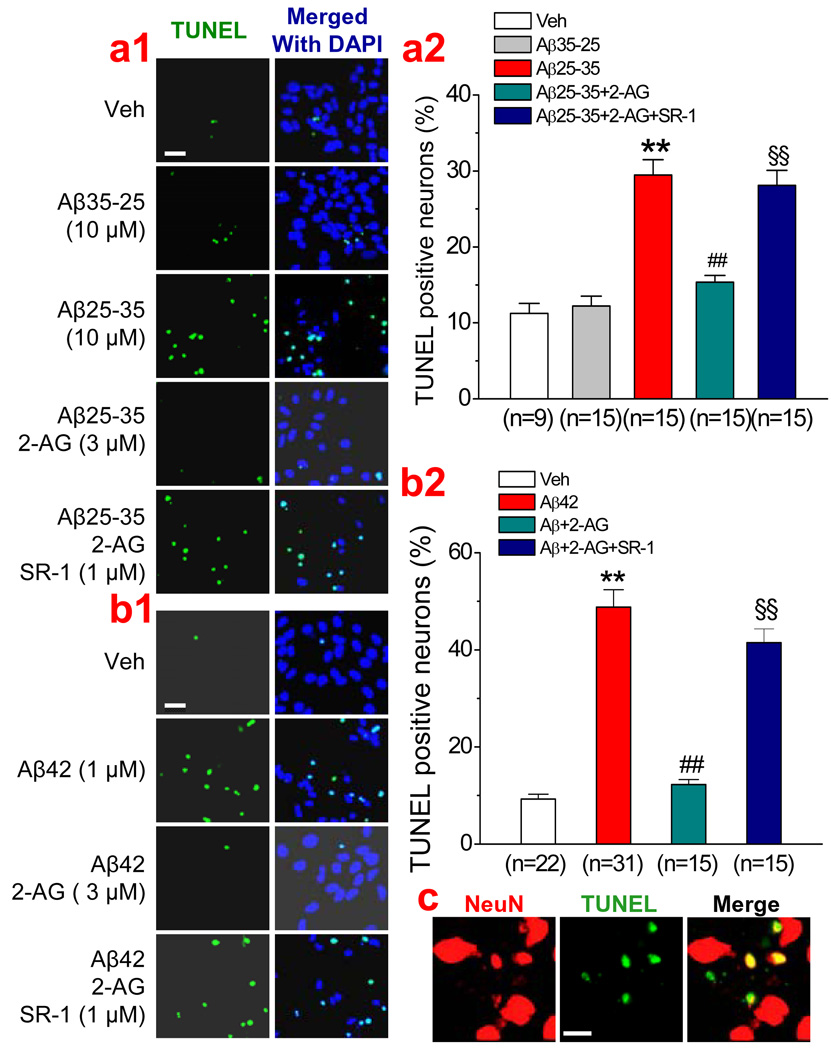
Exogenous application of 2-arachidonoylglycerol (2-AG) protects hippocampal neurons against Aβ-induced degeneration. (a1). TUNEL images of hippocampal neurons in vehicle control, Aβ35–25 (10 µM), Aβ25–35 (10 µM), Aβ25–35+2-AG (3 µM), and Aβ25–35+2-AG+SR141716 (SR-1, 1 µM). Hippocampal neurons in culture were treated with Aβ25–35 in the absence and presence of 2-AG or SR-1 for 24 hrs. (a2). Percentages of TUNEL positive neurons under different treatments. (b1). TUNEL images of hippocampal neurons in vehicle control, Aβ1–42 (1 µM), Aβ1–42+2-AG (3 µM), and Aβ1–42+2-AG+SR-1 (1 µM). Hippocampal neurons in culture were treated with Aβ1–42 in the absence and presence of 2-AG or SR-1 for 72 hrs. (b2). Percentages of TUNEL positive neurons under different treatments. (c). Overlay of NeuN and TUNEL stained neurons from the culture treated with Aβ1–42 (1 µM) for 72 hrs). *P<0.01, compared with the control; ##P<0.01 compared with Aβ25–35 or Aβ1–42; §§P<0.01 compared with Aβ+2-AG. Images were taken using a Zeiss deconvolution microscope with Slidebook 5.0. Scar bars in a1 & b1: 20 µm, and in c: 10 µm.
Figure 2
Figure 2
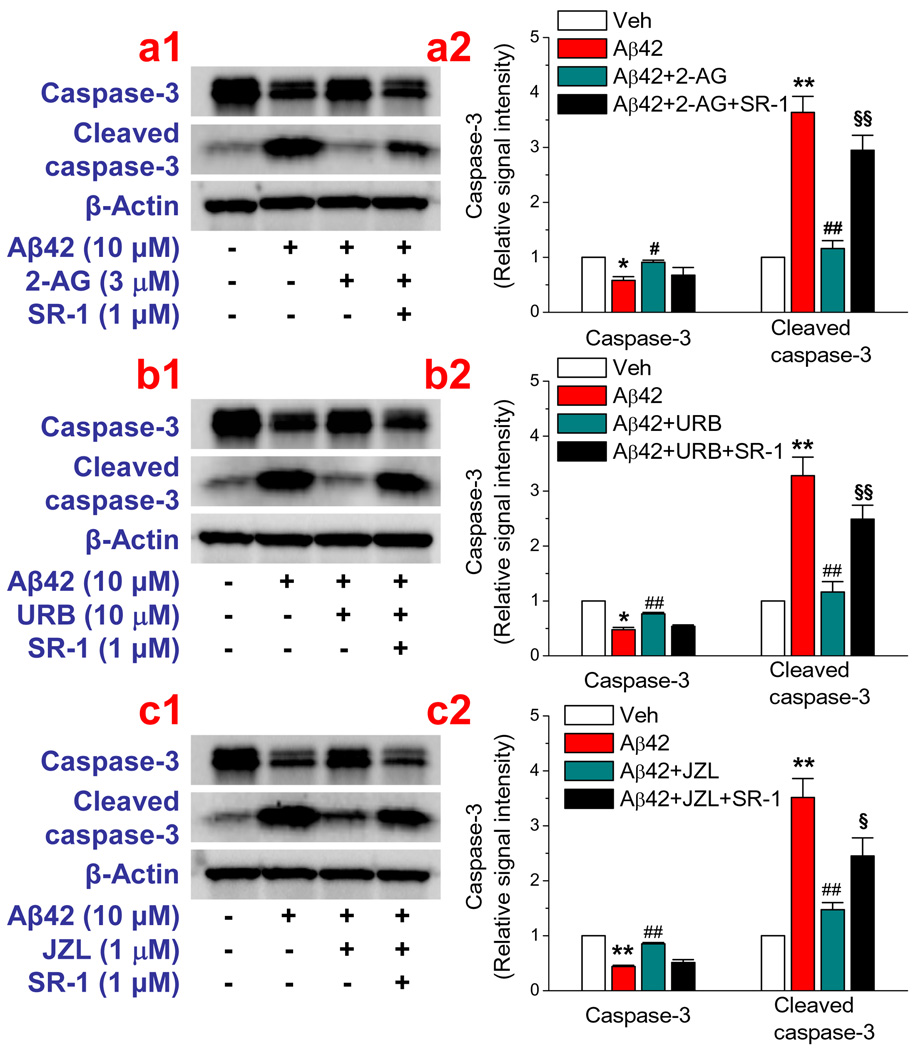
2-AG prevents neuronal apoptosis from Aβ insults. Western blot analysis of cleaved caspase-3 in hippocampal neurons in culture treated with Aβ. (a) Exogenous application of 2-AG produces a CB1R-dependent inhibition of Aβ1–42-induced neuronal apoptosis (n=3–4). Neurons in culture treated with Aβ1–42 (10 µM) for 72 hrs. (b & c). Elevation of endogenous 2-AG by MAGL inhibitor URB602 or JZL184 attenuates Aβ-induced apoptosis (n=3). ##P<0.01 compared with Aβ1–42; §P<0.05; §§P<0.01 compared with Aβ1–42+2-AG, or URB602, or JZL184.
Figure 3
Figure 3
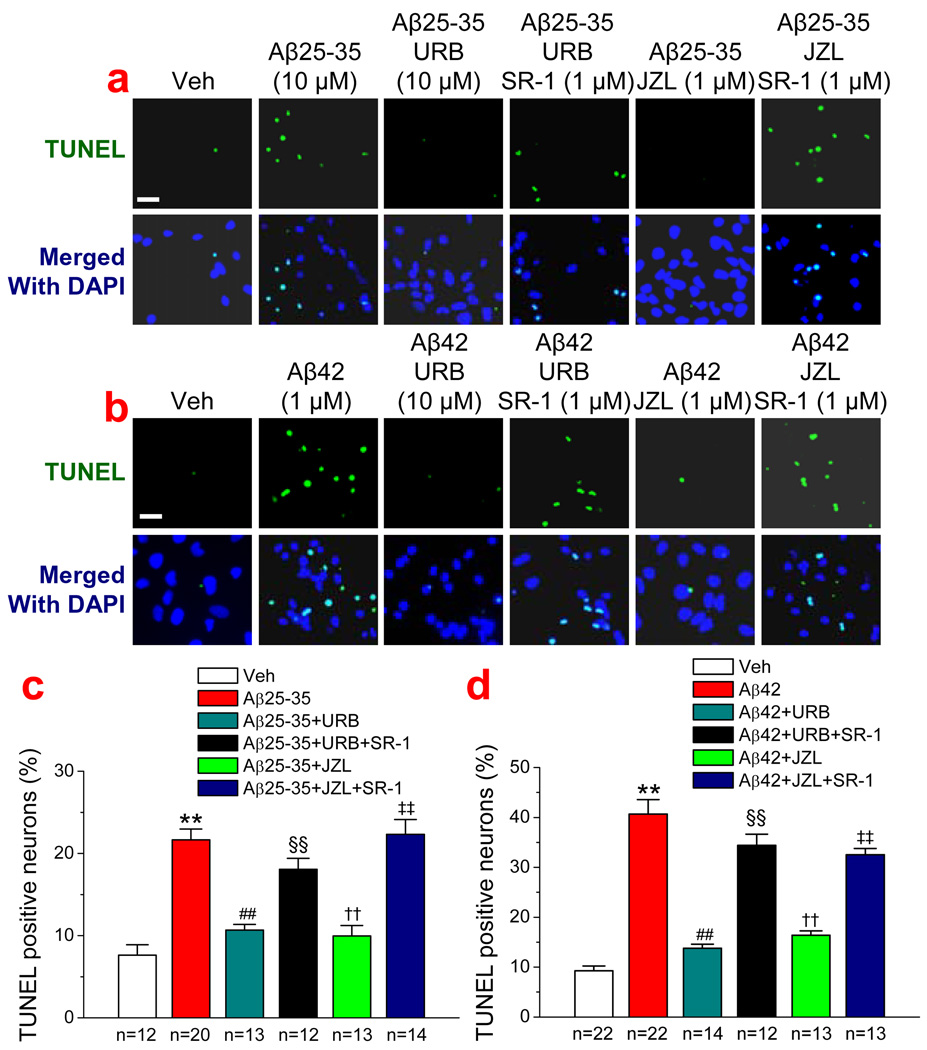
Endogenous 2-AG protects hippocampal neurons against Aβ-induced neurodegeneration. (a). TUNEL images of hippocampal neurons in vehicle control, Aβ25–35 (10 µM), Aβ25–35+URB602 (10 µM), Aβ25–35+URB602+SR-1 (1 µM), Aβ25–35+JZL184 (1 µM), and Aβ25–35+JZL184+SR-1 (1 µM). (b). TUNEL images of hippocampal neurons in vehicle control, Aβ1–42 (1 µM), Aβ1–42+URB602 (10 µM), Aβ1–42+URB602+SR-1 (1 µM), Aβ1–42+JZL184 (1 µM), and Aβ1–42+ JZL184+SR-1 (1 µM). (c). Percentages of TUNEL positive neurons treated with Aβ25–35 in the absence and presence of URB or JZL. (d). Percentages of TUNEL positive neurons treated with Aβ1–42 in the absence and presence of URB or JZL. **P<0.01, compared with the vehicle control; ##P<0.01 compared with Aβ25–35 or Aβ1–42; §§P<0.01 compared with Aβ+URB602 or JZL; †† P<0.01 compared with Aβ25–35 or Aβ1–42; ‡‡ P<0.01 compared with Aβ+URB602 or JZL184. Scar bars in a1 & b1: 20 µm.
Figure 4
Figure 4
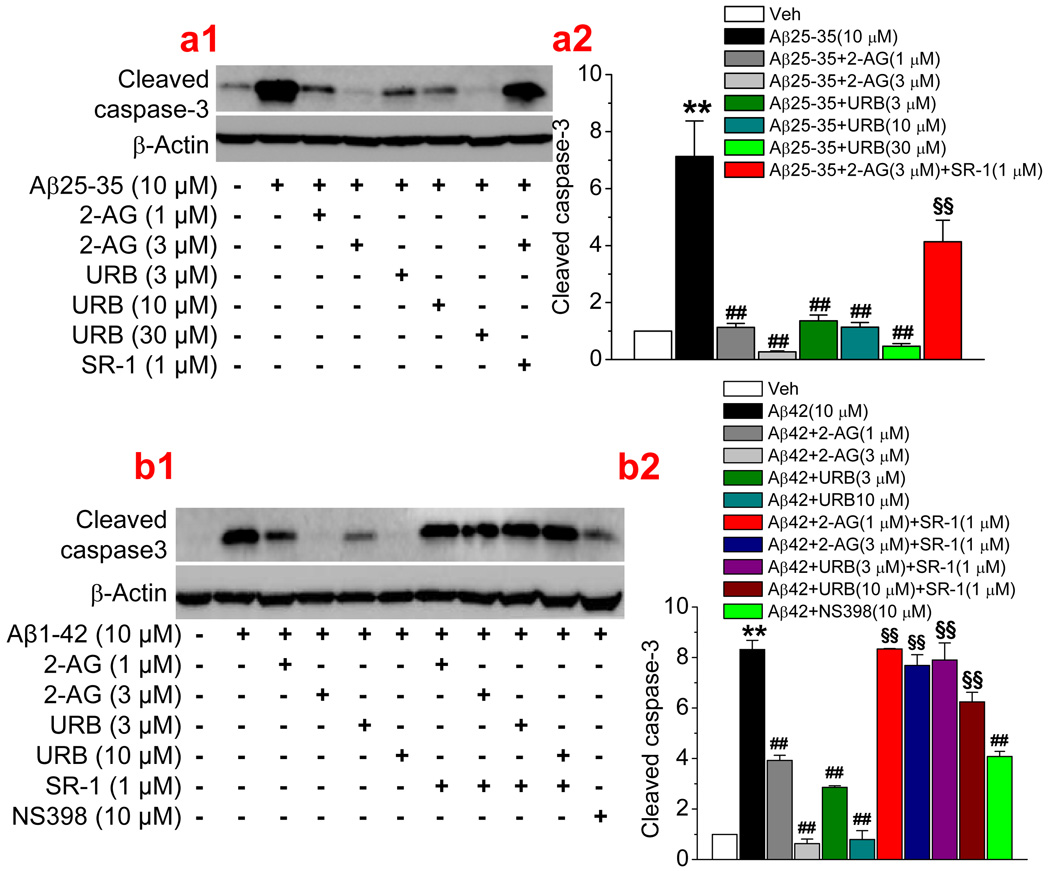
2-AG induces a dose-dependent inhibition of (a1&a2) Aβ25–35- and (b1&b2) Aβ1–42-induced neuronal apoptosis. Neurons in culture treated with Aβ25–35 (10 µM) for 24 hrs and Aβ1–42 (1 µM) for 72 hrs. 2-AG, URB602 (URB), SR141716 (SR-1) or NS398 were added into the cultures 30 min before application of Aβ (n=3). **P<0.01, compared with the vehicle control; ##P<0.01 compared with Aβ25–35 or Aβ1–42; §§P<0.01 compared with Aβ25–35 or Aβ1–42+2-AG, or URB602.
Figure 5
Figure 5
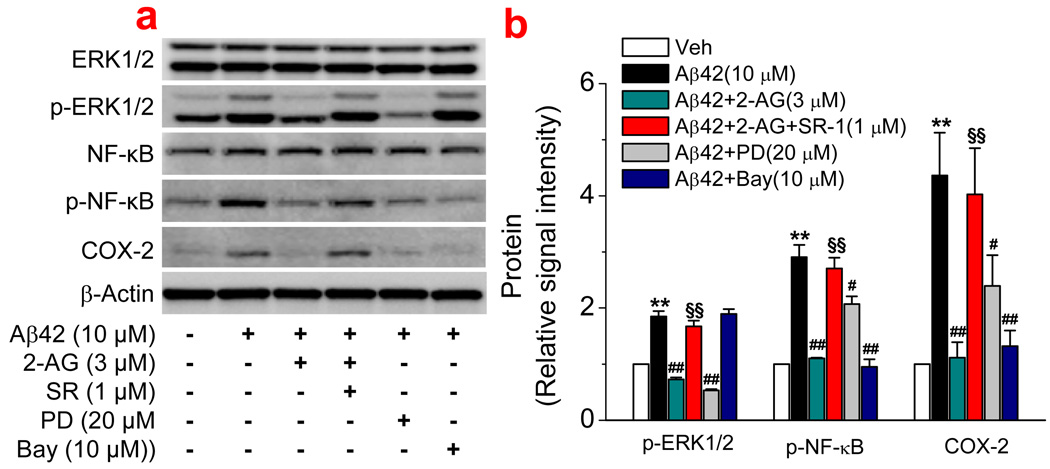
CB1R-dependent suppression of ERK and NF-κB phosphorylation and COX-2 expression is involved in 2-AG-induced neuroprotection. (a). Western blot analysis of ERK and NF-κB phosphorylation and COX-2 expression in hippocampal neurons treated with Aβ1–42 (10 µM) in the absence and presence of 2-AG (3 µM), SR (1 µM), PD98059 (PD, 20 µM), and Bay11-7085 (Bay, 10 µM). Phosphorylation of signaling proteins and COX-2 expression were detected 6 and 12hrs after the cultures were treated with Aβ1–42. (b). Quantifications of protein expressions under different treatments (n=3). ). **P<0.01, compared with the vehicle control; #P<0.05 and ##P<0.01 compared with Aβ1–42; §§P<0.01 compared with Aβ1–42+2-AG.
Figure 6
Figure 6
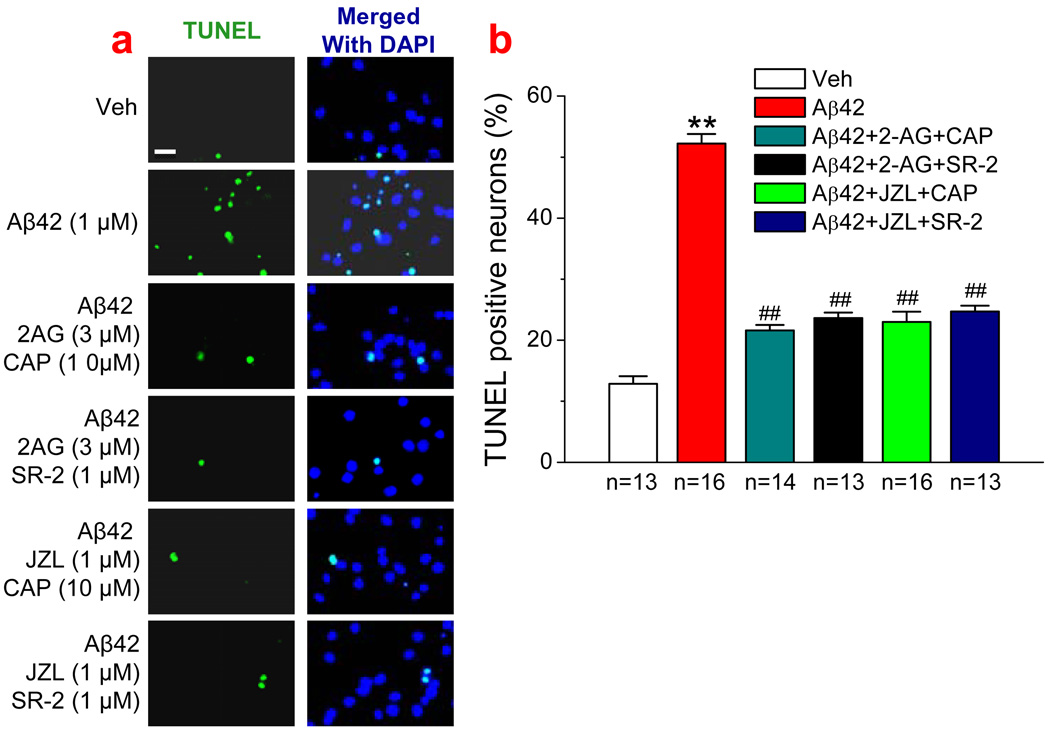
CB2 and TRPV1 receptors are not involved in 2-AG-produced neuroprotection against Aβ-induced neurodegeneration. (a). TUNEL images of hippocampal neurons in vehicle control, Aβ1–42 (1 µM), Aβ1–42+2-AG (3 µM)+ capsazepine (CAP, 10 µM), Aβ1–42+2-AG+ SR144528 (SR-2, 1 µM), Aβ1–42+JZL184 (1 µM)+CAP (10 µM), and Aβ1–42+JZL184+SR-2 (1 µM). the treatments of cultures with reagents were the same as described in Fig. 1. (b). Percentages of TUNEL positive neurons treated with Aβ1–42 in the absence and presence of 2-AG, JZL, CAP or SR-2 (n=3). **P<0.01, compared with the vehicle control; ##P<0.01 compared with Aβ1–42. Scar bar: 20 µm.
Figure 7
Figure 7
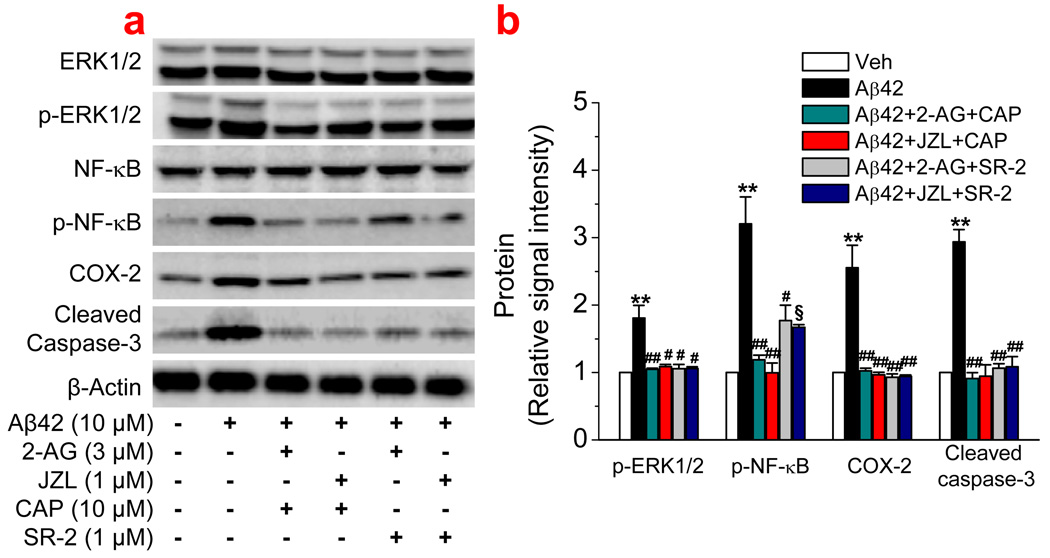
CB2 and TRPV1 receptors do not contribute to the 2-AG-induced suppression of ERK and NF-κB phosphorylation, COX-2 expression, and apoptosis. (a). Western blot analysis of ERK and NF-κB phosphorylation, COX-2 expression, and cleaved caspase-3 in hippocampal neurons treated with Aβ1–42 (10 µM) in the absence and presence of 2-AG (3 µM), JZL184 (1 µM), SR-2 (1 µM), or CAP (10 µM). (b). Quantifications of protein expressions under different treatments (n=3). **P<0.01, compared with the vehicle control; #P<0.05 and ##P<0.01 compared with Aβ1–42; §P<0.01 compared with Aβ1–42+2-AG.

References

    1. Alger BE. Retrograde signaling in the regulation of synaptic transmission: focus on endocannabinoids. Prog Neurobiol. 2002;68:247–286. - PubMed
    1. Bisogno T, Di Marzo V. The role of the endocannabinoid system in Alzheimer's disease: facts and hypotheses. Curr Pharm Des. 2008;14:2299–3305. - PubMed
    1. Blankman JL, Simon GM, Cravavtt BF. A comprehensive profile of brain enzymes that hydrolyze the endocannabinoid 2-arachidonylglycerol. Chem Biol. 2007;14:1347–1356. - PMC - PubMed
    1. Cabral GA, Marciano-Cabral F. Cannabinoid receptors in microglia of the central nervous system: immune functional relevance. J Leukoc Biol. 2005;78:1192–1197. - PubMed
    1. Carrier EJ, Kearn CS, Barkmeier AJ, Breese NM, Yang W, Nithipatikom K, Pfister SL, Campbell WB, Hillard CJ. Cultured rat microglial cells synthesize the endocannabinoids 1-arachidonylglycerol, which increases proleferation via a CB2 receptor-dependent mechanism. Mol Pharmacol. 2004;65:999–1007. - PubMed

Publication types

MeSH terms

Substances