Review
. 2011 Apr;31(3):363-73.
doi: 10.1016/j.reprotox.2010.12.055. Epub 2011 Jan 20.

Prenatal environmental exposures, epigenetics, and disease

Affiliations
Review

Prenatal environmental exposures, epigenetics, and disease

Frederica Perera et al. Reprod Toxicol. 2011 Apr.

Abstract

This review summarizes recent evidence that prenatal exposure to diverse environmental chemicals dysregulates the fetal epigenome, with potential consequences for subsequent developmental disorders and disease manifesting in childhood, over the lifecourse, or even transgenerationally. The primordial germ cells, embryo, and fetus are highly susceptible to epigenetic dysregulation by environmental chemicals, which can thereby exert multiple adverse effects. The data reviewed here on environmental contaminants have potential implications for risk assessment although more data are needed on individual susceptibility to epigenetic alterations and their persistence before this information can be used in formal risk assessments. The findings discussed indicate that identification of environmental chemicals that dysregulate the prenatal epigenome should be a priority in health research and disease prevention.


Conflict of interest statement

Conflict of interest statement

The authors have no conflicts of interest.

Figures
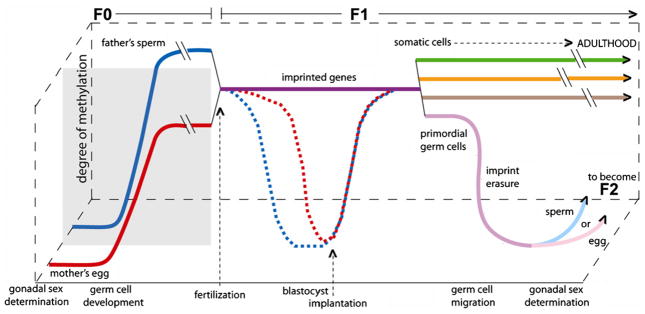
Fig. 1
Fig. 1
There are multiple periods during which environmental exposures could affect the F1 individual’s methylation status, potentially affecting the F1 phenotype. The first window is during F0 (parental) germ cell development when methylation is reprogrammed following imprint erasure in the father’s sperm (solid blue line) and the mother’s egg (solid red line) The second window is post-conception, during F1 embryonic development, when all but imprinted genes are demethylated, with the male germ line (dashed blue line) demethylating more quickly, followed by the female germ line (dashed red line). Imprinted genes (purple line) maintain their methylation marks throughout this reprogramming, allowing for the inheritance of parental-specific monoallelic expression in somatic tissues throughout adulthood [203]. All of the non-imprinted genes are subsequently remethylated once the embryo reaches the early blastocyst stage. During the gonadal sex determination of the F1 embryo, primordial germ cells undergo epigenetic reprogramming, where parental imprinting is erased, as the germ cells of the F1 individual mature (solid light blue or pink line). To determine whether epigenetic alterations are transmitted transgenerationally, the F3 generation must be studied (see text and Fig. 2) [7]. (For interpretation of the references to color in this figure legend, the reader is referred to the web version of the article.)
Fig. 2
Fig. 2
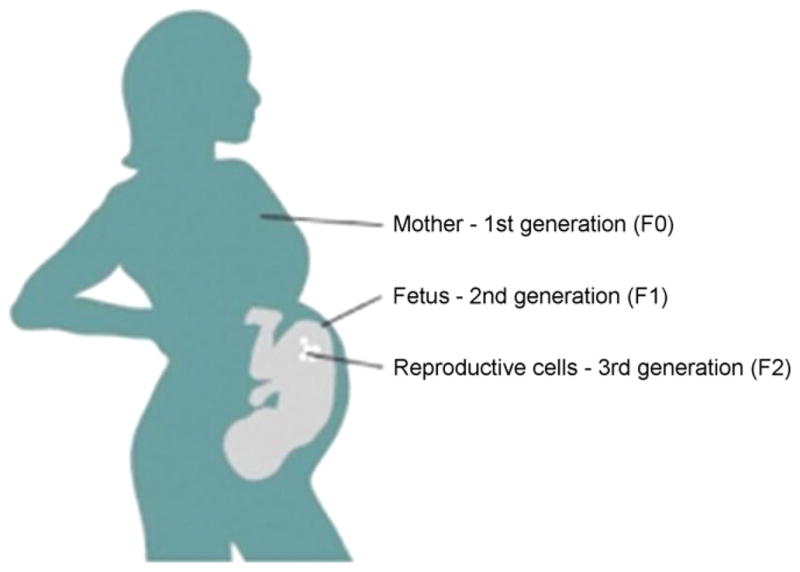
Three generations at once are exposed to the some environmental conditions (diet, toxics, hormones, etc.). In order to provide a convincing case for epigenetic inheritance, an epigenetic change must be observed in the 4th generation.

References

    1. Bollati V, Baccarelli A. Environmental epigenetics. Heredity. 2010;105:105–12. - PMC - PubMed
    1. Aguilera O, Fernandez AF, Munoz A, Fraga MF. Epigenetics and environment: a complex relationship. J Appl Physiol. 2010;109:243–51. - PubMed
    1. Groom A, Elliott HR, Embleton ND, Relton CL. Epigenetics and child health: basic principles. Arch Dis Child. 2010 - PubMed
    1. Joss-Moore LA, Lane RH. The developmental origins of adult disease. Curr Opin Pediatr. 2009;21:230–4. - PMC - PubMed
    1. Nawrot TS, Adcock I. The detrimental health effects of traffic-related air pollution: a role for DNA methylation? Am J Respir Crit Care Med. 2009;179:523–4. - PubMed

Publication types

LinkOut - more resources