


The effects of prenatal marijuana exposure on delinquent behaviors are mediated by measures of neurocognitive functioning
- PMID: 21256427
- PMCID: PMC3052937
- DOI: 10.1016/j.ntt.2010.07.006
The effects of prenatal marijuana exposure on delinquent behaviors are mediated by measures of neurocognitive functioning
Abstract
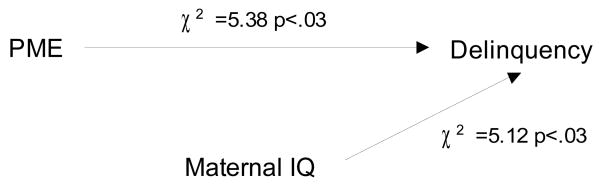
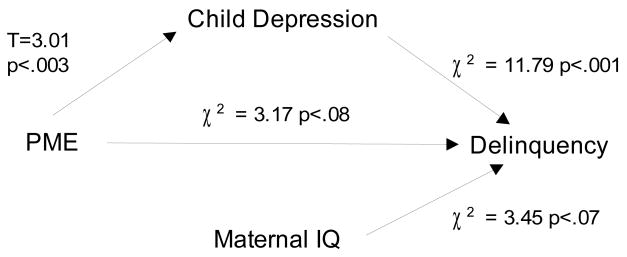
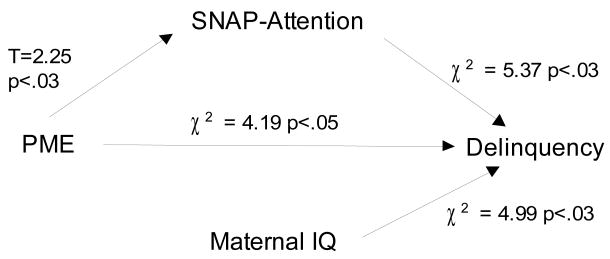
We hypothesized that there would be an association between prenatal marijuana exposure (PME) and delinquency and that the effects of PME on neurocognitive development would mediate this association. Mothers and offspring enrolled in a longitudinal study of the effects of prenatal substance exposure on child development, were interviewed from the fourth prenatal month through 14 years. There were 580 mother/child dyads at the 14-year phase. A standardized protocol assessed psychological, neurocognitive, social, environmental, and demographic characteristics, and substance use at each phase. The Self Report Delinquency scale (Loeber et al., 1998) and the Child Behavior checklist (Achenbach, 1991) delinquency subscale were combined to represent delinquent behavior. First trimester PME was used as a dichotomous variable, daily use versus all other use. Offspring of heavier marijuana users were significantly more likely to report delinquent behavior at age 14. The odds ratio for delinquency among those who were exposed to one or more joints per day during gestation was 1.76 (C.I. 1.05-2.96). PME significantly predicted child depressive symptoms and attention problems at age 10, after controlling for other significant covariates. Child depressive symptoms and attention problems at age 10 significantly predicted delinquency at 14 years. The association between PME and delinquent behavior at 14 years was mediated by depressive symptoms and attention problems in the offspring at 10 years.
Copyright © 2010 Elsevier Inc. All rights reserved.
Figures
References
-
- Achenbach T. Manual for the Child Behavior Checklist/4-18 and 1991 Profile. University of Vermont Department of Psychiatry; Burlington, VT: 1991.
-
- Baker P, Mott F. National Longitudinal Study of Youth - Child Handbook. State University Center for Human Resource Research; Columbus, OH: 1989.
-
- Baker PC, Mott FL. Tabulations and summary discussion. State University Center for Human Resource Research; Columbus, OH: 1991. Children of the National Longitudinal Study of Youth.
-
- Baron RM, Kenny DA. The moderator-mediator variable distinction in social psychological research: Conceptual, strategic and statistical considerations. J Pers Soc Psychol. 1986;51:1173–1182. - PubMed
Publication types
MeSH terms
Grants and funding
LinkOut - more resources
Full Text Sources
Medical
Research Materials
