


Genomic analysis using high-resolution single-nucleotide polymorphism arrays reveals novel microdeletions associated with premature ovarian failure
- PMID: 21256485
- PMCID: PMC3062633
- DOI: 10.1016/j.fertnstert.2010.12.052
Genomic analysis using high-resolution single-nucleotide polymorphism arrays reveals novel microdeletions associated with premature ovarian failure
Abstract
Objective: To analyze DNA from women with premature ovarian failure (POF) for genome-wide copy-number variations (CNVs), focusing on novel autosomal microdeletions.
Design: Case-control genetic association study.
Setting: Department of Obstetrics and Gynecology, Baylor College of Medicine, Houston, Texas.
Patient(s): Of 89 POF patients, eight experienced primary amenorrhea and 81 exhibited secondary amenorrhea before age 40 years.
Intervention(s): Genomic DNA from peripheral blood samples was analyzed for CNVs using high-resolution single-nucleotide polymorphism (SNP) arrays.
Main outcome measure(s): Identification of novel CNVs in 89 POF cases, using the Database of Genomic Variants as a control population.
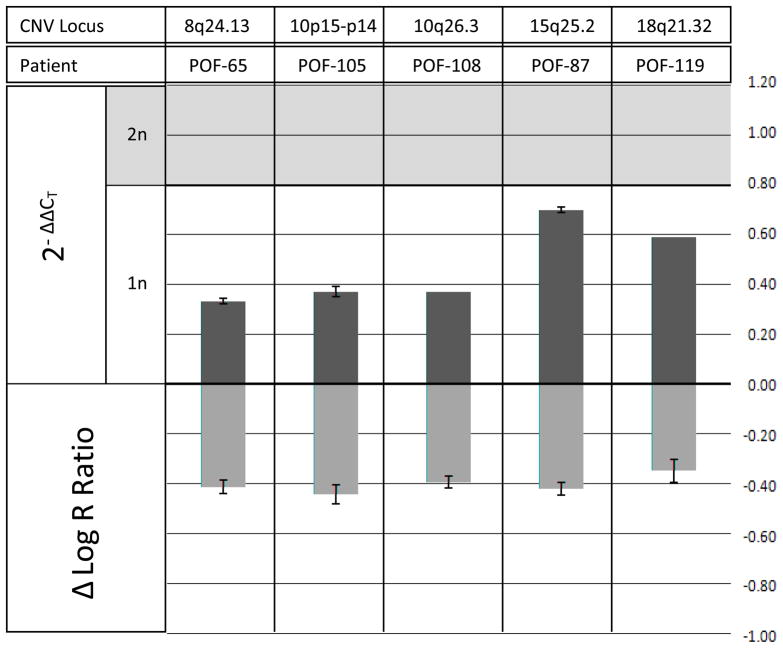
Result(s): A total of 198 autosomal CNVs were detected by SNP arrays, ranging in size from 0.1 Mb to 3.4 Mb. These CNVs (>0.1 Mb) included 17 novel microduplications and seven novel microdeletions, six of which contained the coding regions 8q24.13, 10p15-p14, 10q23.31, 10q26.3, 15q25.2, and 18q21.32. Most of the novel CNVs were derived from autosomes rather than the X chromosome.
Conclusion(s): The present pilot study revealed novel microdeletions/microduplications in women with POF. Two novel microdeletions caused haploinsufficiency for SYCE1 and CPEB1, genes known to cause ovarian failure in knockout mouse models. Chromosomal microarrays may be a useful adjunct to conventional karyotyping when evaluating genomic imbalances in women with POF.
Copyright © 2011 American Society for Reproductive Medicine. Published by Elsevier Inc. All rights reserved.
Figures
References
-
- van Noord PA, Dubas JS, Dorland M, Boersma H, te Velde E. Age at natural menopause in a population-based screening cohort: the role of menarche, fecundity, and lifestyle factors. Fertil Steril. 1997;68:95–102. - PubMed
-
- Coulam CB, Adamson SC, Annegers JF. Incidence of premature ovarian failure. Obstet Gynecol. 1986;67:604–6. - PubMed
-
- Kalantaridou SN, Nelson LM. Premature ovarian failure is not premature menopause. Ann N Y Acad Sci. 2000;900:393–402. - PubMed
-
- Rebar RW, Connolly HV. Clinical features of young women with hypergonadotropic amenorrhea. Fertil Steril. 1990;53:804–10. - PubMed
-
- van Kasteren YM, Schoemaker J. Premature ovarian failure: a systematic review on therapeutic interventions to restore ovarian function and achieve pregnancy. Hum Reprod Update. 1999;5:483–92. - PubMed
Publication types
MeSH terms
Grants and funding
LinkOut - more resources
Full Text Sources
Medical
Research Materials
Miscellaneous
