


Treatment of nicotine addiction: present therapeutic options and pipeline developments
- PMID: 21256603
- PMCID: PMC5564372
- DOI: 10.1016/j.tips.2010.12.008
Treatment of nicotine addiction: present therapeutic options and pipeline developments
Abstract
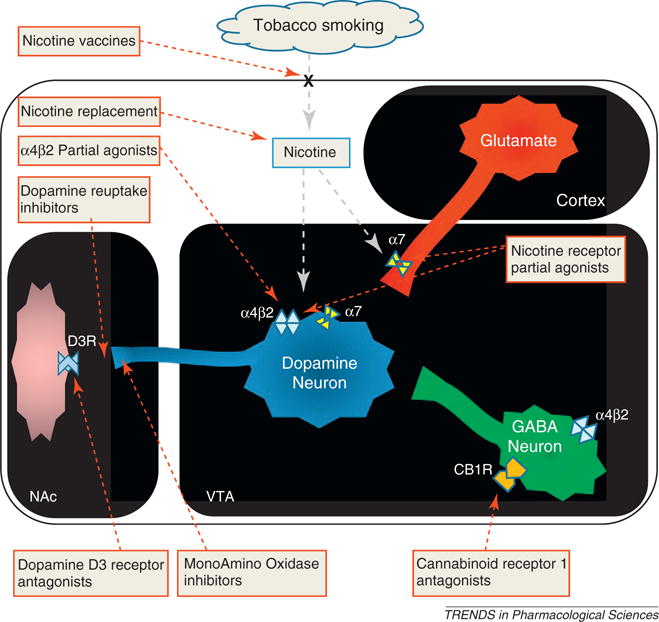
Tobacco use is a global pandemic that poses a substantial and costly health burden. There are some treatment options are available, but currently marketed smoking-cessation drugs lack high levels of efficacy, particularly in real-life settings. Consequently, there is a compelling need for more effective pharmacotherapies to aid smokers in maintaining long-term abstinence. Advances in the understanding of the mechanisms involved in nicotine dependence have recently been translated into new medications and vaccines that interfere with nicotine signaling, many of which are currently at an advanced stage of development. In the present article we review current and emerging pharmacotherapies for tobacco dependence, focusing on the mechanistic rationale for their potential anti-addiction efficacy, major findings in preclinical and clinical studies, and future research directions.
Copyright © 2010 Elsevier Ltd. All rights reserved.
Conflict of interest statement
R.P. has received lecture fees from Pfizer and GlaxoSmithKline and a research grant from Pfizer; he has also served as a consultant to Pfizer and Global Health Alliance for the treatment of tobacco dependence. N.B. serves as a consultant to Pfizer and has consulted in the past with several other pharmaceutical companies that are developing smoking-cessation medications.
Figures
References
-
- World Health Organization (WHO) Tobacco or Health: a Global Status Report. World Health Organization; 1997. pp. 1–32.
-
- US Department of Health and Human Services. The Health Consequences of Amoking: A Report of the Surgeon General. US Department of Health and Human Services, Centers for Disease Control and Prevention, National Center for Chronic Disease Prevention and Health Promotion, Office on Smoking and Health; 2004.
-
- Arcavi L, Benowitz NL. Cigarette smoking and infection. Arch Intern Med. 2004;20:2206–2216. - PubMed
-
- US Department of Health and Human Services. The Health Benefits of Smoking Cessation. US Department of Health and Human Services, Public Health Service, Centers for Disease Control, Center for Chronic Disease Prevention and Health Promotion, Office on Smoking and Health; 1990. (DHHS Publication No. (CDC) 90-8516).
Publication types
MeSH terms
Substances
Grants and funding
LinkOut - more resources
Full Text Sources
Other Literature Sources
Medical
