. 2011 May;69(5):1447-57.
doi: 10.1016/j.joms.2010.07.018. Epub 2011 Jan 21.

Three-dimensional regional displacements after mandibular advancement surgery: one year of follow-up

Affiliations

Three-dimensional regional displacements after mandibular advancement surgery: one year of follow-up

Alexandre T Motta et al. J Oral Maxillofac Surg. 2011 May.

Abstract

Purpose: To evaluate the association of 3-dimensional changes in the position of the condyles, rami, and chin at splint removal and 1 year after mandibular advancement surgery.

Patients and methods: This prospective observational study used preoperative and postoperative scans of 27 subjects presenting with a skeletal Class II jaw relationship with a normal or deep overbite. An automatic technique of cranial base superimposition was used to assess the positional and/or remodeling changes in the anatomic regions of interest. The displacements were visually displayed and quantified using 3-dimensional color maps. The positive and negative values of surface distances in the color maps indicated the direction of the displacements. Pearson correlation coefficients and a linear model for correlated data were used to evaluate the association between the regional displacements.

Results: The postoperative adaptations in the chin position between splint removal and 1 year after surgery were significantly negatively correlated with changes in the borders of the posterior ramus (left, r = -0.73, P ≤ .0001; and right, r = -0.68, P = .00) and the condyles (left, r = -0.53, P = .01; and right, r = -0.46, P = .02), indicating that these structures tended to be displaced in the same direction. Even though the mean condylar displacement with surgery was less than 1 mm, individual displacements greater than 2 mm with surgery were observed for 24% of the condyles. The condylar displacements were maintained at 1 year after surgery for 17% of the condyles.

Conclusions: The surface distance displacements indicated that the postoperative adaptations at different anatomic regions were significantly related.


Figures

FIGURE 1
FIGURE 1
A, After registration procedure with IMAGINE software, superimposition between 3D model (color) and gray scale preoperative image can be observed with ITK-SNAP software, showing matching cranial bases and displaced mandibular structures (mandibular advancement and genioplasty). Aa, axial; Ab, sagittal; Ad, coronal; Ac, note 3D toolbox has tool for painting specific anatomic regions of interest. B, Anatomic regions of interest: 1, right condyle; 2, left condyle; 3, right posterior ramus; 4, left posterior ramus; 5, right superior ramus; 6, left superior ramus; 7, right inferior ramus; 8, left inferior ramus; and 9, chin; Ba, right view; Bb, left view.
FIGURE 2
FIGURE 2
Visualization of right condyle displaced posteriorly, superiorly, and medially between preoperative and postoperative images. A, Color-coded maps indicate outward displacements in red and inward displacements in blue; B, Semitransparencies with preoperative image in solid white and postoperative in transparent red. A, anterior P, posterior.
FIGURE 3
FIGURE 3
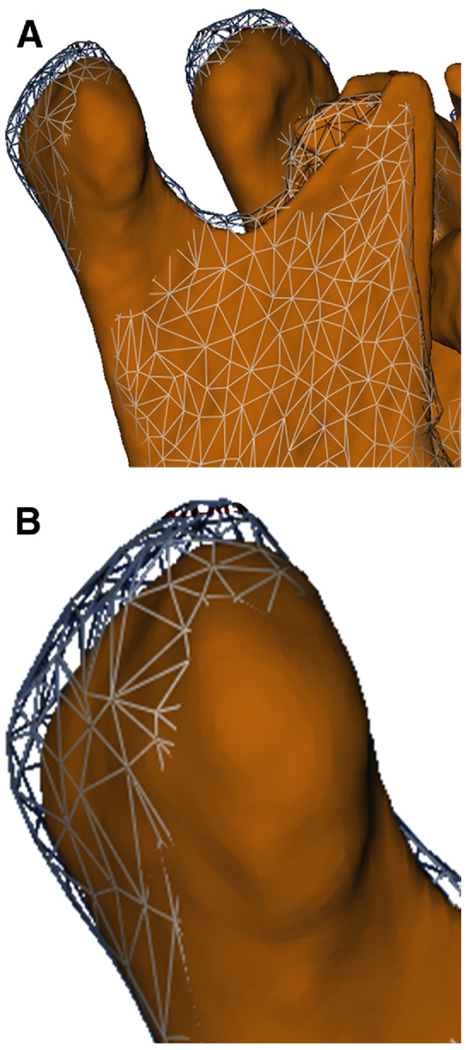
A, Different method to visualize displacements, with mesh-transparencies showing condyle displacement of 3.2 mm after surgery. B, Close-up view of displaced condyle.
FIGURE 4
FIGURE 4
Color map of 3D surface model at 1 year after surgery displaying surface distances of changes between splint removal and 1 year follow-up examination. Visual illustration of how displacements in same direction (posterior) shown using different colors at different anatomic regions: chin shown in blue and posterior border of ramus in red. Note, blue indicates inward displacements relative to bony surfaces at splint removal and red indicates outward displacements.
FIGURE 5
FIGURE 5
Semitransparent overlay of 3D surface models with preoperative image (white) and splint removal (red). A, Visualization showing 6.8-mm mandibular advancement measured at chin. B, Posterior view of lateral displacements of rami (proximal surgical segments). Sagittal osteotomy probably acted as a wedge and condyles as a fulcrum, causing displacement of inferior part of rami.
FIGURE 6
FIGURE 6
Graphic display of observed and predicted mean chin displacement given explanatory measures of right and left condyles and posterior ramus borders using multivariate normal modeling approach. Postoperative displacements of condyles and posterior borders explained 67% of variability in adaptation of the chin (observed chin displacement).
FIGURE 7
FIGURE 7
Semitransparencies between preoperative (solid white) and at splint removal (transparent red) 3D models for 2 patients in present study. Note, variability of surgical displacements to advance mandible. A, In some cases, mandibular advancement was accompanied by vertical increase, and B, other patients had more anterior advancement. Also note, small, but varying, condylar displacements.
FIGURE 8
FIGURE 8
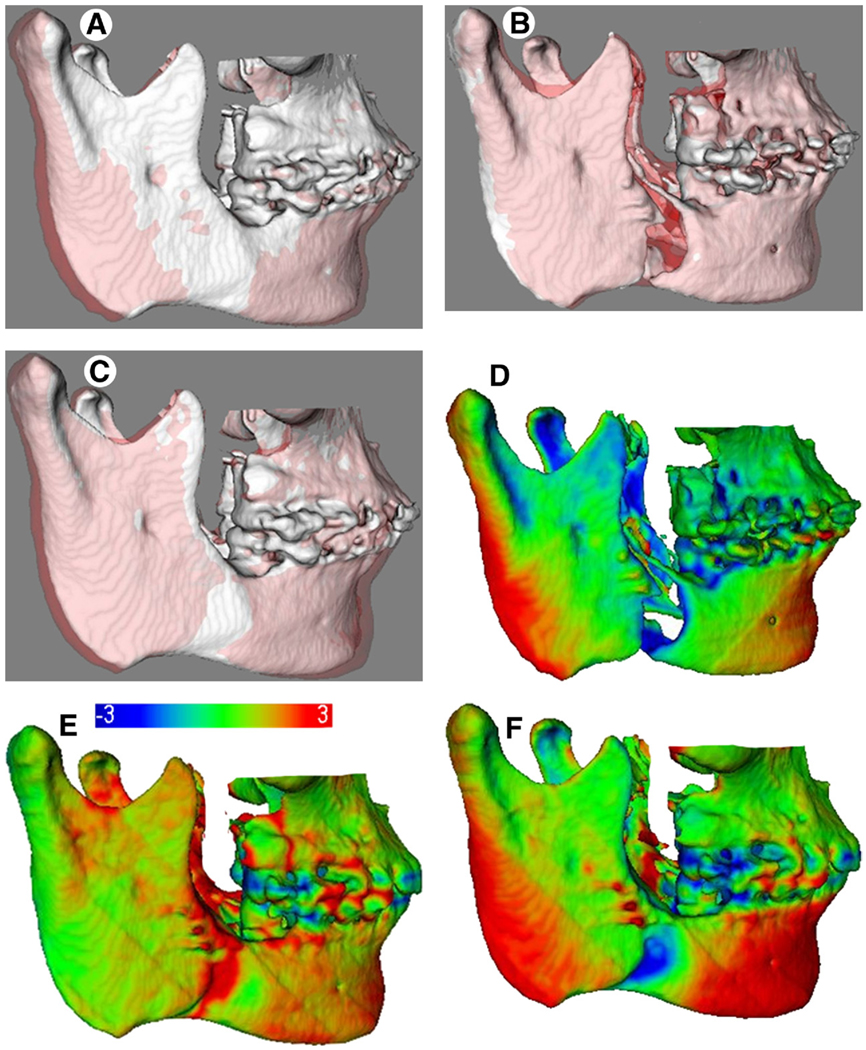
Example of patient with anterior displacement of corpus with mandibular advancement, complemented by adjunctive chin advancement with genioplasty. A–C, Superimposition of semitransparencies; D–F, surface distance color maps between models in Figs A, B, and C, respectively. A, Preoperative (white) to splint removal (semitransparent red); B, splint removal (white) to 1 year postoperatively (semitransparent red); C, preoperative (white) to 1 year postoperatively (semitransparent red). Comparison between Figs A and C (preoperative in white) showed that small condylar and rami displacements occurred with surgery, but surgical results were maintained at 1 year of follow-up. Color maps in Fig E also revealed stability of results in postoperative period.
FIGURE 9
FIGURE 9
Example of patient who presented with more vertical than horizontal changes shown in superimpositions with color maps (Left) and semitransparencies (Right). Small overjet but deep overbite was present, and improvement of the lower facial height was planned. A–C, Superimposition of semitransparencies; D–F, surface distance color maps between models in Figs A, B, C, respectively. A, Preoperative (white) to splint removal (semitransparent red) showing large posterior displacement at rami and condyles and vertical displacement at chin with surgery. B, Splint removal (white) to 1 year postoperatively (semitransparent red) showing mandibular anterior movement in postoperative adaptation period. C, Preoperative (white) to 1 year postoperatively (semitransparent red). Note, slight additional anterior movement in Fig B resulted in more marked and improved chin anterior and vertical displacements in Fig C, with some of posterior displacement at condyles and rami maintained 1 year after surgery.
FIGURE 10
FIGURE 10
A–C, Preoperative and D–F, 1 year postoperative photographs of patient described in Figure 9. Note, effect of lateral displacement of rami in frontal photograph, A, D.

References

    1. Bailey LJ, Cevidanes LH, Proffit WR. Stability and predictability of orthognathic surgery. Am J Orthod Dentofac Orthop. 2004;126:273. - PMC - PubMed
    1. Proffit WR, Turvey TA, Phillips C. Orthognathic surgery: A hierarchy of stability. Int J Adult Orthodon Orthognath Surg. 1996;11:191. - PubMed
    1. Efstratiadis S, Baumrind S, Shofer F, et al. Evaluation of Class II treatment by cephalometric regional superimpositions versus conventional measurements. Am J Orthod Dentofac Orthop. 2005;128:607. - PubMed
    1. Costa F, Robiony M, Toro C, et al. Condylar positioning devices for orthognathic surgery: A literature review. Oral Surg Oral Med Oral Pathol Oral Radiol Endod. 2008;106:179. - PubMed
    1. Alder ME, Deahl ST, Matteson SR, et al. Short-term changes of condylar position after sagittal split osteotomy for mandibular advancement. Oral Surg Oral Med Oral Pathol Oral Radiol Endod. 1999;87:159. - PubMed

Publication types

MeSH terms