


2B4+ CD8+ T cells play an inhibitory role against constrained HIV epitopes
- PMID: 21256826
- PMCID: PMC3063451
- DOI: 10.1016/j.bbrc.2011.01.062
2B4+ CD8+ T cells play an inhibitory role against constrained HIV epitopes
Abstract
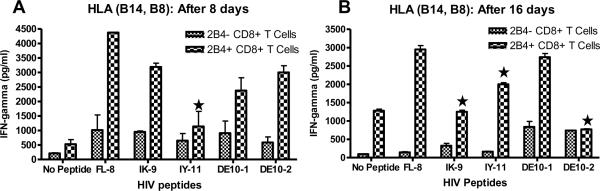
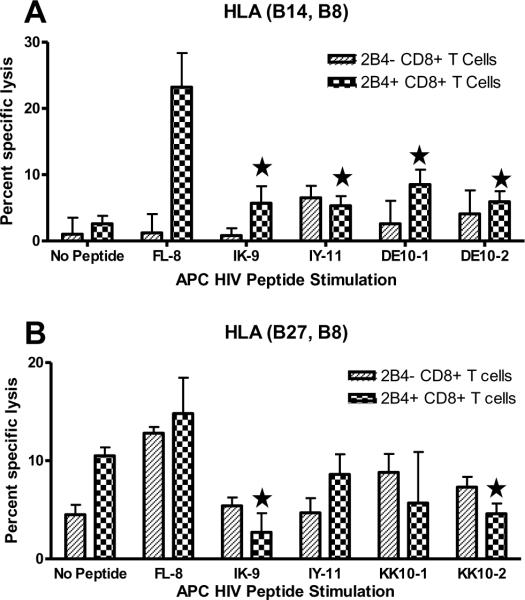
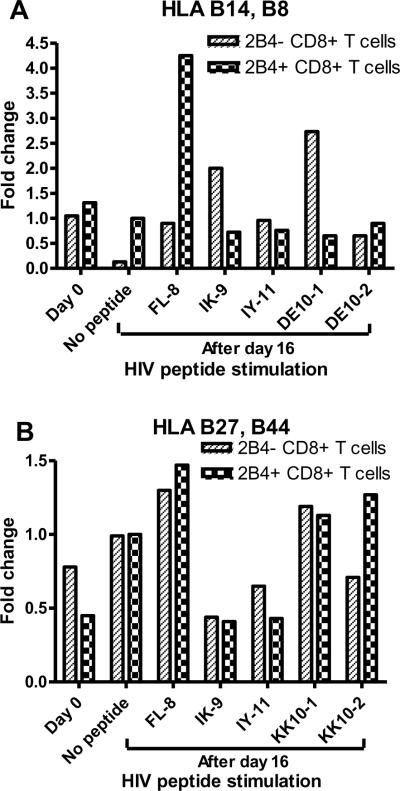
Cytotoxic T cells play a critical role in the control of HIV and the progression of infected individuals to AIDS. 2B4 (CD244) is a member of the SLAM family of receptors that regulate lymphocyte development and function. The expression of 2B4 on CD8+ T cells was shown to increase during AIDS disease progression. However, the functional role of 2B4+ CD8+ T cells against HIV infection is not known. Here, we have examined the functional role of 2B4+ CD8+ T cells during and after stimulation with HLA B14 or B27 restricted HIV epitopes. Interestingly, IFN-γ secretion and cytotoxic activity of 2B4+ CD8+ T cells stimulated with HIV peptides were significantly decreased when compared to influenza peptide stimulated 2B4+ CD8+ T cells. The expression of the signaling adaptor molecule SAP was downregulated in 2B4+ CD8+ T cells upon HIV peptide stimulation. These results suggest that 2B4+ CD8+ T cells play an inhibitory role against constrained HIV epitopes underlying the inability to control the virus during disease progression.
Published by Elsevier Inc.
Figures
References
-
- Schneidewind A, Brockman MA, Sidney J, Wang YE, Chen H, Suscovich TJ, Li B, Adam RI, Allgaier RL, Mothe BR, Kuntzen T, Oniangue-Ndza C, Trocha A, Yu XG, Brander C, Sette A, Walker BD, Allen TM. Structural and functional constraints limit options for cytotoxic T-lymphocyte escape in the immunodominant HLA-B27-restricted epitope in human immunodeficiency virus type 1 capsid. J. Virol. 2008;82:5594–5605. - PMC - PubMed
-
- den Uyl D, van der Horst-Bruinsma IE, van Agtmael M. Progression of HIV to AIDS: a protective role for HLA-B27? AIDS Rev. 2004;6:89–96. - PubMed
-
- Imami N, Gotch F. Mechanisms of loss of HIV-1-specific T-cell responses. J. HIV Ther. 2002;7:30–34. - PubMed
-
- Brooks JM, Colbert RA, Mear JP, Leese AM, Rickinson AB. HLA-B27 subtype polymorphism and CTL epitope choice: studies with EBV peptides link immunogenicity with stability of the B27:peptide complex. J. Immunol. 1998;161:5252–5259. - PubMed
-
- Sacha JB, Chung C, Rakasz EG, Spencer SP, Jonas AK, Bean AT, Lee W, Burwitz BJ, Stephany JJ, Loffredo JT, Allison DB, Adnan S, Hoji A, Wilson NA, Friedrich TC, Lifson JD, Yang OO, Watkins DI. Gag-specific CD8+ T lymphocytes recognize infected cells before AIDS-virus integration and viral protein expression. J. Immunol. 2007;178:2746–2754. - PMC - PubMed
Publication types
MeSH terms
Substances
Grants and funding
LinkOut - more resources
Full Text Sources
Medical
Research Materials
Miscellaneous
