


doi: 10.1128/AEM.02328-10.
Epub 2011 Jan 21.
Prevalence and genetic diversity of Aichi viruses in wastewater and river water in Japan
Affiliations
- PMID: 21257803
- PMCID: PMC3067340
- DOI: 10.1128/AEM.02328-10
Item in Clipboard
Prevalence and genetic diversity of Aichi viruses in wastewater and river water in Japan
Appl Environ Microbiol.
2011 Mar.
Abstract
Aichi virus (AiV) genomes were detected in 12 (100%) influent and 11 (92%) effluent wastewater and 36 (60%) river water samples. Among 260 strains identified, 255 were genotype A and 5 were genotype B. This is the first report describing the molecular characterization of AiVs in aquatic environments in Japan.
Figures
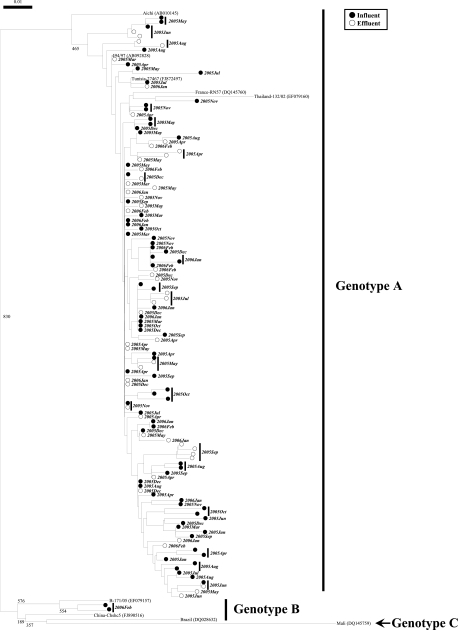
Phylogenetic tree of AiV strains identified in wastewater samples. The tree was constructed on the basis of sequences of a 224-nucleotide stretch within the 3CD junction region. The numbers on each branch indicate bootstrap values for the genotype, and bootstrap values of 950 or greater were considered statistically significant for grouping. The scale represents nucleotide substitutions per site. Filled and open circles indicate AiV strains detected in influent and effluent wastewater samples, respectively. The year and month are shown in bold italics beside the symbols.
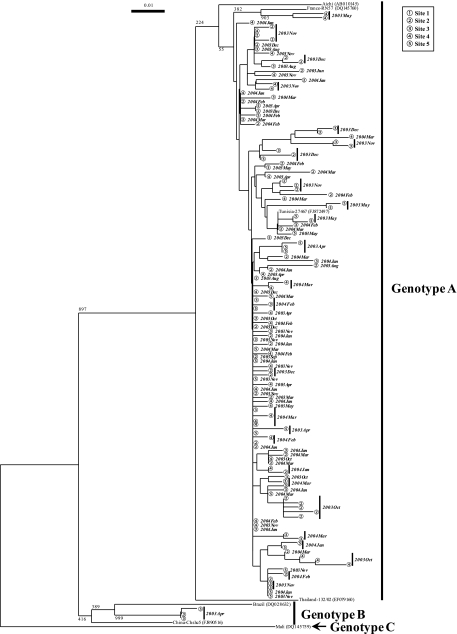
Phylogenetic tree of AiV strains identified in water samples from the Tamagawa River. The tree was constructed on the basis of sequences of a 224-nucleotide stretch within the 3CD junction region. The numbers on each branch indicate bootstrap values for the genotype, and bootstrap values of 950 or greater were considered statistically significant for grouping. The scale represents nucleotide substitutions per site. Circled numbers indicate AiV strains detected at each sampling site. The year and month are shown in bold italics beside the symbols.
References
-
- Goyer, M., L. S. Aho, J. B. Bour, K. Ambert-Balay, and P. Pothier. 2008. Seroprevalence distribution of Aichi virus among a French population in 2006-2007. Arch. Virol. 153:1171-1174. - PubMed
-
- Hansman, G. S., et al. 2008. Detection of human enteric viruses in Japanese clams. J. Food Prot. 71:1689-1695. - PubMed
Publication types
MeSH terms
Associated data
- Actions
- Actions
- Actions
- Actions
- Actions
- Actions
- Actions
- Actions
- Actions
- Actions
- Actions
- Actions
- Actions
- Actions
- Actions
- Actions
- Actions
- Actions
- Actions
- Actions
- Actions
- Actions
- Actions
- Actions
- Actions
- Actions
- Actions
- Actions
- Actions
- Actions
- Actions
- Actions
- Actions
- Actions
- Actions
- Actions
- Actions
- Actions
- Actions
- Actions
- Actions
- Actions
- Actions
- Actions
- Actions
- Actions
- Actions
- Actions
- Actions
- Actions
- Actions
- Actions
- Actions
- Actions
- Actions
- Actions
- Actions
- Actions
- Actions
- Actions
- Actions
- Actions
- Actions
- Actions
- Actions
- Actions
- Actions
- Actions
- Actions
- Actions
- Actions
- Actions
- Actions
- Actions
- Actions
- Actions
- Actions
- Actions
- Actions
- Actions
- Actions
- Actions
- Actions
- Actions
- Actions
- Actions
- Actions
- Actions
- Actions
- Actions
- Actions
- Actions
- Actions
- Actions
- Actions
- Actions
- Actions
- Actions
- Actions
- Actions
- Actions
- Actions
- Actions
- Actions
- Actions
- Actions
- Actions
- Actions
- Actions
- Actions
- Actions
- Actions
- Actions
- Actions
- Actions
- Actions
- Actions
- Actions
- Actions
- Actions
- Actions
- Actions
- Actions
- Actions
- Actions
- Actions
- Actions
- Actions
- Actions
- Actions
- Actions
- Actions
- Actions
- Actions
- Actions
- Actions
- Actions
- Actions
- Actions
- Actions
- Actions
- Actions
- Actions
- Actions
- Actions
- Actions
- Actions
- Actions
- Actions
- Actions
- Actions
- Actions
- Actions
- Actions
- Actions
- Actions
- Actions
- Actions
- Actions
- Actions
- Actions
- Actions
- Actions
- Actions
- Actions
- Actions
- Actions
- Actions
- Actions
- Actions
- Actions
- Actions
- Actions
- Actions
- Actions
- Actions
- Actions
- Actions
- Actions
- Actions
- Actions
- Actions
- Actions
- Actions
- Actions
- Actions
- Actions
- Actions
- Actions
- Actions
- Actions
- Actions
- Actions
- Actions
- Actions
- Actions
- Actions
- Actions
- Actions
- Actions
- Actions
- Actions
- Actions
- Actions
- Actions
- Actions
- Actions
- Actions
- Actions
- Actions
- Actions
- Actions
- Actions
- Actions
- Actions
- Actions
- Actions
- Actions
- Actions
- Actions
- Actions
- Actions
- Actions
- Actions
- Actions
- Actions
- Actions
- Actions
- Actions
- Actions
- Actions
- Actions
- Actions
- Actions
- Actions
- Actions
- Actions
- Actions
- Actions
- Actions
- Actions
- Actions
- Actions
- Actions
- Actions
- Actions
- Actions
- Actions
- Actions
- Actions
- Actions
- Actions
- Actions
- Actions
- Actions
- Actions
- Actions
- Actions
- Actions
- Actions
LinkOut - more resources
Full Text Sources
