. 2011 Sep;45(3):632-41.
doi: 10.1165/rcmb.2010-0397OC. Epub 2011 Jan 21.

Cytoprotective-selective activated protein C attenuates Pseudomonas aeruginosa-induced lung injury in mice

Affiliations

Cytoprotective-selective activated protein C attenuates Pseudomonas aeruginosa-induced lung injury in mice

Nastasha Bir et al. Am J Respir Cell Mol Biol. 2011 Sep.

Abstract

Inhibition of the small GTPase RhoA attenuates the development of pulmonary edema and restores positive alveolar fluid clearance in a murine model of Pseudomonas aeruginosa pneumonia. Activated protein C (aPC) blocks the development of an unfavorably low ratio of small GTPase Rac1/RhoA activity in lung endothelium through endothelial protein C receptor (EPCR)/protease-activated receptor-1 (PAR-1)-dependent signaling mechanisms that include transactivating the sphingosine-1-phosphate (S1P) pathway. However, whether aPC's cytoprotective effects can attenuate the development of pulmonary edema and death associated with P. aeruginosa pneumonia in mice remains unknown. Thus, we determined whether the normalization of a depressed ratio of activated Rac1/RhoA by aPC would attenuate the P. aeruginosa-mediated increase in protein permeability across lung endothelial and alveolar epithelial barriers. Pretreatment with aPC significantly reduced P. aeruginosa-induced increases in paracellular permeability across pulmonary endothelial cell and alveolar epithelial monolayers via an inhibition of RhoA activation and a promotion of Rac1 activation that required the EPCR-PAR-1 and S1P pathways. Furthermore, pretreatment with aPC attenuated the development of pulmonary edema in a murine model of P. aeruginosa pneumonia. Finally, a cytoprotective-selective aPC mutant, aPC-5A, which lacks most of aPC's anticoagulant activity, reproduced the protective effect of wild-type aPC by attenuating the development of pulmonary edema and decreasing mortality in a murine model of P. aeruginosa pneumonia. Taken together, these results demonstrate a critical role for the cytoprotective activities of aPC in attenuating P. aeruginosa-induced lung vascular permeability and mortality, suggesting that cytoprotective-selective aPC-5A with diminished bleeding risks could attenuate the lung damage caused by P. aeruginosa in critically ill patients.


Figures

Figure 1.
Figure 1.
Activated protein C (aPC) attenuates P. aeruginosa–induced increase in permeability via an inhibition of the small GTPase RhoA in bovine pulmonary endothelial and human microvascular lung endothelial cell monolayers. Bovine pulmonary artery cell (BPAEC) and human microvascular lung endothelial cell (HMVEC) monolayers were treated with the wild-type P. aeruginosa strain (PAK) (bacterial to bovine cell ratio, 1:2) or its vehicle. Cell monolayers were treated with recombinant human aPC (0.01–1.0 μg/ml) or its vehicle for 1 hour before stimulation with P. aeruginosa (PAK) or its vehicle. (A) aPC decreased PAK-induced permeability in a dose-dependent manner in BPAEC monolayers. (B) Pretreatment with aPC inhibited PAK-induced increase in RhoA activity in BPAEC monolayers. (C) aPC increased the ratio of Rac1/RhoA activity in BPAEC monolayers. (D) Pretreating cells with aPC inhibited PAK-induced formation of actin stress fibers in BPAEC monolayers. (E) aPC decreased PAK-induced permeability. (F) Pretreatment with aPC inhibited PAK-induced increase in RhoA activity in HMVEC monolayers. (G) aPC increased the ratio of Rac1/RhoA activity in HMVEC monolayers. All experiments were performed at least in triplicate, and repeated four times. Results are shown as mean ± SD. *P < 0.05 vs. control samples. **P < 0.05 vs. PAK-treated cell monolayers.
Figure 2.
Figure 2.
aPC attenuates P. aeruginosa–induced increase in paracellular permeability via an inhibition of small GTPase RhoA in rat alveolar epithelial Type II (ATII) cell monolayers. Rat ATII cell monolayers were treated with wild-type P. aeruginosa strain PAK (bacterial to rat cell ratio, 1:2) or its vehicle. Cell monolayers were treated with recombinant human aPC (1.0 μg/ml) or its vehicle for 1 hour before stimulation with P. aeruginosa (PAK) or its vehicle. (A) aPC decreased PAK-induced permeability in a dose-dependent manner in ATII cell monolayers. (B) Pretreatment with aPC inhibited PAK-induced increase in RhoA activity in ATII cell monolayers. (C) aPC increased the ratio of Rac1/RhoA activity in ATII cell monolayers. All experiments were performed at least in triplicate, and repeated four times. Results are mean ± SD, *P < 0.05 vs. control samples. **P < 0.05 vs. PAK-treated cell monolayers.
Figure 3.
Figure 3.
aPC attenuation of P. aeruginosa–induced increase in paracellular permeability is mediated via the endothelial protein C receptor (EPCR) and protease-activated receptor 1 (PAR-1) pathway, and the sphingosine-1–phosphate (S1P) and the phosphoinositide-3 kinase (PI3K) pathway, in bovine pulmonary endothelial cell monolayers. Bovine pulmonary artery cell (BPAEC) monolayers were treated with wild-type P. aeruginosa strain PAK (bacterial to bovine cell ratio, 1:2) or its vehicle. Cell monolayers were treated with recombinant human aPC (1.0 μg/ml) or its vehicle for 1 hour before stimulation with P. aeruginosa (PAK) or its vehicle. Some cell monolayers were also treated with a blocking antibody (Ab) to either EPCR or PAR-1 or their respective isotype control antibodies for 1 hour before stimulation with P. aeruginosa (PAK). (A) aPC (1.0 μg/ml) decreased PAK-induced permeability across BPAEC monolayers, but this effect was reversed with antibody blockade of either EPCR or PAR-1. (B) Blocking EPCR or PAR-1 receptors completely blocked the ability of aPC pretreatment (1.0 μg/ml) to inhibit the PAK-mediated increase in RhoA activity in BPAEC monolayers. Results are mean ± SD. *P < 0.05 vs. control samples. **P < 0.05 vs. PAK + aPC–treated BPAEC monolayers. (C) aPC (1.0 μg/ml) caused a significant increase in the phosphorylation of SK1. *P < 0.05 vs. control samples. (D) aPC decreased PAK-induced permeability, but this effect was blocked by pretreatment of cells with an SK1 inhibitor, dimethylsphingosine (DMS). *P < 0.05 vs. PAK-treated cell monolayers. **P < 0.05 vs. PAK + aPC–treated cell monolayers. (E) Pretreatment with a specific agonist for S1P1 receptor SEW2871 for 1 hour before exposure to PAK significantly attenuated PAK-mediated increase in paracellular permeability. *P < 0.05 vs. control samples. **P < 0.05 vs. PAK-treated cell monolayers. (F) Cell monolayers were treated with recombinant human aPC (1.0 μg/ml), a specific PI3K inhibitor N-(2,3-Dihydro-7,8-dimethoxyimidazo [1,2-c]quinazolin-5-yl)-3-pyridinecarboxamide (PIK-90) and/or their vehicle for 1 hour before stimulation with P. aeruginosa (PAK) or its vehicle. Results are mean ± SD. *P < 0.05 vs. control samples. **P < 0.05 vs. PAK + aPC–treated cell monolayers. For A–F, results are mean ± SD. Experiments were performed at least in triplicate, and repeated four times.
Figure 4.
Figure 4.
Cytoprotective-selective 3K3A-aPC attenuates P. aeruginosa–induced increase in paracellular permeability via EPCR and PAR-1 in bovine pulmonary artery and human microvascular lung endothelial cell monolayers. Bovine pulmonary artery endothelial cell (BPAEC) and human microvascular lung endothelial cell (HMVEC) monolayers were treated with wild-type P. aeruginosa strain PAK (bacterial to bovine/human cell ratio, 1:2) or its vehicle. Cell monolayers were treated with recombinant human cytoprotective-selective 3K3A-aPC (1.0 μg/ml) or its vehicle for 1 hour before stimulation with P. aeruginosa (PAK) or its vehicle. (A and B) 3K3A-aPC decreased PAK-induced permeability across bovine and human lung endothelial cell monolayers. *P < 0.05 vs. control samples. **P < 0.05 vs. PAK-treated cell monolayers. (C and D) Cytoprotective-selective 3K3A-aPC decreased PAK-induced permeability, but this effect was reversed by blocking either EPCR or PAR-1 across bovine and human lung endothelial cell monolayers. *P < 0.05 vs. control samples. **P < 0.05 vs. PAK ± aPC–treated cell monolayers. For A–D, results are mean ± SD. Each experiment was repeated at least four times.
Figure 5.
Figure 5.
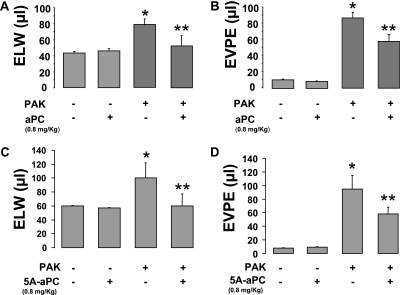
Pretreatment with cytoprotective-selective 5A-aPC reduces pulmonary edema in a murine model of P. aeruginosa pneumonia. C57BL/6 mice were treated with wild-type murine aPC or cytoprotective-selective murine 5A-aPC (0.8 mg/kg, intraperitoneal) or their vehicle, 1 hour before exposure of airspace to P. aeruginosa or its vehicle for 4 hours (n = 5 in each group). (A and C) Pretreatment with wild-type aPC or 5A-aPC significantly reduced pulmonary edema induced by P. aeruginosa. (B and D) Pretreatment with wild-type aPC or 5A-aPC significantly reduced lung vascular protein permeability induced by P. aeruginosa. ELW, extravascular lung water; EVPE, lung endothelial permeability to protein. Results are mean ± SD. *P < 0.05 vs. control samples. **P < 0.05 vs. mice treated with airspace P. aeruginosa and aPC vehicle.
Figure 6.
Figure 6.
Pretreatment with cytoprotective-selective 5A-aPC attenuates alterations in alveolar epithelial permeability and fluid transport in a murine model of P. aeruginosa pneumonia. C57BL/6 mice were treated with murine 5A-aPC (0.8 mg/kg, intraperitoneal) or its vehicle, 1 hour before exposure of airspace to P. aeruginosa or its vehicle for 4 hours (n = 5 in each group). (A and B) Pretreatment with 5A-aPC attenuates P. aeruginosa-induced alteration in alveolar epithelial permeability. AFC, alveolar fluid clearance; BAL, bronchoalveolar lavage. Results are presented as mean ± SD. *P < 0.05 vs. control samples. **P < 0.05 vs. mice treated with airspace P. aeruginosa and 5A-aPC vehicle.
Figure 7.
Figure 7.
Pretreatment with cytoprotective-selective 5A-aPC does not attenuate neutrophil recruitment into the airspace, and does not decrease lung myeloperoxidase activity or BAL fluid levels of keratinocyte-derived cytokine (KC), but decreases mortality in a murine model of P. aeruginosa pneumonia. (A–D) C57BL/6 mice were treated with non-anticoagulant murine 5A-aPC (0.8 mg/kg intraperitoneal) or its vehicle, 1 hour before exposure of airspace to P. aeruginosa or its vehicle for 8 hours (n = 5 in each group). BAL was performed, cells were counted, and myeloperoxidase (MPO) activity and KC levels were measured as described in Materials and Methods. For all experiments in A–D, results are shown as mean ± SD. (E) C57BL/6 mice were treated twice with murine 5A-aPC (0.8 mg/kg, intraperitoneal) or its vehicle, 1 hour before and 12 hours after exposure of airspace to P. aeruginosa or its vehicle. Kaplan-Meier survival analysis was performed (n = 10 mice in each experimental group). Mice treated with 5A-aPC had 40% survival at 60 hours after exposure of airspace to P. aeruginosa, whereas all mice treated only with control vehicle died within 28 hours after onset of P. aeruginosa pneumonia (P < 0.05).

References

    1. Rello J, Allegri C, Rodriguez A, Vidaur L, Sirgo G, Gomez F, Agbaht K, Pobo A, Diaz E. Risk factors for ventilator-associated pneumonia by Pseudomonas aeruginosa in presence of recent antibiotic exposure. Anesthesiology 2006;105:709–714 - PubMed
    1. Rello J, Rue M, Jubert P, Muses G, Sonora R, Valles J, Niederman MS. Survival in patients with nosocomial pneumonia: impact of the severity of illness and the etiologic agent. Crit Care Med 1997;25:1862–1867 - PubMed
    1. Gunther A, Mosavi P, Heinemann S, Ruppert C, Muth H, Markart P, Grimminger F, Walmrath D, Temmesfeld-Wollbruck B, Seeger W. Alveolar fibrin formation caused by enhanced procoagulant and depressed fibrinolytic capacities in severe pneumonia: comparison with the acute respiratory distress syndrome. Am J Respir Crit Care Med 2000;161:454–462 - PubMed
    1. Neyrinck AP, Liu KD, Howard JP, Matthay MA. Protective mechanisms of activated protein C in severe inflammatory disorders. Br J Pharmacol 2009;158:1034–1047 - PMC - PubMed
    1. Mosnier LO, Zlokovic BV, Griffin JH. The cytoprotective protein C pathway. Blood 2007;109:3161–3172 - PubMed

Publication types