. 2011 Mar;43(3):264-8.
doi: 10.1038/ng.759. Epub 2011 Jan 23.

Chromatin accessibility pre-determines glucocorticoid receptor binding patterns

Affiliations

Chromatin accessibility pre-determines glucocorticoid receptor binding patterns

Sam John et al. Nat Genet. 2011 Mar.

Abstract

Development, differentiation and response to environmental stimuli are characterized by sequential changes in cellular state initiated by the de novo binding of regulated transcriptional factors to their cognate genomic sites. The mechanism whereby a given regulatory factor selects a limited number of in vivo targets from a myriad of potential genomic binding sites is undetermined. Here we show that up to 95% of de novo genomic binding by the glucocorticoid receptor, a paradigmatic ligand-activated transcription factor, is targeted to preexisting foci of accessible chromatin. Factor binding invariably potentiates chromatin accessibility. Cell-selective glucocorticoid receptor occupancy patterns appear to be comprehensively predetermined by cell-specific differences in baseline chromatin accessibility patterns, with secondary contributions from local sequence features. The results define a framework for understanding regulatory factor-genome interactions and provide a molecular basis for the tissue selectivity of steroid pharmaceuticals and other agents that intersect the living genome.


Figures
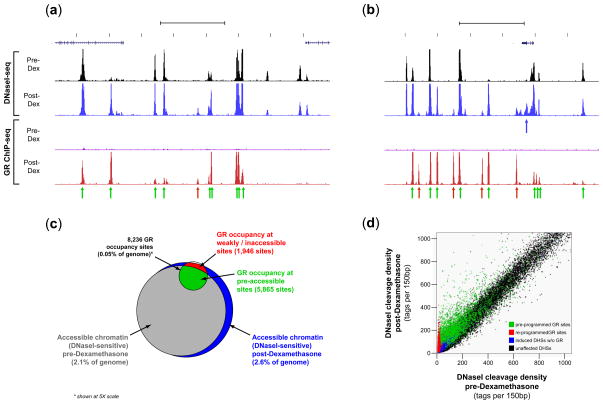
FIGURE 1
FIGURE 1. Dominant effect of chromatin accessibility on GR occupancy patterns
(a–b) Examples of DNaseI sensitivity and GR occupancy patterns in relation to dexamethasone exposure (see Supplementary Figure 2a–c for additional examples). Each data track shows tag density (150bp sliding window) from either DNaseI-seq or GR ChIP-seq, normalized to allow comparison across different samples (Online Methods). Green arrows mark sites of post-hormone GR occupancy in pre-existing DNaseI-sensitive chromatin (‘pre-programmed’ sites). Red arrows mark GR occupancy sites in pre-hormone inaccessible chromatin that result in post-hormone chromatin remodeling (‘re-programmed’ sites). Blue arrows mark hormone-induced DHSs not directly associated with GR occupancy (see also Supplementary Fig 4c). (c) Venn diagram summarizing global GR occupancy vs. chromatin accessibility landscape (~25M read depth) in mammary cells (Note: for legibility, GR circle shown at 5X scale). Most GR occupancy occurs within pre-hormone accessible chromatin. A small fraction of generally weak GR peaks (5.2% of total) are not associated with re-programmed or pre-programmed chromatin. (d) DNaseI sensitivity (tag density) pre-hormone (horizontal axis) vs. post-hormone (vertical axis). Colors match those used in panel (c). Black = pre-hormone accessible regions with no post-hormone GR occupancy. Blue = DNaseI-sensitive regions induced post-hormone without GR occupancy (see Supplementary Fig 4c). Green = pre-hormone DNaseI sensitive regions occupied by GR post-hormone (‘pre-programmed’ sites). Red = pre-hormone inaccessible chromatin remodeled by GR occupancy (‘re-programmed’ sites), resulting in marked alteration in DNaseI sensitivity. (see Supplementary Fig 4a–b).
FIGURE 2
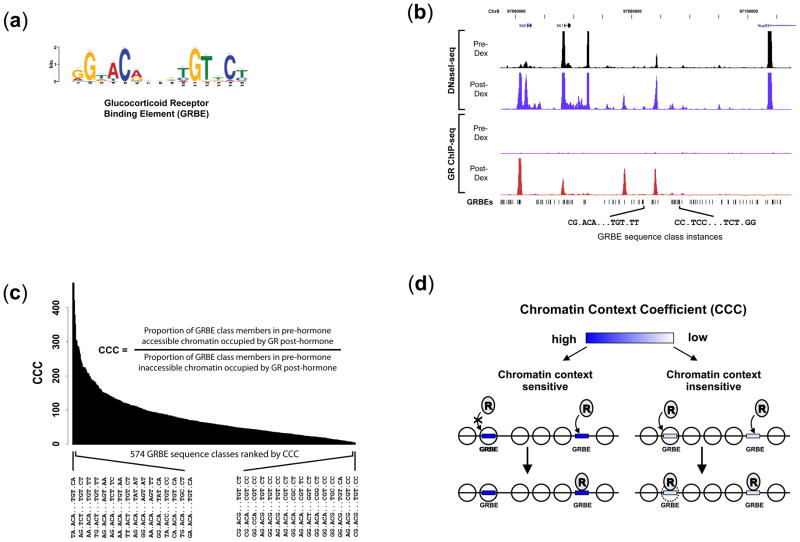
FIGURE 2. Quantitative effect of chromatin context on GR occupancy of GRBEs
(a) Top scoring motif recovered from de novo motif discovery performed on the top 500 GR occupancy sites by ChIP-seq tag density (MEME E-value: 8.6e−753) closely matches the consensus glucocorticoid receptor binding element (GRBE). (b) 50kb genomic region comparing pre-and post-hormone chromatin accessibility and GR occupancy in relation to GRBE genomic sequence matches (P<10−3). Only a small fraction of the ~2.3×10⁶ GRBE consensus sites are occupied in vivo, and occupied sites differ in their underlying combinations of consensus GRBE motif nucleotides. (c) GRBE sequence classes ranked by Chromatin Context Coefficient (CCC). Genomic GRBE motif matches can be partitioned into discrete sequence classes, each comprising an identical (and distinct) combination of consensus nucleotides. Within each class of identical sequence elements, occurrence of member genomic sequences in a range of pre-hormone DNaseI sensitivity environments (from inaccessible to hyperaccessible) enables quantification of the effect of chromatin context on the probability of post-hormone GR occupancy. Ranking specific GRBE sequence classes by CCC reveals graded sensitivity to chromatin context, from highly context-dependent elements that engender GR occupancy only when situated in accessible chromatin, to relatively context-independent elements associated with sites where GR occupancy induces chromatin remodeling. (d) Model illustrating the contribution of chromatin accessibility to transcription factor binding. CCC encodes the occupancy potential of different GRBE sequence classes relative to accessibility.
FIGURE 3
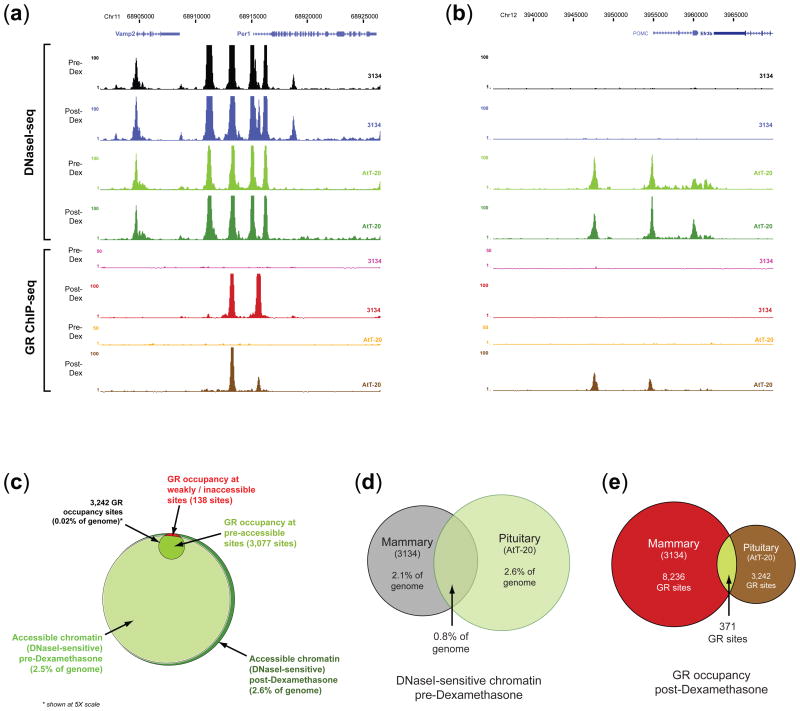
FIGURE 3. Cell-specific chromatin landscapes determine cell-selective GR occupancy
(a–b) Pituitary-specific GR occupancy dictated by pituitary-specific DNaseI sensitivity transitions. Shown are examples of DNaseI sensitivity and GR occupancy patterns in relation to hormone exposure comparing mouse mammary (3134) and pituitary (AtT-20) cells (see Fig.1 legend and Supplementary Fig.8a-c for additional examples). (c) Global GR occupancy vs. chromatin accessibility landscape in pituitary cells. In pituitary cells, virtually all sites of GR occupancy (94.9%, 3,079/3,242 sites) occur within pre-hormone accessible chromatin. The small fraction of re-programmed GR sites (138 GR ChIP peaks, 4.2% of total) is shown in red. As in mammary cells, only a small fraction of pre-hormone accessible chromatin is occupied (note: for legibility, GR circle shown at 5X scale). (d) Significant differences in genomic distribution of pre-hormone DNaseI sensitivity in mammary (grey) vs. pituitary (green) cells; only 0.78% of genome (20.5Mb) is accessible in both cell types. (e) GR occupancy is highly cell-selective. Only 371 GR occupancy sites are shared between mammary and pituitary cells (4.5% of 3134 sites and 11.4% of AtT-20 sites).
FIGURE 4
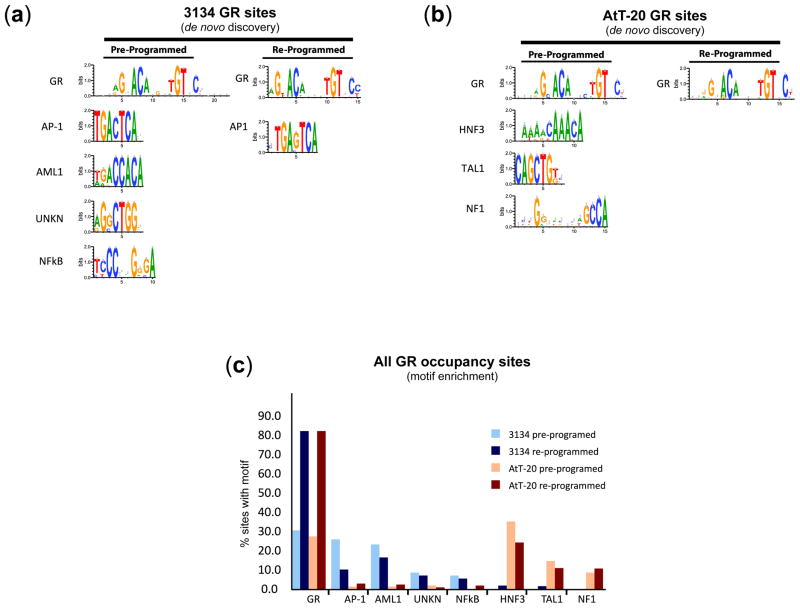
FIGURE 4. Regulatory motifs in GR-occupied regions differ substantially between cell types
(a–b) Results of de novo motif discovery (see Supplementary Notes) performed on the top 500 GR occupancy sites identified in 3134 (panel a) and AtT-20 (panel b). The GR sites were further separated into pre-programmed (GR occupancy within pre-hormone accessible chromatin) vs. re-programmed (GR occupancy within pre-hormone inaccessible chromatin) sites. Shown are motifs with highly significant enrichment (e<10−5). In all cases, the GRBE is the most highly enriched single motif (8.6e−753). Notably, AP1 and AML1 motifs are enriched in 3134 cells (panel a) while HNF3 and NF1 are correspondingly enriched in AtT-20 (panel b). (c). Motif occurrence patterns across all GR occupancy sites. Bar plots show percentage of all GR occupancy sites (8,236 sites in 3134 cells vs. 3,242 sites in AtT-20) that harbor significant matches to the de novo-identified motifs from panels a–b. Note that canonical GRBEs are highly enriched in re-programmed sites vs. pre-programmed sites (>80% of re-programmed sites vs. <30% of pre-programmed sites, P<10−4).

References

    1. Britten RJ, Davidson EH. Gene regulation for higher cells: a theory. Science. 1969;165:349–357. - PubMed
    1. McKenna NJ, O'Malley BW. Combinatorial control of gene expression by nuclear receptors and coregulators. Cell. 2002;108:465–474. - PubMed
    1. Okita K, Ichisaka T, Yamanaka S. Generation of germline-competent induced pluripotent stem cells. Nature. 2007;448:313–317. - PubMed
    1. Evans RM. The steroid and thyroid hormone receptor superfamily. Science. 1988;240:889–895. - PMC - PubMed
    1. Felsenfeld G, Groudine M. Controlling the double helix. Nature. 2003;421:448–453. - PubMed

Publication types