. 2011 Feb;13(2):124-31.
doi: 10.1038/ncb2151. Epub 2011 Jan 23.

PP2A activates brassinosteroid-responsive gene expression and plant growth by dephosphorylating BZR1

Affiliations

PP2A activates brassinosteroid-responsive gene expression and plant growth by dephosphorylating BZR1

Wenqiang Tang et al. Nat Cell Biol. 2011 Feb.

Abstract

When brassinosteroid levels are low, the GSK3-like kinase BIN2 phosphorylates and inactivates the BZR1 transcription factor to inhibit growth in plants. Brassinosteroid promotes growth by inducing dephosphorylation of BZR1, but the phosphatase that dephosphorylates BZR1 has remained unknown. Here, using tandem affinity purification, we identified protein phosphatase 2A (PP2A) as a BZR1-interacting protein. Genetic analyses demonstrated a positive role for PP2A in brassinosteroid signalling and BZR1 dephosphorylation. Members of the B' regulatory subunits of PP2A directly interact with BZR1's putative PEST domain containing the site of the bzr1-1D mutation. Interaction with and dephosphorylation by PP2A are enhanced by the bzr1-1D mutation, reduced by two intragenic bzr1-1D suppressor mutations, and abolished by deletion of the PEST domain. This study reveals a crucial function for PP2A in dephosphorylating and activating BZR1 and completes the set of core components of the brassinosteroid-signalling cascade from cell surface receptor kinase to gene regulation in the nucleus.


Figures

Figure 1
Figure 1. Identification of PP2A as a BZR1-interacting phosphatase
(a) Yeast two-hybrid assays showing the interaction between BZR1 and PP2A B’ family members. (b) Gel blots of phosphorylated (pBZR1) and unphosphorylated (BZR1) MBP-BZR1 were probed with GST-PP2AB’α (B’α) or GST-BIN2 (BIN2) followed by HRP labelled anti-GST antibody, or stained with Ponceau S (Stain) to show equal loading. (c) BiFC assays showing that BZR1 interacts with PP2A B’α, B’β, B’η but not B’ε in Nicotiana Benthamiana leaf epidermal cells. Left column shows bright field and right column BiFC fluorescence. Scale bars represent 50 μm. (d) Co-immunoprecipitation of BZR1 with PP2A. Arabidopsis plants expressing BZR1::BZR1-CFP were treated with 100 nM brassinolide (BL) or mock solution for 15 min. BZR1-CFP was immunoprecipitated using anti-YFP antibody, and the immunoblots were probed with antibodies against YFP or the PP2A C subunits. Full scans of immunoblots are shown in Supplementary Information, Fig. S9.
Figure 2
Figure 2. Overexpression of PP2AB’α and PP2AB’β activates BR signalling and partially suppresses BR signalling mutants
(a) Wild-type (Col), bzr1-1D, and seedlings overexpressing PP2AB’α-YFP or PP2AB’β-YFP fusion protein in the Col background were grown in the dark for 4 days on regular MS medium (MS) or MS medium containing 2 μM brassinazole (BRZ). Scale bars are 5 mm. (b) Overexpression of PP2AB’α-YFP and PP2AB’β-YFP partially suppresses the bri1-5 mutant. Wild type (WS), bri1-5, and bri1-5 transformed with 35S::PP2AB’α-YFP (B’α-OX) or PP2AB’β-YFP (B’β-OX) were grown in the dark for 4 days. Scale bar are 5 mm. Inset shows anti-YFP immunoblot (upper band) of the transgenic plants and Ponceau S staining as loading control (lower band). (c) Expression levels of the CPD gene in seedlings shown in panel b were analyzed by quantitative RT-PCR. Values shown indicate fold-increase over normalized wild-type (Ws) expression levels. The difference between bri1-5 and B’-OX or wild type plants is statistically significant (P<0.05, n=3). Error bars represent SE. (d) Four-week old light-grown plants of wild type (WS), bri1-5, and bri1-5 overexpressing PP2AB’β (B’β OX/bri1-5). Scale bars = 10 mm. (e) Immunoblot analysis of BZR1 in transgenic plants overexpressing PP2AB’α or PP2AB’β in the bri1-5 mutant or wild type background. Arrows mark the phosphorylated (+P) and unphosphorylated (-P) BZR1, and the asterisk marks a non-specific band that serves as loading reference. Full scan of immunoblot is shown in Supplementary Information, Fig. S9. (f) Overexpression of PP2ABβ-YFP partially suppresses the homozygous bri1-116 null mutant. Scale bars = 10 mm. (g) Overexpression of PP2AB’β-YFP partially suppresses the homozygous bin2-1 mutant phenotype. The bin2-1 mutant was crossed with the bzr1-1D mutant and with transgenic plants overexpressing PP2AB’β, BSK3, and BSU1. Scale bars = 10 mm.
Figure 3
Figure 3. PP2A is essential for BR signalling and BZR1 dephosphorylation
(a) A wild type plant and two pp2ab’αβ double mutant plants grown in the light for four weeks. Scale bars = 10 mm. (b) Immunoblotting analysis of phosphorylated (+P) and unphosphorylated (-P) BZR1 in plants shown in panel a, using the anti-BZR1 antibody. St, Ponceau S staining of blot shows loading. The ratio between phosphorylated and unphosphorylated BZR1 bands (+P/-P) and the level of unphosphorylated BZR1 relative to that observed in the wild type (-P%) were calculated after normalization against the intensity of Ponceau S staining and are shown beneath the gel images. (c) Six-day old dark-grown seedlings of wild type and the pp2ab’αβ double mutant with short hypocotyls. Scale bar = 5 mm. (d) Protein extracts were isolated from seven-day old BZR1::BZR1-CFP transgenic Arabidopsis seedlings grown in the absence (-OA) or presence of 250 nM okadaic acid (+OA) and treated with 100 nM BL for 30 min. After SDS-PAGE and transfer, the immunoblot was probed with anti-YFP antibody. +P/-P, ratio between phosphorylated and unphosphorylated BZR1. (e) Nine-day old light-grown seedlings of homozygous bin2-1 mutant were treated with mock solution or 1 μM okadaic acid for 1 hr, then with 50 μM bikinin for 15 min. BZR1 phosphorylation was analyzed by immunoblotting using the anti-BZR1 antibody. +P/-P, ratio between phosphorylated and unphosphorylated BZR1. Full scans of immunoblots are shown in Supplementary Information, Fig. S9.
Figure 4
Figure 4. PP2A B’ subunit binds to the PEST domain of BZR1 to promote BZR1 dephosphorylation in vivo
(a) Sequence of the region of BZR1 (aligned with the corresponding sequences of BZR2 and rice OsBZR1), containing the PP2A-binding domain and the bzr1-1D, bzs247 and bzs248 mutations (amino acid substitutions shown in boxes). (b) Yeast two-hybrid assay of PP2A binding by various fragments of BZR1 shown by box diagrams. Yeast growth on –AH medium indicates interaction between the BZR1 fragment and PP2AB’α. (c) Deletion of the PP2A-binding domain abolishes BR-induced BZR1 dephosphorylation in plants. Two-week old plants of a 35S::BZR1-YFP transgenic line expressing the wild type BZR1-YFP, or three independent transgenic lines expressing the mutant BZR1-YFP containing deletion of amino acids 232-251 (ΔPEST-A, -B, and -C lines), were treated with mock solution or 250 nM brassinolide (BL) for 1 hr. (d) The bzr1-1D mutation increases dephosphorylation of BZR1 in planta. Upper panel shows an immunoblot of BZR1/bzr1-1D protein extracted from wild type (BZR1) and bzr1-1D mutant plants. In each sample, the upper band is phosphorylated (pBZR1) and the lower band is unphosphorylated (BZR1) protein. Stain, Ponceau S staining shows equal loading. (e) PP2A binds more strongly to the bzr1-1D protein. MBP-BZR1 and MBP-bzr1-1D proteins were gel-blotted on a nitrocellulose membrane and probed sequentially with GST-PP2AB’α and anti-GST antibody. Lower panel shows Ponceau S staining of the gel blot. (f) From left to right are wild type, bzr1-1D, bzr1-1D bzs247 and bzr1-1D bzs248 seedlings grown in the dark on 2 μM BRZ for 5 days. Scale bar = 2.5 mm. (g) Anti-BZR1 immunoblot shows the phosphorylated BZR1 (pBZR1) and unphosphorylated BZR1 (BZR1) in the plants shown in panel f. (h) The bzs mutations reduce PP2A binding. Equal amounts of MBP, MBP-BZR1, MBP-bzr1-1D, and MBP-bzr1-1D containing bzs247 and bzs248 mutations were gel blotted to nitrocellulose membrane and probed with GST-PP2AB’α or GST-BIN2 and anti-GST antibody, and the blots were subsequently stained with Ponceau S (Stain). Full scans of immunoblots are shown in Supplementary Information, Fig. S9.
Figure 5
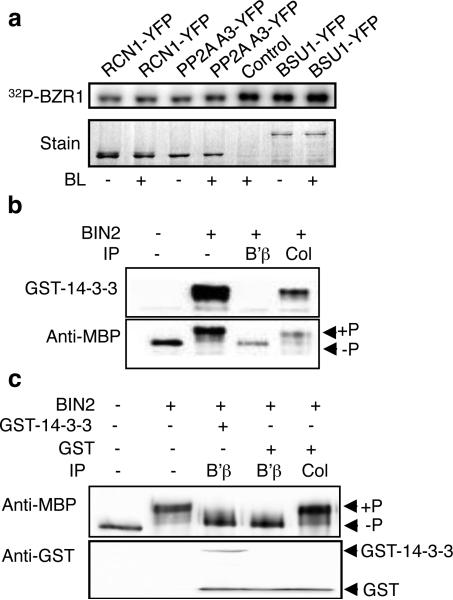
Figure 5. PP2A dephosphorylates BZR1 and abolishes its binding by the 14-3-3 proteins
(a) MBP-BZR1 protein was phosphorylated by BIN2 using 32P-γATP, and then incubated at 30 degree for 3 hr with PP2A (RCN1-YFP, PP2AA3-YFP) or BSU1-YFP, which were immunoprecipitated from BL-treated (+, 1 hr) or untreated (-) transgenic Arabidopsis plants. The control reaction used anti-YFP immunoprecipitate from non-transgenic plants. Lower panel shows the Coomassie Blue staining of the precipitated YFP fusion proteins. (b) Recombinant MBP-BZR1 (-BIN2) was phosphorylated by BIN2 in vitro (+BIN2), and then incubated with anti-YFP immunoprecipitate from wild type control plants (Col) or from the 35S::PP2AB’β-YFP transgenic plants (B’β) for 3.5 hr in the presence of 30 μM bikinin. The proteins were separated by SDS-PAGE, blotted, and incubated with GST-14-3-3 protein plus anti-GST antibody to detect binding by 14-3-3, or with anti-MBP antibody to detect phosphorylated (+P) and unphosphorylated (-P) MBP-BZR1. (c) Pre-incubation of BIN2-phosphorylated BZR1 with the 14-3-3 protein did not interfere with its dephosphorylation by PP2A. BIN2-phosphorylated BZR1 was pre-incubated with GST or GST-14-3-3 for 1 hr and then dephosphorylated by anti-YFP immunoprecipitation product from Col control (Col) or 35S::PP2A-B’β-YFP (B’β) for another 1 hr. Phosphorylated (+P) and unphosphorylated (-P) BZR1 are marked by arrows. Full scans of immunoblots are shown in Supplementary Information, Fig. S9.

References

    1. Kim TW, Wang ZY. Brassinosteroid Signal Transduction from Receptor Kinases to Transcription Factors. Annu Rev Plant Biol. 2010;61:681–704. - PubMed
    1. Vert G, Nemhauser JL, Geldner N, Hong F, Chory J. Molecular mechanisms of steroid hormone signaling in plants. Annu Rev Cell Dev Biol. 2005;21:177–201. - PubMed
    1. Clouse SD. Brassinosteroids. Plant counterparts to animal steroid hormones? Vitam Horm. 2002;65:195–223. - PubMed
    1. Tang W, Deng Z, Wang ZY. Proteomics shed light on the brassinosteroid signaling mechanisms. Curr Opin Plant Biol. 2010;23:27–33. - PMC - PubMed
    1. Kim T-W, et al. Brassinosteroid signal transduction from cell-surface receptor kinases to nuclear transcription factors. Nat Cell Bio. 2009;11:1254–1260. - PMC - PubMed

Publication types

MeSH terms