


Review
doi: 10.1039/c0np00057d.
Epub 2011 Jan 24.
Isolation and analysis of ginseng: advances and challenges
Affiliations
- PMID: 21258738
- PMCID: PMC3056508
- DOI: 10.1039/c0np00057d
Item in Clipboard
Review
Isolation and analysis of ginseng: advances and challenges
Nat Prod Rep.
2011 Mar.
Abstract
Ginseng occupies a prominent position in the list of best-selling natural products in the world. Because of its complex constituents, multidisciplinary techniques are needed to validate the analytical methods that support ginseng's use worldwide. In the past decade, rapid development of technology has advanced many aspects of ginseng research. The aim of this review is to illustrate the recent advances in the isolation and analysis of ginseng, and to highlight new applications and challenges. Emphasis is placed on recent trends and emerging techniques.
Figures

Procedures for isolation of ginseng saponins from ginseng plant materials.

Chemical structures of recently isolated dammarane-type saponins from ginseng, compounds 1–71.

Chemical structures of recently isolated dammarane-type saponins from ginseng, compounds 72–95.

Chemical structures of recently isolated dammarane-type saponins from ginseng, compounds 96–123.

Online chromatographic knockout technique, modified from Ref. . An example is shown for American ginseng, ginsenosides Re and Rb1 are knocked out simultaneously.

Immunoaffinity chromatographic method for preparation of Rb1 knockout extract from P. ginseng extract, modified from Ref. . The red spot in the upper right shows Rb1. Lines 1, 2, and 3 in thin layer chromatography (TLC) plate located in the low right indicate crude extract, knockout extract, and purified Rb1, respectively.

General strategy for identification of ginseng saponins in ginseng samples by mass spectrometry (MSn and accurate mass experiments).

Mass spectrometry (MS) characterization of malonyl-ginsenoside Rb1 by tandem MS in negative ion mode. (A) Sequential mass spectrometric analysis of deprotonated malonyl-ginsenoside Rb1. (B) Interpretation of the fragmentation pattern. Experimental conditions were shown in Ref. .

HPLC-UV chromatograms of ginseng roots and chemical degradation in steaming process, modified from Ref. . (A) Ethanol extract of American ginseng, Asian ginseng and notoginseng root. (B) Ethanol extract of steamed ginseng roots at 120 °C for 4 h. Chromatographic separation was performed on a Prodigy ODS column. Detection wavelength was set at 202 nm. The mobile phase used acetonitrile and water for a gradient elution.

Proposed in vivo metabolic pathways of ginseng saponins. (A) protopanaxadiol-type saponins. (B) protopanaxatriol-type saponins. “→” denotes major pathways; “⤏” denotes additional pathways. [P]: metabolites detected in plasma; [U]: metabolites in urine; [F]: metabolites in feces; [B]: metabolites in bile. ig: metabolites after oral administration; iv: metabolites after intravenous injection.
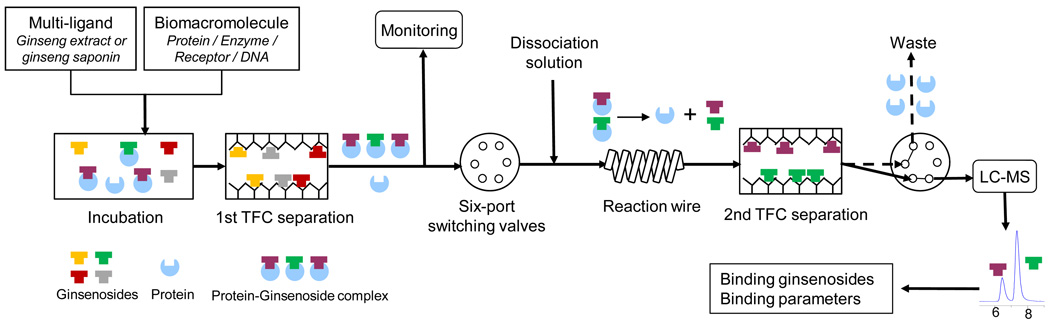
Schematic diagram of the two-dimensional turbulent flow column-switching LC/MS apparatus, modified from Ref. . Ginseng extract or ginseng saponin is incubated with the target biomacromolecule. The first turbulent flow chromatography (TFC) that only retains low-molecular-weight analytes is used to separate free compounds and protein-ginsenoside complex. The captured complex is disrupted in reaction wire by dissociation solution. The compounds released are separated and enriched from biomacromolecules by the second TFC. Online-LC/MS is used to determine the structural information and affinity parameters of the binding compounds.
References
-
- Li P, Qi LW, Liu EH, Zhou JL, Wen XD. Trac-Trends Anal. Chem. 2008;27:66–77.
-
- Fishbein AB, Wang CZ, Li XL, Mehendale SR, Sun S, Aung HH, Yuan CS. Arch. Pharm. Res. 2009;32:505–513. - PubMed
-
- Li GY, Zeng YM, Meng H, Li X, Wang JH. Chinese Chem. Lett. 2009;20:1207–1210.
Publication types
MeSH terms
Substances
Grants and funding
LinkOut - more resources
Full Text Sources
Other Literature Sources
Miscellaneous
