Review
. 2011 Sep;17(9):2325-36.
doi: 10.1007/s00894-010-0951-x. Epub 2011 Jan 22.

RNA and protein 3D structure modeling: similarities and differences

Affiliations
Review

RNA and protein 3D structure modeling: similarities and differences

Kristian Rother et al. J Mol Model. 2011 Sep.

Abstract

In analogy to proteins, the function of RNA depends on its structure and dynamics, which are encoded in the linear sequence. While there are numerous methods for computational prediction of protein 3D structure from sequence, there have been very few such methods for RNA. This review discusses template-based and template-free approaches for macromolecular structure prediction, with special emphasis on comparison between the already tried-and-tested methods for protein structure modeling and the very recently developed "protein-like" modeling methods for RNA. We highlight analogies between many successful methods for modeling of these two types of biological macromolecules and argue that RNA 3D structure can be modeled using "protein-like" methodology. We also highlight the areas where the differences between RNA and proteins require the development of RNA-specific solutions.


Figures
Figure
Figure
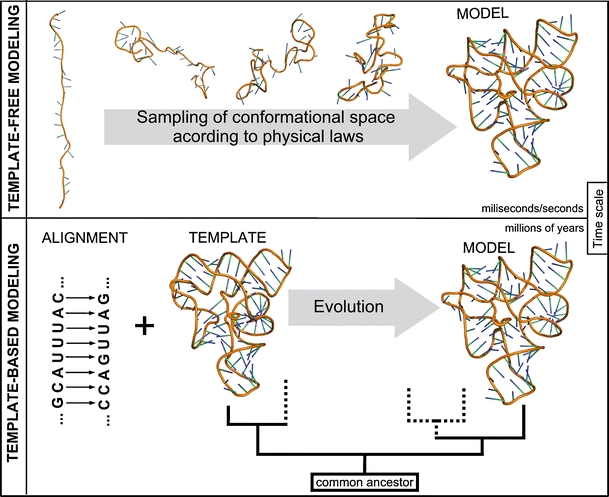
Approaches for predicting RNA structure. Top: Template-free modeling. Bottom: Template-based modeling
Fig. 1
Fig. 1
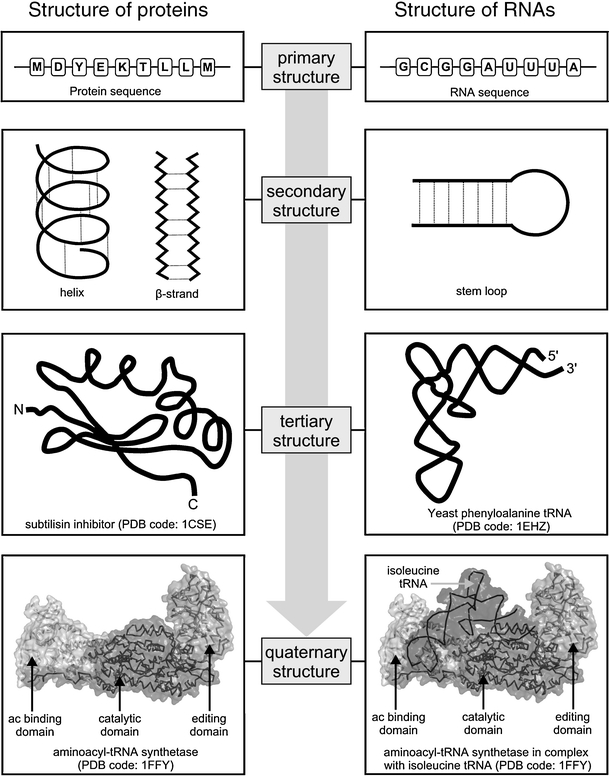
Hierarchical structure of proteins and RNAs
Fig. 2
Fig. 2
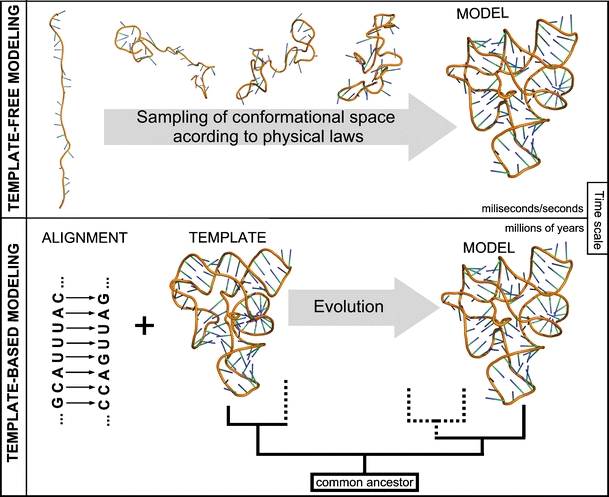
Template-dependent and template-free approaches to prediction of macromolecular structures, exemplified by the modeling of evolution and folding, respectively
Fig. 3
Fig. 3
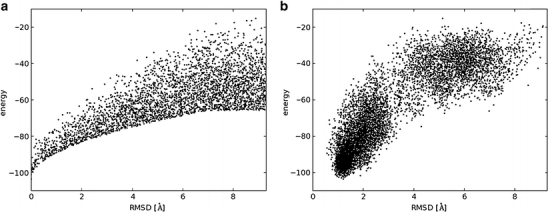
A funnel-like relationship between the value of a function for scoring of structural models and their deviation from the native structure (expressed e.g., in root mean square deviation of superimposable atoms or in some other similarity measure): (a) a hypothetical “ideal” function that maximizes the discrimination between native, native-like and non-native conformations. The minimal value of energy as well as the spread of energy values for conformations at a particular distance from the native structure (corresponding to the global energy minimum) increase monotonically with the increasing distance, so conformations closer to the native structure on the average exhibit lower energies than those farther away. Here a random sample of points that fulfill this relationship is shown. (b) results of folding simulations of an immunoglobulin light chain-binding domain of protein L (2ptl in the Protein Data Bank), carried out using the REFINER method [20], which uses a Monte Carlo sampling scheme and a statistical potential

References

    1. Dill KA. Dominant forces in protein folding. Biochemistry. 1990;29:7133–7155. doi: 10.1021/bi00483a001. - DOI - PubMed
    1. Ferre-D'Amare AR, Doudna JA. RNA folds: insights from recent crystal structures. Annu Rev Biophys Biomol Struct. 1999;28:57–73. doi: 10.1146/annurev.biophys.28.1.57. - DOI - PubMed
    1. Thirumalai D, Hyeon C. RNA and protein folding:common themes and variations. Biochemistry. 2005;44:4957–4970. doi: 10.1021/bi047314+. - DOI - PubMed
    1. Laskowski RA, Thornton JM. Understanding the molecular machinery of genetics through 3D structures. Nat Rev Genet. 2008;9:141–151. doi: 10.1038/nrg2273. - DOI - PubMed
    1. Laederach A. Informatics challenges in structured RNA. Brief Bioinform. 2007;8:294–303. doi: 10.1093/bib/bbm026. - DOI - PMC - PubMed

Publication types

LinkOut - more resources