Review
. 2011 Feb 18;50(8):1770-91.
doi: 10.1002/anie.201002313. Epub 2011 Jan 21.

The Tn antigen-structural simplicity and biological complexity

Affiliations
Review

The Tn antigen-structural simplicity and biological complexity

Tongzhong Ju et al. Angew Chem Int Ed Engl. .

Abstract

Glycoproteins in animal cells contain a variety of glycan structures that are added co- and/or posttranslationally to proteins. Of over 20 different types of sugar-amino acid linkages known, the two major types are N-glycans (Asn-linked) and O-glycans (Ser/Thr-linked). An abnormal mucin-type O-glycan whose expression is associated with cancer and several human disorders is the Tn antigen. It has a relatively simple structure composed of N-acetyl-D-galactosamine with a glycosidic α linkage to serine/threonine residues in glycoproteins (GalNAcα1-O-Ser/Thr), and was one of the first glycoconjugates to be chemically synthesized. The Tn antigen is normally modified by a specific galactosyltransferase (T-synthase) in the Golgi apparatus of cells. Expression of active T-synthase is uniquely dependent on the molecular chaperone Cosmc, which is encoded by a gene on the X chromosome. Expression of the Tn antigen can arise as a consequence of mutations in the genes for T-synthase or Cosmc, or genes affecting other steps of O-glycosylation pathways. Because of the association of the Tn antigen with disease, there is much interest in the development of Tn-based vaccines and other therapeutic approaches based on Tn expression.


Figures

Scheme 1
Scheme 1
Structures of the Tn antigen and O‐glycan derivatives of the Tn antigen. The Tn antigen is a precursor for many types of O‐glycans, which are designated as core 1, core 2, and core 3 structures. These structures may be further modified, as shown in Scheme 3.
Scheme 2
Scheme 2
Chemical synthesis of Tn antigen by α glycosylation of Ser or Thr building blocks. For details on the synthetic strategies shown, see references and the text. In (a), an azidosugar halogen donor is used,22, 32–40, 334, 335 whereas in (b), an azidosugar thiophenyl donor is used.24 Bn=benzyl, Fmoc=9‐fluorenylmethoxycarbonyl, Tf2O=trifluoromethanesulfonic anhydride.
Scheme 3
Scheme 3
Biosynthesis of the Tn antigen and different O‐glycan core structures derived from the Tn precursor.
Figure 1
Figure 1
Molecular basis for the production of normal O‐glycans and for the expression of Tn and sialyl‐Tn antigen in cells lacking functional T‐synthase owing to loss of function of Cosmc.61 Left: Cosmc is expressed in the endoplasmic reticulum, where it binds to newly synthesized T‐synthase and assists in folding of the enzyme and its acquisition of activity. The dimeric T‐synthase can then move to the Golgi apparatus, where it functions to add galactose residues from the donor UDP‐Gal to the Tn‐antigen precursor of O‐glycans. Normal O‐glycans may be sialylated to generate the sialylated core 1 O‐glycans, or may be elongated to extended core 1 structures or core 2 O‐glycans (see Scheme 3). Right: In the absence of functional Cosmc, the newly synthesized T‐synthase in the ER is misfolded, retrotranslocated to the cytoplasm, ubiquitinated, and degraded in the 26S proteasome. The lack of functional T‐synthase in the Golgi apparatus leads to expression of the Tn and sialyl‐Tn antigens on the cell surface and secreted glycoproteins.61, 83, 134
Figure 2
Figure 2
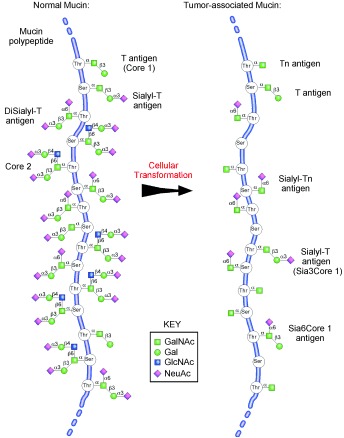
Mucins and the expression of Tn and sialyl‐Tn antigens. Typical mucins contain large numbers of Ser, Thr, and Pro residues in the backbone polypeptide and an abundance of GalNAcα1‐O‐Ser/Thr modifications. In normal mucins, the GalNAcα1‐O‐Ser/Thr residues are modified to contain different core glycans, as shown in Scheme 3. However, upon cellular transformation, the modification of GalNAcα1‐O‐Ser/Thr may be compromised, and cells may generate tumor‐associated mucins containing the tumor‐associated carbohydrate antigens (TACAs) Tn, sialyl‐Tn, and T. One mechanism for the expression of the Tn and sialyl‐Tn antigens on mucins is the loss of function of the chaperone Cosmc (Figure 1), but other factors could also lead to elevated expression of these TACAs, as discussed in the text.
Figure 3
Figure 3
IgA1 and O‐glycosylation of the hinge region. Whereas normal IgA1 contains core 1 type O‐glycans at about five sites in the hinge region, IgA1 from patients with IgA nephropathy displays O‐glycans with reduced amounts of galactose, and many chains are truncated and contain the Tn and STn antigens.

References

    1. Moreau R., Dausset J., Bernard J., Moullec J., Bull. Mem. Soc. Med. Hop. Paris 1957, 73, 569–587. - PubMed
    1. Huebner G., Z. Immunitaetsforsch. Exp. Ther. 1926, 45, 223–248.
    1. Thomsen O., Z. Immunitaetsforsch. Exp. Ther. 1927, 52, 85–107.
    1. Thomsen O., C. R. Seances Soc. Biol. Ses Fil. 1927, 96, 556–558.
    1. Thomsen O., Z. Immunitaetsforsch. Exp. Ther. 1928, 57, 301–319.

Publication types

MeSH terms

LinkOut - more resources