Comparative Study
. 2011 Jan 24;12(1):16.
doi: 10.1186/1465-9921-12-16.

Greater severity of new onset asthma in allergic subjects who smoke: a 10-year longitudinal study

Affiliations
Comparative Study

Greater severity of new onset asthma in allergic subjects who smoke: a 10-year longitudinal study

Riccardo Polosa et al. Respir Res. .

Abstract

Background: Little is known about the association between cigarette smoking and asthma severity. We assessed smoking as a determinant of disease severity and control in a cohort of clinic-referred allergic subjects who developed new onset asthma.

Methods: Allergic rhinitis subjects with no asthma (n = 371) were followed-up for 10 years and routinely examined for asthma diagnosis. In those who developed asthma (n = 152), clinical severity and levels of asthma control were determined. Among these subjects, 74 (48.7%) were current smokers, 17 (11.2%) former smokers, and 61 (40.1%) never smokers.

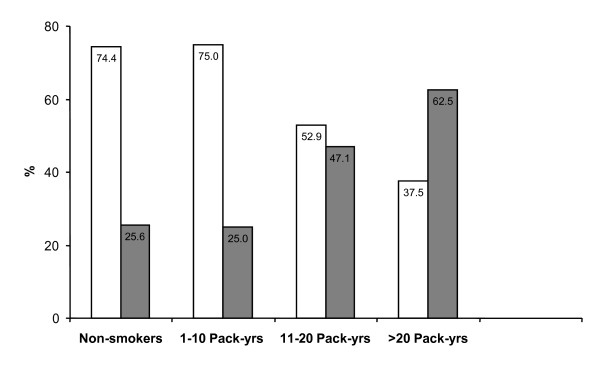
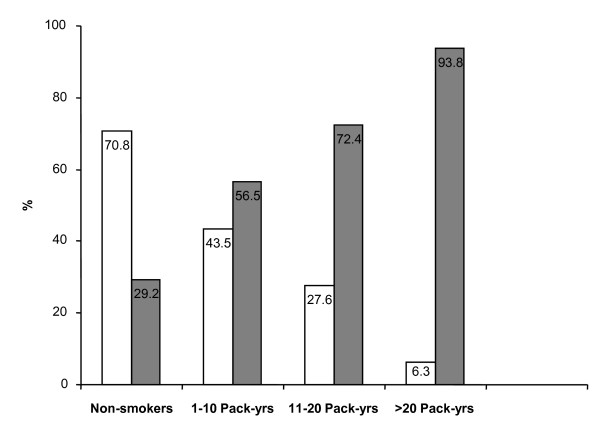
Results: When comparing current or past smokers to never smokers they had a higher risk of severe asthma in the univariate analysis, which became non-significant in the multivariate analysis. On the other hand, the categories of pack-years were significantly related to severe asthma in a dose response relationship in both the univariate and multivariate analysis: compared to 0 pack years, those who smoked 1-10 pack-years had an OR(95% CI) of 1.47(0.46-4.68), those who smoked 11-20 pack-years had an OR of 2.85(1.09-7.46) and those who smoked more than 20 pack-years had an OR of 5.59(1.44-21.67) to develop more severe asthma. Smokers with asthma were also more likely to have uncontrolled disease. A significant dose-response relationship was observed for pack-years and uncontrolled asthma. Compared to 0 pack years, those who smoked 1-10 pack-years had an OR of 5.51(1.73-17.54) and those who smoked more than 10 pack-years had an OR of 13.38(4.57-39.19) to have uncontrolled asthma.

Conclusions: The current findings support the hypothesis that cigarette smoking is an important predictor of asthma severity and poor asthma control.


Figures
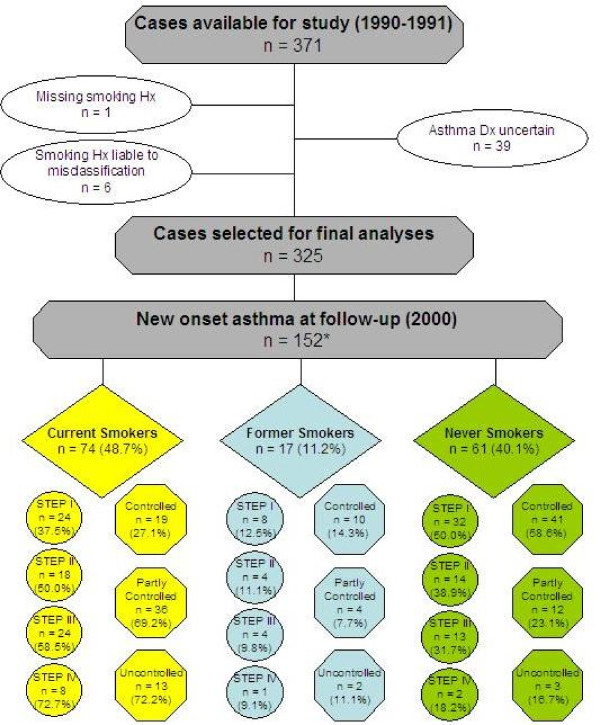
Figure 1
Figure 1
Study flow chart. Medical records of cases with allergic rhinitis in the period between January 1990 and December 1991 were reviewed. To be included in the study cases had to be between the ages of 18 and 40 years and not diagnosed with asthma. Out of the initial 371 cases, complete study outcomes variables were available from 325 subjects. A diagnosis of asthma could be established at final review (from January to April 2000) in 152 subjects. Among these subjects, 74 (48.7%) were current smokers, 17 (11.2%) former smokers, and 61 (40.1%) never smokers. Clinical severity class (circles) and level of asthma control (octagons) were then computed for each categorized smoking status. * At final review, asthma control data could not be calculated in 12 of those with new onset asthma due to lack of information about exacerbations.
Figure 2
Figure 2
Percentage of subjects with less severe (GINA Step I and II; white bars) and more severe (GINA Step III and IV; grey bars) forms of asthma among the non-smokers and those who smoked. Estimation of the amount and duration of smoking exposure was established by calculating pack-years. Smokers were therefore categorized by incremental pack-years.
Figure 3
Figure 3
Percentage of subjects with optimal ("Controlled"; white bars) and suboptimal ("Partly Controlled" and "Uncontrolled"; grey bars) asthma control among the non-smokers and those who smoked. Estimation of the amount and duration of smoking exposure was established by calculating pack-years. Smokers were therefore categorized by incremental pack-years.

References

    1. Lange P, Parner J, Vestbo J, Schnohr P, Jensen G. A 15 year follow-up study of ventilatory function in adults with asthma. N Engl J Med. 1998;339:1194–1200. doi: 10.1056/NEJM199810223391703. - DOI - PubMed
    1. Apostol G, Jacobs D, Tsai A, Crow R, Williams O, Townsend M, Beckett W. Early life factors contribute to the decrease in lung function between ages 18 and 40. Am J Respir Crit Care Med. 2002;166:166–172. doi: 10.1164/rccm.2007035. - DOI - PubMed
    1. James AL, Palmer LJ, Kicic E, Maxwell PS, Lagan SE, Ryan GF, Musk AW. Decline in Lung Function in the Busselton Health Study: the Effects of Asthma and Cigarette Smoking. Am J Respir Crit Care Med. 2005;171(2):109–14. doi: 10.1164/rccm.200402-230OC. - DOI - PubMed
    1. Siroux V, Pin I, Oryszcyn MP, Le Moual N, Kauffmann F. Relationships of active smoking to asthma and asthma severity in the EGEA study. Eur Respir J. 2000;15:470–477. doi: 10.1034/j.1399-3003.2000.15.08.x. - DOI - PubMed
    1. Austin JB, Selvaraj S, Godden D, Russell G. Deprivation, smoking, and quality of life in asthma. Arch. Dis. Child. 2005;90:253–257. doi: 10.1136/adc.2004.049346. - DOI - PMC - PubMed

Publication types

MeSH terms