


Long-term outcome in medical patients aged 80 or over following admission to an intensive care unit
- PMID: 21261976
- PMCID: PMC3222073
- DOI: 10.1186/cc9984
Long-term outcome in medical patients aged 80 or over following admission to an intensive care unit
Abstract
Introduction: The aim of this study was to evaluate factors influencing short- and long-term survival in medical patients aged 80 and over following admission to an intensive care unit.
Methods: All patients aged 80 years or over and admitted between 2001 and 2006 were included in this study. Survival was evaluated between the time of admission and June 2009; factors associated with mortality were determined. Health-related quality of life was evaluated using Short Form (SF)-36 in long-term survivors.
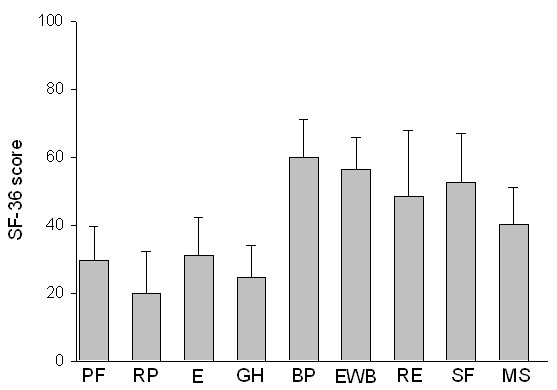
Results: For the 299 patients included (mean age, 84 ± 4 y), hospital mortality was 55%. Factors independently associated with hospital mortality were a higher SAPS II score at ICU admission; the existence of a fatal disease as reflected by the McCabe score and a cardiac diagnosis at admission. In the 133 hospital survivors, median survival time was 710 days (95% CI, 499-921). Two-year mortality rates were 79% of the initial cohort and 53% of hospital survivors. The standardized ratio of mortality at 2 years after hospital discharge was 2.56 (95% CI, 2.08-3.12) when compared with age- and gender-adjusted mortality of the general population. Factors independently associated with mortality at 2 years after hospital discharge were SAPS II score at ICU admission and the McCabe score. Conversely, functional status prior to admission as assessed by Knaus or Karnofsky scores was not associated with long-term mortality. In long-term survivors, SF-36 physical function scores were poor but scores for pain, emotional well-being and social function were not much affected.
Conclusions: The severity of acute disease at admission influences mortality at the hospital and following discharge in patients aged 80 or over. Although up to 50% of patients discharged from the hospital were still alive at 2 years, mortality was increased when compared with the general population. Physical function of long-term hospital survivors was greatly altered.
Figures

Comment in
-
Octogenarians in the ICU: are you ever too old?Crit Care. 2011 Feb 24;15(1):125. doi: 10.1186/cc10018. Crit Care. 2011. PMID: 21371344 Free PMC article.
-
Older patients in the ICU: a cautious analysis of epidemiologic data is required.Crit Care. 2011;15(2):421. doi: 10.1186/cc10134. Epub 2011 Apr 27. Crit Care. 2011. PMID: 21542891 Free PMC article. No abstract available.
-
Outcomes in elderly intensive care unit patients, pulmonary hypertension in sickle cell disease, and total liquid ventilation for therapeutic hypothermia after cardiac arrest in rabbits.Am J Respir Crit Care Med. 2012 Feb 15;185(4):453-4. doi: 10.1164/rccm.201109-1608RR. Am J Respir Crit Care Med. 2012. PMID: 22336678 Free PMC article. No abstract available.
References
-
- Fécondité-Espérance de vie-Mortalité. http://www.insee.fr/fr/themes/theme.asp?theme=2&sous_theme=2
-
- Garrouste-Orgeas M, Timsit JF, Montuclard L, Colvez A, Gattolliat O, Philippart F, Rigal G, Misset B, Carlet J. Decision-making process, outcome, and 1-year quality of life of octogenarians referred for intensive care unit admission. Intensive Care Med. 2006;32:1045–1051. doi: 10.1007/s00134-006-0169-7. - DOI - PubMed
-
- Garrouste-Orgeas M, Boumendil A, Pateron D, Aergerter P, Somme D, Simon T, Guidet B. ICE-CUB Group. Selection of intensive care unit admission criteria for patients aged 80 years and over and compliance of emergency and intensive care unit physicians with the selected criteria: an observational, multicenter, prospective study. Crit Care Med. 2009;37:2919–2928. doi: 10.1097/CCM.0b013e3181b019f0. - DOI - PubMed
MeSH terms
LinkOut - more resources
Full Text Sources
