


The influence of human leukocyte antigen class I alleles and their population frequencies on human immunodeficiency virus type 1 control among African Americans
- PMID: 21262311
- PMCID: PMC3778654
- DOI: 10.1016/j.humimm.2011.01.003
The influence of human leukocyte antigen class I alleles and their population frequencies on human immunodeficiency virus type 1 control among African Americans
Abstract
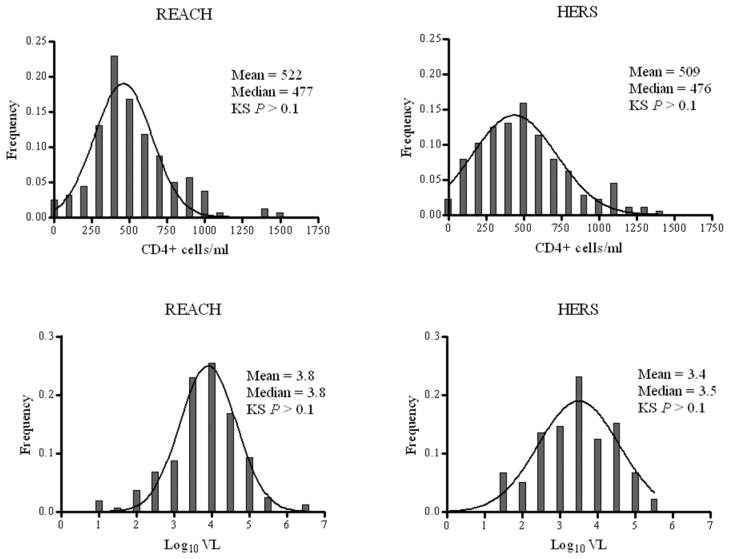
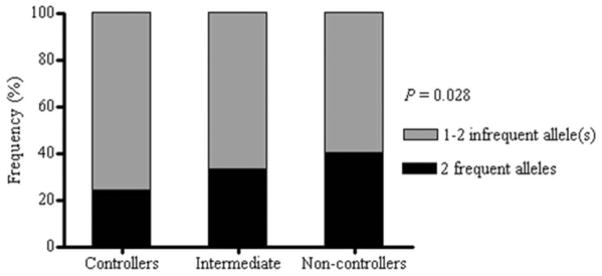
Populations of African ancestry continue to account for a disproportionate burden of the human immunodeficiency virus type 1 (HIV-1) epidemic in the United States. We investigated the effects of human leukocyte antigen (HLA) class I markers in association with virologic and immunologic control of HIV-1 infection among 338 HIV-1 subtype B-infected African Americans in 2 cohorts: Reaching for Excellence in Adolescent Care and Health (REACH) and HIV Epidemiology Research Study (HERS). One-year treatment-free interval measurements of HIV-1 RNA viral loads and CD4(+) T cells were examined both separately and combined to represent 3 categories of HIV-1 disease control (76 controllers, 169 intermediates, and 93 noncontrollers). Certain previously or newly implicated HLA class I alleles (A*32, A*36, A*74, B*14, B*1510, B*3501, B*45, B*53, B*57, Cw*04, Cw*08, Cw*12, and Cw*18) were associated with 1 or more of the endpoints in univariate analyses. After multivariable adjustments for other genetic and nongenetic risk factors of HIV-1 progression, the subset of alleles more strongly or consistently associated with HIV-1 disease control included A*32, A*74, B*14, B*45, B*53, B*57, and Cw*08. Carriage of infrequent HLA-B but not HLA-A alleles was associated with more favorable disease outcomes. Certain HLA class I associations with control of HIV-1 infection cross the boundaries of race and viral subtype, whereas others appear confined within one or the other of those boundaries.
Copyright © 2011 American Society for Histocompatibility and Immunogenetics. All rights reserved.
Figures
References
-
- Campbell RD, Trowsdale J. Map of the human MHC. Immunol Today. 1993;14(7):349. - PubMed
-
- Kaslow RA, McNicholl JK, Hill AVS. Genetic Susceptibility to Infectious Diseases. 2008
-
- Kaslow RA, Carrington M, Apple R, Park L, Munoz A, Saah AJ, Goedert JJ, Winkler C, O’Brien SJ, Rinaldo C, Detels R, Blattner W, Phair J, Erlich H, Mann DL. Influence of combinations of human major histocompatibility complex genes on the course of HIV-1 infection. Nat Med. 1996;2(4):405. - PubMed
-
- Keet IP, Tang J, Klein MR, LeBlanc S, Enger C, Rivers C, Apple RJ, Mann D, Goedert JJ, Miedema F, Kaslow RA. Consistent associations of HLA class I and II and transporter gene products with progression of human immunodeficiency virus type 1 infection in homosexual men. J Infect Dis. 1999;180(2):299. - PubMed
-
- Klein MR, Keet IP, D’Amaro J, Bende RJ, Hekman A, Mesman B, Koot M, de Waal LP, Coutinho RA, Miedema F. Associations between HLA frequencies and pathogenic features of human immunodeficiency virus type 1 infection in seroconverters from the Amsterdam cohort of homosexual men. J Infect Dis. 1994;169(6):1244. - PubMed
Publication types
MeSH terms
Substances
Grants and funding
LinkOut - more resources
Full Text Sources
Medical
Research Materials
